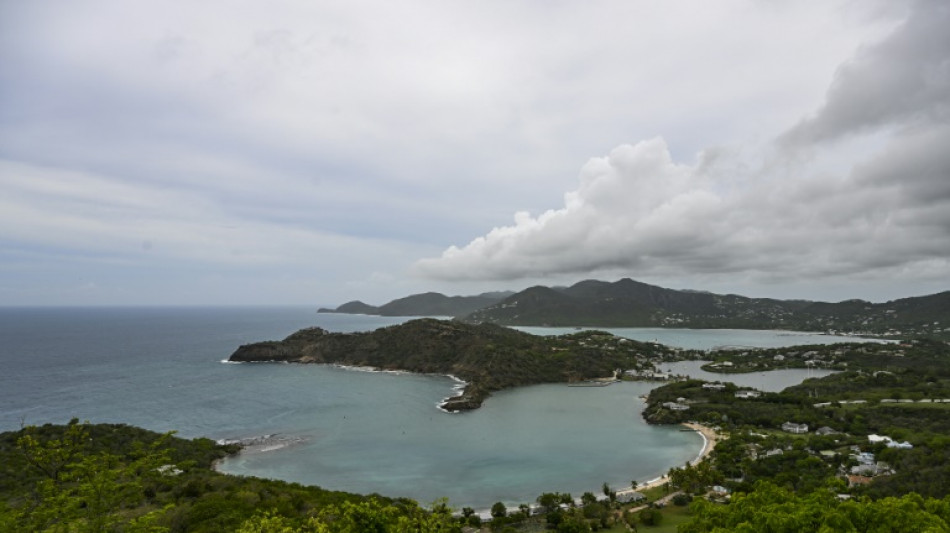
World's island states blame richest countries for climate threats / Photo: © AFP/File

 Indonesia doing 'everything' but still struggling to curb fires
 Once decried as 'human cockfighting', MMA wants Olympic spot
 China's Yu, 13, great for swimming says multiple Olympic medallist
 Putin's party set to retain power after Russia vote hit by cyberattacks, drones
 Germany's Merz under pressure after bruising state election losses
 Messi, Miami frustrated in 2-2 draw with San Diego

 Thousands march in France against 'licence to kill' draft law
 Braves clinch division title as Red Sox reach MLB playoffs
 Bordeaux-Begles hammer Stade Francais despite Jalibert injury

 Milan and Juventus end blips with home wins
 Bridgeman wins PGA Biltmore title with sizzling 61

 Williams injured as Bears shut down by Vikings

 US warns of rapid escalation in Middle East war
 Germany's far-right AfD celebrates another state election win
 Russia vows revenge for election-day attacks as poll shows ruling party win

 Spaun late shows snatches PGA Championship win

 Conceicao strikes as Juventus beat Atalanta
 Britain, Zverev-inspired Germany, Spain complete Davis Cup finals

 Man Utd salvage Fulham draw as pressure mounts on Carrick

 Spanish civil war drama 'The Black Ball' wins at Toronto festival

 Germany's Merz shaken by far-right and far-left gains in state votes

 Macron welcomes Canada's Carney to French Atlantic territory
 Fiorentina frustrate Napoli with Serie A draw, Como upset

 Five-star Man City top Premier League after Sunderland thriller
 Ukrainian drones hit Moscow on last day of Russian elections
Extremely vulnerable to climate change, not rich enough to stop it on their own, and not poor enough to merit aid and development financing: the world's small island states on Monday blamed wealthy countries for their misfortune.
Small Island Developing States (SIDS) "find themselves on the front line of a battle against a confluence of crises, none of which they have caused or created," said Gaston Browne, prime minister of Antigua and Barbuda, which is hosting a SIDS conference this week.
The most pressing crisis is a worsening climate catastrophe as the world nears global warming of 1.5C, the upper threshold set in the Paris climate accord.
"The major contributors to climate change have failed to meet the obligations to mitigate its effects, causing significant harm to SIDS and our planet in general," Browne said.
Seychelles President Wavel Ramkalawan warned that "the climate crisis will destroy all of us," but that "the world is taking its time while we suffer."
Caught between rising debts and rising oceans, from the Caribbean to Africa to the Pacific, many SIDS share characteristics that make them especially vulnerable to external shocks: small landmasses home to scattered and isolated populations, with import dependent, non-diversified economies.
And climate change -- with its brutal droughts, powerful hurricanes and rising seas -- is threatening to erase some of them from the map altogether.
"We cannot accept the disappearance of any country or culture under the rising waves," UN Secretary-General Antonio Guterres said as he opened the SIDS conference, adding the international community has a "duty" to offer support.
"The idea that an entire island state could become collateral damage for profiteering by the fossil fuel industry, or competition between major economies, is simply obscene," Guterres said.
- 'Blue economy' -
"The costs will only rise and will be paid in more and more human lives if we fail to deal with the root cause, that is fossil fuels," said Hilda Heine, president of the Marshall Islands.
High on the agenda for the 39 states, whose populations number roughly 65 million people: increasing climate financing, even as many criticize the slow pace of fulfilling previous UN aid pledges.
According to the UN Development Program, some $4.7-7.3 billion in financing is needed per year just for climate adaptation measures in SIDS countries.
But most small island states are classified as middle-income countries or higher -- meaning that they're unable to access international aid and preferential financing available to the world's poorest countries.
"They are being trapped in a no man's land where financing from the international community that is often a kind of safety net is simply not available to them," said Achim Steiner, head of the UNDP.
Beyond seeking outside aid, however, many are also turning toward reforming their own economies.
Priorities include developing renewable energy sectors and engaging in the so-called "blue economy" of sustainable fishing and ocean conservation -- a serious opportunity for SIDS countries, which account for 19 percent of the world's Exclusive Economic Zones.
Tourism, too, can be made more sustainable -- though the specter of climate change hangs over these countries' marine biodiversity and coral reefs, which draw scuba divers from across the world.
A.Gasser--BTB