India's onion farmers cry foul at politicians' price recipe / Photo: © AFP

 Sisters of jailed Pakistan ex-PM Imran Khan arrested

 African players in Europe: Semenyo brace helps City top table

 'For my family': India boxer beats hardship, injury to go for Games gold
 Indonesia doing 'everything' but still struggling to curb fires

 Once decried as 'human cockfighting', MMA wants Olympic spot

 China's Yu, 13, great for swimming says multiple Olympic medallist

 Putin's party set to retain power after Russia vote hit by cyberattacks, drones

 Germany's Merz under pressure after bruising state election losses

 Messi, Miami frustrated in 2-2 draw with San Diego

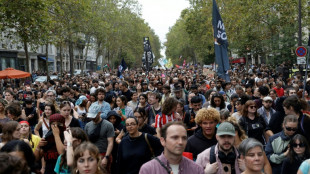 Thousands march in France against 'licence to kill' draft law

 Braves clinch division title as Red Sox reach MLB playoffs

 Bordeaux-Begles hammer Stade Francais despite Jalibert injury

 Milan and Juventus end blips with home wins

 Bridgeman wins PGA Biltmore title with sizzling 61

 Williams injured as Bears shut down by Vikings

 US warns of rapid escalation in Middle East war

 Germany's far-right AfD celebrates another state election win

 Russia vows revenge for election-day attacks as poll shows ruling party win

 Spaun late shows snatches PGA Championship win

 Conceicao strikes as Juventus beat Atalanta

 Britain, Zverev-inspired Germany, Spain complete Davis Cup finals

 Man Utd salvage Fulham draw as pressure mounts on Carrick

 Spanish civil war drama 'The Black Ball' wins at Toronto festival

 Germany's Merz shaken by far-right and far-left gains in state votes

 Macron welcomes Canada's Carney to French Atlantic territory

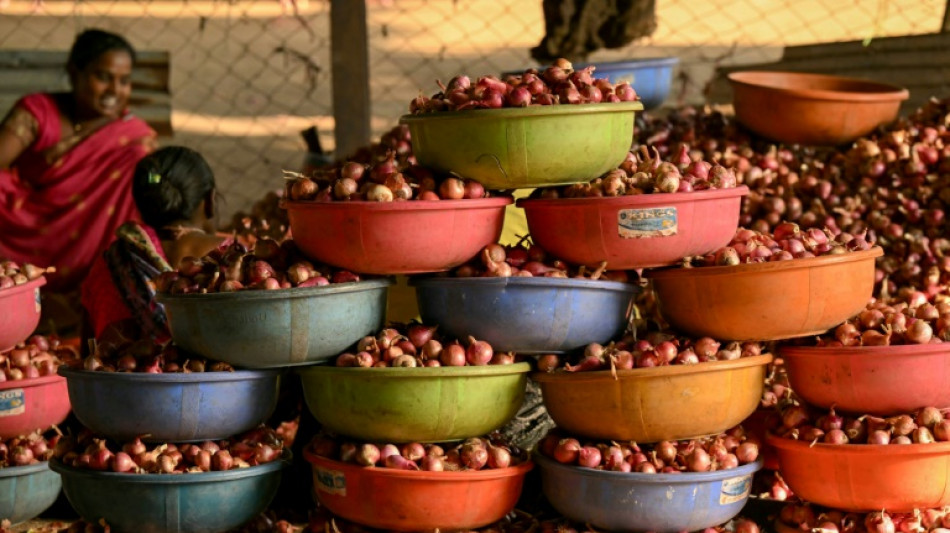
Almost every Indian meal requires an onion -- one of the cooking essentials along with sugar and lentils that sweet-talking politicians use to curry favour with their voters by lowering costs.
But their policies to cut prices by slapping export bans on some goods including on onions and sugar, or by allowing duty-free imports of lentils, has made the key voting demographic of farmers furious.
They say the politicians' decisions flood the markets, and that the savings shoppers make are at their expense.
"The governments talk a lot about us," said onion farmer Kanha Vishnu Gulave. "But their actions only hurt us -- to keep the easily agitated city people happy by keeping our produce cheap."
Gulave, 28, comes from India's onion-producing heartland of Nashik district in Maharashtra state, which produces some 40 percent of onions nationwide.
He felt cheated when prices crashed after a sudden export ban in December.
"We dread elections," said Bharat Dighole, onion producers' association president for Maharashtra. "The most unwise interventions come around polls."
After the ban, prices dropped to sometimes less than a third, Dighole said.
That sparked dozens of small-scale protests in Maharashtra.
- Onion barometer -
At the same time, production expenses have more than doubled since 2017, Dighole added.
But the slump in wholesale prices meant that was not passed on to the consumer -- or voter, from the politicians' viewpoint.
They paid the same for their onions as they had done for years.
"All polls are fought in the name of farmers, but the government policy clearly favours the consumers," said Dighole.
India will vote on Saturday in the seventh and final phase of a general election, stretched over six weeks to ease the logistical burden of polls in the world's most populous country.
Two-thirds of India's 1.4 billion people draw their livelihood from agriculture, accounting for nearly a fifth of the country's gross domestic product.
In India, onions can be a barometer of a government's popularity.
Runaway prices have triggered mass protests and toppled governments in the past.
In 1998, the Bharatiya Janata Party (BJP) of Narendra Modi -- at the time a local politician -- lost control of the capital Delhi in state elections.
The defeat was widely blamed on voter anger at high onion prices.
While Prime Minister Modi is expected to sweep a third term in the ongoing national elections, the BJP has been out of power in the capital's state legislature ever since.
- 'Nothing but rhetoric' -
Days before voting began in the onion belt of Nashik, Modi's government lifted the export ban.
But analysts called that a political ploy.
"The opening up of the onion market is nothing but rhetoric," said economist Ashok Gulati, from the Indian Council for Research on International Economic Relations.
Gulati said restrictions remained -- including a minimum export price and 40 percent duty -- and made exports unviable, leaving farmers teary-eyed.
"Our best hope is to not sell for a loss," 30-year-old farmer Akshay Tarle told AFP at an onion auction, where lines of trailers piled high with the vegetable waited.
"When I leave home in the morning I don't even know if I'll be able to sell my produce at the right price," added another farmer, Vikas Babaji Tushare.
"My family ask me to buy things on my way back home, but there are days I don't even have the money," the 36-year-old added.
"I don't even know what to tell my children."
- Finger on the pulse -
Gulati warned export bans and unchecked imports of other products such as lentils -- a key staple and protein source for many -- were distorting markets and hurting producers.
India's import of pulses jumped to a six-year-high of around $3.75 billion in 2023-24, according to commerce figures cited by Indian media.
"Duty-free import of pulses... would dent the progress made in domestic production," Gulati said.
But some hope for change.
"People at the top fear that if onion prices rise, governments will fall," said Jagannath Bhimaji Kute, 58, vice-president of a wholesale onion market in Nashik.
"Whoever comes to power next will have to address our issues."
Kute urged Indians to "think about the farmers", questioning why people swallowed rising prices on fuel and cooking oil, but not food.
"Why must what we produce remain cheap, when everything else is getting more expensive?" he said.
O.Lorenz--BTB