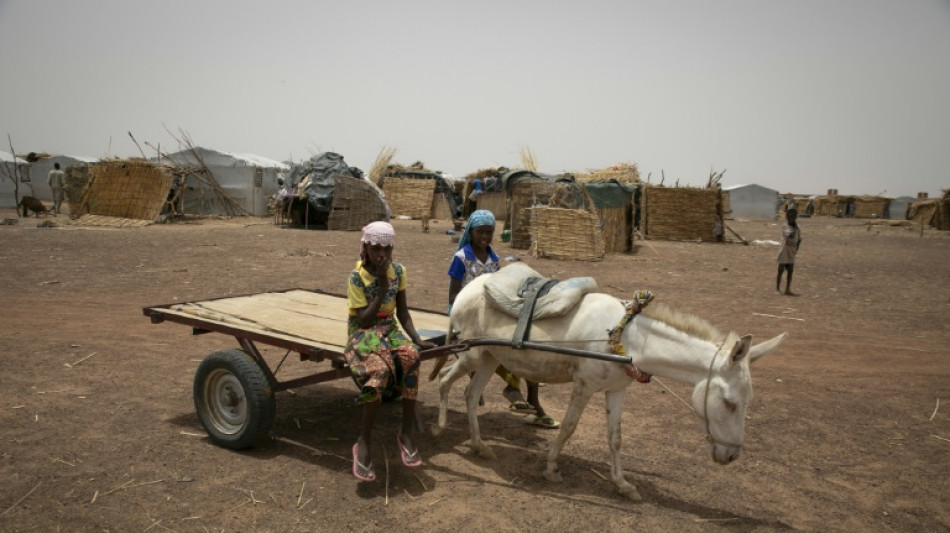
Jihadist bloodshed fills Burkina displacement camps / Photo: © AFP

 Spain coach De la Fuente gets new deal after World Cup success

 Pressure grows on Germany's Merz after election defeats

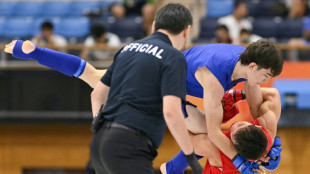
 China's Zhang beats Japan rivals to Asian Games gymnastics gold
 Samlingen Haupt: Vad pengar avslöjar om oss människor

 Tens of thousands of German auto workers protest to save jobs

 हॉप्त् कलेक्शन: पैसा हमारे बारे में एक इंसान के रूप में क्या प्रकट करता है

 Συλλογή Haupt: Τι αποκαλύπτει το χρήμα για εμάς τους ανθρώπους

 TradersYard Shifts Focus to Futures Trading

 ハウプト・コレクション:お金が人間について明かすこと

 하우프트 컬렉션: 돈이 우리 인간에 대해 드러내는 것

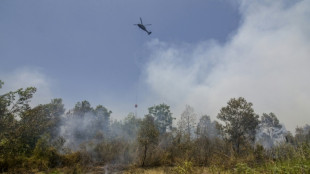
 Indonesia doing 'everything' but struggling to curb fires

 Sbírka Haupt: Co o nás lidech prozrazují peníze
 North and South Korea fight out draw in niggly Asian Games clash

 Officials say man shot, wounded by ICE agent in Texas

 豪普特收藏:金錢如何揭露人類的本質

 Kolekcja Haupta: Co pieniądze mówią o nas, ludziach
 The Haupt Collection: What Money Reveals About Us as Human Beings

 Barcelona enter new era aiming to retain Women's Champions League crown

 US has deported 25,000 to third countries under secretive deals: report
 Three South Korean soldiers injured in DMZ blast: military
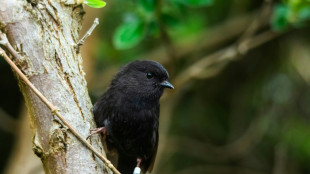 New Zealanders pick endangered black robin as Bird of the Year

 Asia stocks rise on AI, US-China trade talks optimism
 Malaysia's 'elephant whisperer' fights to save Borneo's endangered giants
 'I live in fear': 1.5 million Pakistani children sexually exploited online

 Cowboys beat Commanders, Vikings down Bears as star QBs injured
Feebly shaded by trees in the blistering heat, desperate civilians throng a displacement camp in tents and ramshackle shelters after fleeing jihadist violence in northeastern Burkina Faso.
Abandoning their homes and farms as the militants swooped, thousands have run for their lives to these camps near the town of Dori, where little hope awaits them.
Humanitarians call it a "neglected" catastrophe.
"They came to our village and threatened us. They stole our cattle. They killed our people," said one of the survivors, Kirissi Sawadogo.
"That is why we had to flee and came here," she said, preparing a meal of millet paste.
From her home village of Lelly in the Sahel desert region, she fled to Wendou 2, an offshoot of a vast initial camp of the same name that is now home to 3,000 people.
Armed jihadists have for almost 10 years been terrorising civilians in this African country on the southern fringe of the Sahel.
The displaced people rarely speak of the groups' names, but authorities generally identify them as militants linked to Al-Qaeda or the Islamic State group.
In September 2023, armed men attacked the Wendou camp, killing eight inhabitants.
- 'Neglected' displacement crisis -
A new ranking by the non-government Norwegian Refugee Council (NRC) published on Monday judged that Burkina Faso is suffering the most neglected displacement crisis for the second year in a row.
A quarter of the estimated two million displaced people in Burkina Faso are from the Sahel region in the north, according to the country's latest official data, which date from 2023.
At the start of this year, 85 percent of schools and 69 percent of the health centres in the Sahel sector were closed, according to the UN Office for the Coordination of Humanitarian Affairs.
Visiting the camps in late May, the NRC's head Jan Egeland said the Sahel "is an area which is systematically overlooked".
He said the situation had worsened due to a diplomatic crisis between Western donor states and the military leaders who took power in recent years in three countries struggling with jihadists: Burkina Faso, Mali and Niger.
The Burkinabe authorities frequently claim victories over the jihadists, but no end to the violence is in sight and part of the country is beyond the army's control.
- Illegal gold-panning -
In the Torodi camp, another desolate displacement centre near Dori, Amadou Dicko said he arrived six months ago with his family.
"We are just here with nothing," he said. "We have to rely on ourselves to survive."
Some of the men earn a handful of CFA francs from illegal gold-panning in the surrounding region, despite the danger posed there by the armed groups.
Even the children in the camp "try to bring home something to eat", said Aissetou Amadou, another inhabitant who arrived six months ago.
She fled her home village near the town of Gorgadji after being threatened by "armed men".
"Yesterday (the children) managed to bring back two kilos (4.4 pounds) of rice" that they bought in the town, she said, sitting on a mat in a tiny makeshift shelter of wood and tarpaulin.
"We cooked half of it in the evening and the rest this morning," she said.
She did not know when the family's next meal would come.
- Food convoys threatened -
The UN World Food Programme flies in some essentials to the displaced here.
But most food, fuel and farming supplies must still go by road, under army escort, through a dangerous stretch of road frequently targeted by jihadists.
Dori, a big town on the highway to the capital Ouagadougou, is a key hub for such supplies.
By the roadside stand dozens of trucks, waiting for permission to leave in a convoy on the perilous route through the Dori district.
"In the past you could load your vehicle at 7:00 pm in the evening in Ouagadougou and by 6:00 am it would be at the store" to unload the delivery, said Amadou Hamidou Dicko, president of the Dori traders' association.
"Nowadays, you have to wait two weeks, a month or a month and a half," he added. "It depends, because they never tell you the exact day when the convoy is going to leave."
- Food prices soar -
The restrictions have driven up the price of trucking and, in turn, the cost of products in the shop.
"Two or three years ago, a 50-kilogram sack of rice sold for 16 or 17,000 CFA (about $28). Now it's 27,000 CFA," said Dicko.
Traders sometimes resort to driving by alternative routes without an escort -- at risk of having their goods and trucks stolen or destroyed.
Back in the Wendou 2 camp, Kirissi Sawadogo finishes preparing her millet paste. In the evening, she will add a bit of water and salt to it and feed it to her children.
Another refugee in the camp, Hawa Mama, a red scarf covering her head, said she had "no strength left to move", having also fled her village.
"Even though it is hard here, back there it is worse," she said, in the Fulfulde language of the Fulani people.
"We have no choice but to stay here. There is nothing left for us back there."
L.Dubois--BTB