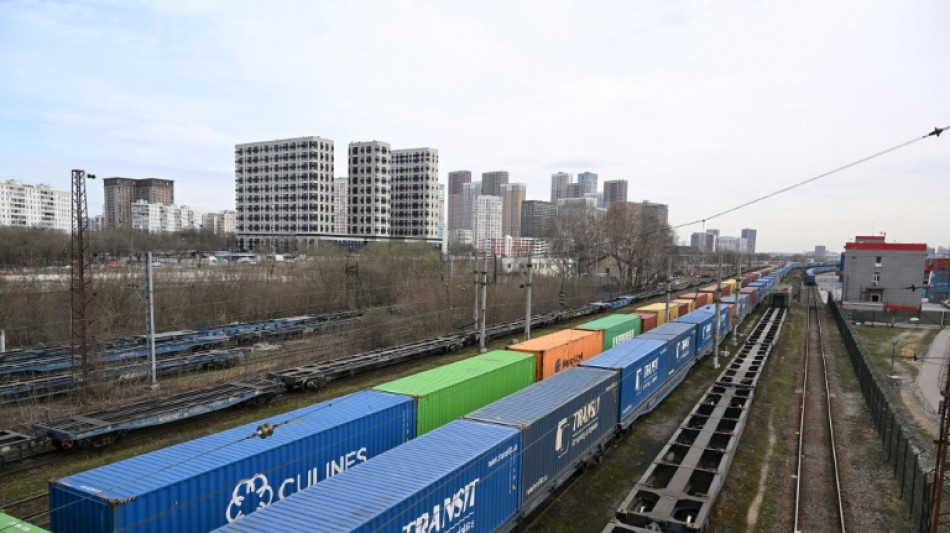
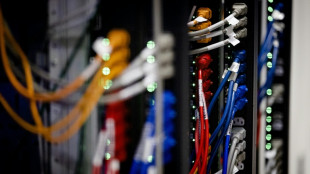
Despite sanctions, Russia still gets hands on Western goods / Photo: © AFP/File

 Bardot auction in Paris fetches nearly one million euros

 No timeline on Daniels injury return, says Commanders coach

 British Columbia sues OpenAI in US court over Canada school shooting

 French star Batum retires after 18-year NBA career

 Zidane leads first France training session

 Man shot by ICE agent in Texas detained with bullet inside him: lawyer

 California declares state of emergency ahead of El Nino

 South Africa arrests three more suspects, after nine women murdered

 Carse needs time away from England, says captain Brook

 NOWPayments Releases Cross-Chain Payout Data Revealing Key Performance Benchmarks Across TRON, BNB Chain, and Solana

 British Museum bans photos of Bayeux Tapestry as crowds linger
 COP31 host says AI climate footprint to be a summit priority

 Berlin's far-left vote winners reject anti-semitism charges

 Mancini eager for 'new adventure' on Italy return

 Mbappe says having Zidane as France coach 'like a film'
 Palmer, Rice out of England Nations League squad

 German auto workers stage mass protests in bid to save jobs
 Embattled Merz vows to keep ruling for 'democratic future' of Germany

 Merz vows to keep ruling coalition together for 'democratic future' of Germany
 Spain coach De la Fuente gets new deal after World Cup success
 Pressure grows on Germany's Merz after election defeats

 China's Zhang beats Japan rivals to Asian Games gymnastics gold
 Samlingen Haupt: Vad pengar avslöjar om oss människor

 Tens of thousands of German auto workers protest to save jobs

 हॉप्त् कलेक्शन: पैसा हमारे बारे में एक इंसान के रूप में क्या प्रकट करता है

A Kansas businessman shipped banned avionics equipment to Russia through Armenia, the UAE and other third countries. A French firm falsified documents to help unscrupulous European exporters circumvent sanctions.
Despite more than two years of Western punitive measures, Russia is still getting its hands on prohibited goods, with the help of cunning businesses that go to great lengths to dodge the embargo.
Last week, the United States unveiled fresh sanctions against 300 targets in and outside Russia.
"(These) actions strike at their remaining avenues for international materials and equipment, including their reliance on critical supplies from third countries," said Treasury Secretary Janet Yellen.
It may still not be enough.
"Unfortunately, when people want to commit fraud, it might take some time but they succeed," Claire Lavarde, a lawyer at international law firm Bryan Cave Leighton Paisner, told AFP.
Russia was hit with a first wave of sanctions following its annexation of Crimea from Ukraine in 2014. The West tightened the screws after Moscow invaded its neighbour in February 2022.
But Russia's economy has withstood the shock, growing 5.4 percent in the first quarter of this year as its trade relations with Asia and the Middle East soared.
Some business leaders say they cannot always control where their products end up in the supply chain.
"We are not necessarily naive, but there is nothing we can do," said a senior executive at a European manufacturer of precision machinery who spoke on condition of anonymity.
For legal protection, he said, "our lawyers advised us to have all our clients worldwide sign a document stating that they would not resell our products to Russia, Belarus and Iran".
Lavarde, whose firm helps banking, luxury and high-tech groups know who they can still work with, said: "One can imagine controlling the first re-export, but not the tenth."
Despite export controls, Russia "continues to be able to import large amounts of goods needed for military production", according to a January report by the Kyiv School of Economics and the Yermak-McFaul International Working Group on Russian Sanctions.
Moscow's imports of "battlefield goods" and "critical components" took a hit in the aftermath of the invasion but they recovered in the second half of 2022 "as Russia was able to adapt supply chains", the report said.
Russian imports of battlefield goods reached $932 million (868 million euros) between January and October 2023, only 10 percent lower than the pre-sanctions period.
Data compiled by Eric Dor, director of economic studies at the France-based IESEG School of Management, showed that EU exports to Russia of 50 "high-priority items", such as semiconductors and integrated circuits, fell 95 percent between October 2022 and September 2023 compared to the same period in 2020-2021.
Meanwhile, the study found that EU exports of such items to former Soviet republics, Turkey and the United Arab Emirates soared.
They more than tripled for Kazakhstan, quadrupled for Armenia and jumped almost 1,700 percent for Kyrgyzstan.
"It's too systematic," Dor told AFP. These goods, he said, are "clearly" being re-exported to Russia.
- Third countries -
The Kansas businessman, Cyril Gregory Buyanovsky, 60, pleaded guilty in December for his role in a "long-running scheme to smuggle sophisticated US avionics equipment to Russia", Assistant Attorney General Matthew Olsen said at the time.
After Washington tightened sanctions in 2022, Buyanovsky and other conspirators shipped goods to Russia through intermediary companies in Armenia, Cyprus and the United Arab Emirates, US authorities said.
They filed false export forms and used foreign bank accounts in Armenia, Kazakhstan, Kyrgyzstan, Cyprus and the UAE to funnel money from Russian customers to Buyanovsky's KanRus Trading Company.
In France, customs authorities raided an unidentified company in the Paris region in May that, according to the economy ministry, "specialised in the illegal export of goods to Russia".
In 2023, the company produced hundreds of fake customs forms that allowed the shipment of goods to Russia worth tens of millions of euros for dozens of "unscrupulous exporters".
National regulators are stepping up scrutiny.
The UK's Office of Financial Sanctions Implementation has tripled its staffing since Russia's invasion of Ukraine.
In Sweden, the foreign ministry said it was told by the European Commission that some major companies "may have circumvented the sanctions through third countries, either via subsidiaries, subcontractors or other actors".
Telecoms giant Ericsson denied dodging EU sanctions, saying that if any of its equipment "were to be imported into Russia, this would not be through Ericsson, but rather through some secondary market".
Truck-maker Volvo Group also said that if any goods stemming from its production ended up in Russia, it was "exported by other parties".
- 'Will I report?' -
Ted Datta, head of financial crime compliance at Moody's Analytics, said companies must conduct more thorough investigations than before to track their goods through supply chains.
He said companies must ask themselves: "If the volume of trade suddenly spikes to Uzbekistan or another neighbouring third country, or I've got transactions which are going to Moldova, will I report that risk to my regulator?"
Companies are expected to check that their partners are not on Western blacklists. They must also verify that contracts in joint projects with Russian companies that were awarded before the sanctions can be legally completed.
A European lawyer who helps clients examine such scenarios on a case-by-case basis said he ensures they comply with the rules.
But not every Western firm plays by the rules, with some opening new factories in third countries to export products to Russia, he said on condition of anonymity.
"It is even more complicated for the authorities to prove, because the structure of these transactions is made in a sophisticated way," the lawyer said.
Adding to the complexity, some products are stripped for their parts.
IESEG said Russia is suspected of using the electronic components of laundry machines or dishwashers.
The European Union exported 1.6 million euros worth of laundry washing machines to Kazakhstan between 2020-2021, according to IESEG. The amount soared above 18 million euros two years later, an increase of 1,310 percent.
burx-lem-alb/soe/bur/lth/cw/
C.Meier--BTB
