Is the founder of the modern Olympics being cancelled? / Photo: © AFP

 UK agrees support for Saudi in struggle with Houthis: reports

 EU foreign policy chief calls for continued sanctions on Russia

 Flights scrapped, evacuations urged as Typhoon Dujuan wallops Japan

 Fonseca to take break from tennis

 A Cuban zoo, and its animals, in epic battle for survival

 Infantino proposes consulting federations to reform FIFA

 El Nino weather pattern enters record territory: scientist
 OpenAI calls for US to lead global effort on AI standards
 South African ostriches plucked alive for luxury fashion: report

 US networks halt Trump coverage in revolt over White House ban

 Paramount settles with US states to clear Warner Bros. mega-merger

 Climate crisis a job for world leaders, not just activists: UK FM
 US networks halt Trump coverage over White House ban
 French singer accuses Miley Cyrus of plagiarism
 EU fines Google 403 mn euros for location data breach
 'Best is yet to come,' says De la Fuente after Spain extension

 Why diesel prices are rising more than crude oil

 COP31 host says AI's climate footprint to be a summit priority

 Renewables hit record in 2025, but world must move faster: report
 US media outlets to sue Trump administration after White House ban
 Global stocks rally on lower oil prices, US-China hopes
 EU proposes energy rating for data centres

 Schoolgirl Yu scorches to second gold as doping case rocks Games

 Putin's party secures record score in Russia election
 Haupt Koleksiyonu: Paranın Biz İnsanlar Hakkında Anlattıkları

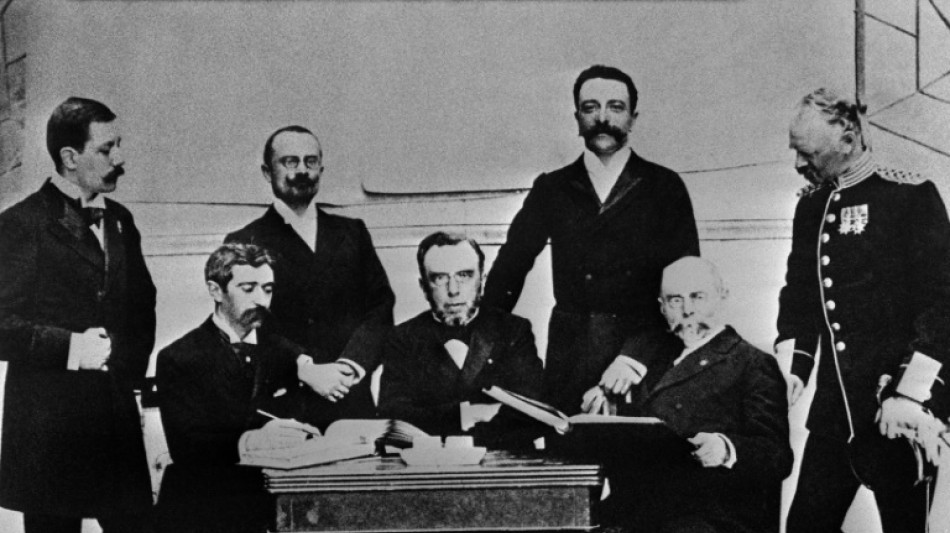
France likes to honour its late pioneers and visionaries, but the aristocratic Frenchman who founded the modern Olympics is proving to be a troublesome figure for organisers of the Paris 2024 Games.
Inspired by William Penny Brookes' Wenlock Olympian Games, Baron Pierre de Coubertin almost singlehandedly created the Olympics by reviving the ancient Greek tradition of Games at the end of the 19th century.
Lauded for his devotion to using sport to promote peace and international cooperation, he is now classed in the 21st century as a sexist, a class snob and a supporter of colonialism.
"He created the movement, he had the idea, he laid the foundations," Daphne Bolz, a sports historian at the University of Rouen, told AFP on the sidelines of a recent seminar in Paris.
"In this respect, he's never completely forgotten. But he was a man of his time, not in line with the contemporary values of France and those promoted by today's International Olympic Committee (IOC)," she added.
The question of how much prominence to give him as France hosts its first Olympics in 100 years next month -- the last Paris Games in 1900 and 1924 were during de Coubertin's time -- has posed a dilemma.
"Paris is going to host its third Games and we know what we owe to the baron," chief organiser Tony Estanguet told reporters in March when asked about him. "If we are here today it's because of him."
Yet de Coubertin is only very rarely name-checked by Paris organisers, nor does he feature prominently in any of the official narrative around the Games, which begin on July 26.
He has no major Paris stadium named after him, besides a municipal sports centre in the southwest of the capital that will be used as a training base.
A homage for him on Sunday at the Sorbonne University in Paris -- marking a speech he gave there in June 23, 1894, to create the International Olympic Committee -- is being snubbed by Sports Minister Amelie Oudea-Castera.
Although IOC head Thomas Bach is expected, Paris Mayor Anne Hidalgo said Wednesday that she too had "another event" that made it impossible for her to attend.
"Paris 2024 has not done much around Pierre de Coubertin, either to show appreciation or raise awareness," his great-great niece, Diane de Navacelle, speaking on behalf of the family, told AFP in an interview.
- 'Right place'? -
The treatment of de Coubertin comes at a time of a broad ideological struggle about how to remember major historical figures in the modern era who are tainted by their beliefs or actions, particularly in relation to colonialism.
Across Western countries in recent years, left-wing student groups have torn down or defaced statues of individuals linked to slavery in a movement denounced as "cancel culture" by critics.
In France, this has been symbolised by the struggle over a statue outside the national parliament of Jean-Baptiste Colbert, a 17th-century statesman who helped write legal guidance for slave owners in the French West Indies.
De Coubertin held fairly typical views for a man of his class and era, namely a belief in the superiority of white men and Western civilisation.
The Games were conceived for wealthy, upper-class amateurs, while the prospect of women competing was "uninteresting" and "unaesthetic", he wrote.
He also heaped praise on the infamous Nazi-organised games of 1936, which were instrumentalised by Adolf Hitler.
"How do you expect me to repudiate these celebrations?" he wrote.
But he did not attend in person and was no longer head of the IOC at the time, his family contends.
"What delighted him was to see a country make such an exceptional investment for the first time to host the Olympics," de Navacelle said.
Paris Mayor Hidalgo said this week that she had no interest in "starting a fight to tear down the image of Pierre de Coubertin".
"We need to add to history, explain history, complete history, including the shadowy areas of some people," she urged on Wednesday.
For Bolz, organisers have probably got the balance right.
"He doesn't represent the things we want to promote nowadays, that's why he's a bit withdrawn," she said. "In the end, he's in the right place. He's present, but without being glorified."
F.Pavlenko--BTB

