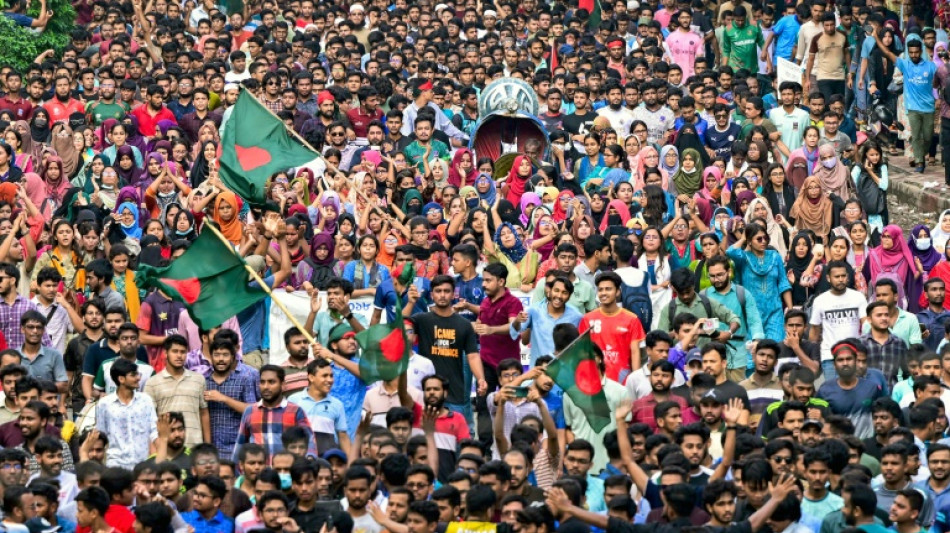
Bangladeshi protesters demand end to civil service job quotas / Photo: © AFP

 Stocks rise on AI buzz, oil prices cool

 India narrowly survive huge scare against minnows Japan

 Missing F-35 fighter parts 'not sensitive', says Australia minister
 Cambodia showcases scams crackdown with global conference

 Afghan cyclist who disguised herself as man wins Asian Games silver

 Typhoon Dujuan leaves four dead in Japan, 45,000 houses without power

 G7 leaders condemn Houthi strikes on Saudi Arabia
 Google data centre sparks protests in Austria

 Shin Ohashi: Junk food-loving teen and Japan's next big swimming hope

 Stocks rise on AI buzz, drop in oil prices

 China's robot dancers limber up for America's Got Talent final

 Despite military might, Saudi struggles to crush the Houthis

 Trump to tout deals, defend Iran war in UN speech

 Sri Lanka to issue verdict in landmark Easter attack trial

 No green light to lift EU sanctions on Russian oligarchs, talks to resume

 UK agrees support for Saudi in struggle with Houthis: reports

 EU foreign policy chief calls for continued sanctions on Russia

 Flights scrapped, evacuations urged as Typhoon Dujuan wallops Japan

 Fonseca to take break from tennis

 A Cuban zoo, and its animals, in epic battle for survival

 Infantino proposes consulting federations to reform FIFA

 El Nino weather pattern enters record territory: scientist
 OpenAI calls for US to lead global effort on AI standards

 South African ostriches plucked alive for luxury fashion: report
 US networks halt Trump coverage in revolt over White House ban

Thousands of Bangladeshi university students threw roadblocks across key highways on Sunday, demanding the end of "discriminatory" quotas for coveted government jobs, including reserving posts for children of liberation heroes.
Students in almost all major universities took part, demanding a merit-based system for well-paid and massively over-subscribed civil service jobs.
"It's a do-or-die situation for us," protest coordinator Nahidul Islam told AFP, during marches at Dhaka University.
"Quotas are a discriminatory system," the 26-year-old added. "The system has to be reformed".
The current system reserves more than half of posts, totalling hundreds of thousands of government jobs.
That includes 30 percent reserved for children of those who fought to win Bangladeshi independence in 1971, 10 percent for women, and 10 percent set aside for specific districts.
Students said only those quotas supporting ethnic minorities and disabled people -- six percent of jobs -- should remain.
Critics say the system benefits children of pro-government groups, who back Prime Minister Sheikh Hasina.
Her father, Sheikh Mujibur Rahman, was Bangladesh's founding leader.
Hasina, 76, won her fourth consecutive general election in January, in a vote without genuine opposition parties, with a widespread boycott and a major crackdown against her political opponents.
Critics accuse Bangladeshi courts of rubber-stamping decisions made by her government.
The system was initially abolished after weeks of student protests in 2018.
But in June, Dhaka's High Court rolled that back, saying the cancellation had been invalid.
- 'Wasting their time' -
Hasina has condemned the protests, saying the matter had been settled by the court.
"Students are wasting their time," Hasina told female activists from her party on Sunday, Bangladeshi newspapers reported.
"After the court's verdict, there is no justification for the anti-quota movement."
Protests began earlier in July and have grown in size.
"We will bury the quota system", students chanted on Sunday in Bangladesh’s second city Chittagong, where hundreds of protesters marched.
In Dhaka, hundreds of students disrupted traffic for hours, police said.
At the elite Jahangirnagar University, at least 500 students blocked the highway connecting the capital with southeastern Bangladesh "for two hours", local police chief A.F.M. Shahed told AFP.
Bin Yamin Molla, a protest leader, said at least 30,000 students participated in the protests, although the number could not be verified.
Bangladesh was one of the world's poorest countries when it gained independence in 1971, but it has grown an average of more than six percent each year since 2009.
Hasina has presided over that breakneck economic growth, with per capita income in the country of 170 million people overtaking India in 2021.
But much of that growth has been on the back of the mostly female factory workforce powering its garment export industry, and economists say there is an acute crisis of jobs for millions of university students.
O.Lorenz--BTB