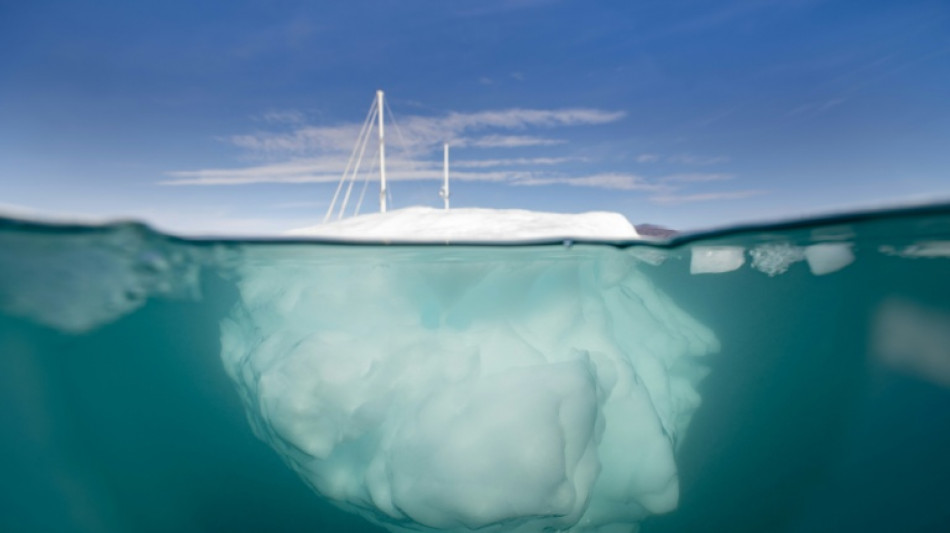
European heatwave's unlikely accomplice: an ocean 'cold blob' / Photo: © AFP/File

 Radical Numerics develops offline AI tool to detect engineered pathogens

 Startup turns Chennai’s history and culture into an interactive world

 Four firms compete to design Chennai’s model mobility corridors

 Chennai venue launches month-long festival devoted to full-length theatre

 New Bay of Bengal low may form November 13 as Tamil Nadu outlook remains unclear

 ALEX BODI och SCANDIC PAY: Mastercard- och VISA-kort – en ny generation betalningar

 알렉스 보디와 SCANDIC PAY: Mastercard·VISA 카드를 통한 차세대 결제

 ALEX BODIとSCANDIC PAY:Mastercard・VISAカードによる新世代の決済

 ALEX BODI a SCANDIC PAY: karty Mastercard a VISA – nová generace plateb

 ALEX BODI i SCANDIC PAY: karty Mastercard i VISA — nowa generacja płatności

 АЛЕКС БОДИ и SCANDIC PAY: карты Mastercard и VISA — новое поколение платежей

 ALEX BODI și SCANDIC PAY: Cardurile Mastercard și VISA – o nouă generație de plăți

 Best Pet Advent Calendars for Christmas 2026: Dog Treats and Cat Toys

 FUBAR PAC Founder Jack Inacker Targets Sen. Fetterman After Midterm Success
The heatwave battering Europe may have an unlikely partner-in-crime: a patch of cold ocean water south of Iceland and Greenland that can influence weather patterns over the continent.
Often called the "cold blob", this swath of water in the North Atlantic has bucked the global warming trend, cooling even as the planet's temperatures rise due to human-induced climate change.
A recent study reinforced concerns that it could signal a weakening of a key Atlantic Ocean current system that helps regulate the planet's climate.
A shutdown of this conveyor belt of ocean currents, known as Atlantic Meridional Overturning Circulation (AMOC), could potentially lead to harsher winters in northern Europe in the future, scientists say.
But researchers have also explored the cold blob's connection to heatwaves in Europe, finding that extreme hot spells have coincided with periods when these waters west of Britain were unusually cold.
"A cold Atlantic doesn't necessarily mean a colder Europe," Gerard McCarthy, oceanographer at Ireland's Maynooth University, told AFP.
"That cold isn't a kind of a get-out-of-jail-free card in terms of global warming. Some of the hot extremes can actually be exacerbated by this cold blob in the Atlantic," McCarthy said.
- Heat dome -
Greenhouse gas emissions are the main driver of climate change, which has made heatwaves more frequent and intense.
But several factors have made Europe the planet's fastest-warming continent, including changes in atmospheric circulation and melting ice.
Studies suggest the cold blob influences atmospheric circulation by altering the path and speed of the jet stream that flows west to east across the continent.
When cooler and warmer waters meet, the sharp contrast changes the air above, making the jet stream wavier and slower, according to researchers.
These changes can create conditions for high-pressure systems that park over Europe, such as the "heat dome" searing the continent this week.
Marilena Oltmanns, an ocean and climate physicist, pointed to recent data showing a strong cold anomaly currently present in the subpolar North Atlantic, creating a front that "acts like a guide" for the winds and the jet stream.
"The jet stream ... bends northward and flows northward around Europe instead of crossing it. As a result, a heat dome emerges over Europe," Oltmanns told AFP.
Oltmanns, a professor at the University of Bremen in Germany, led a 2024 study showing that the melting of Greenland ice pours freshwater into the ocean, creating colder surface waters in the North Atlantic.
"The chain of events, starting from the meltwater and the North Atlantic cold blob, then leading to changes in the ocean and atmospheric circulations, makes Europe heat up more quickly than other parts of the world in summer," she told AFP.
A 2016 study suggested that cold Atlantic anomalies were a "common precursor" to major heatwaves that had hit Europe since the 1980s.
Another paper published in 2023 ran computer simulations -- with and without the cold blob -- to see if the anomaly had an influence on European heatwaves.
"With this cold anomaly, we have longer and more intense heatwaves in Europe," that study's lead author Sabine Bischof, researcher at Germany's GEOMAR Helmholtz Centre for Ocean Research Kiel, told AFP.
- 'Very worried' -
While worldwide sea surface temperatures have increased by 1C on average since 1900, the cold blob region has cooled by up to 0.9C, according to a 2019 study.
Research published last month sought to settle a scientific debate over whether the loss of heat from the sea surface or a weakening AMOC were behind the cold blob.
"We find that this famous 'cold blob' in the northern Atlantic is caused by ocean currents bringing less heat into this region, and not by more heat lost through the sea surface there," the study's lead author, Stefan Rahmstorf, told AFP.
The AMOC carries warm tropical waters to the Northern Hemisphere, where they cool, become denser and sink before returning southward at depth.
Scientists broadly agree the AMOC is weakening with warming, but debate persists over how fast it could slow and whether a collapse is possible this century.
Rahmstorf, head of Earth system analysis at the Potsdam Institute for Climate Impact Research, used to be sceptical about the risk of an AMOC shutdown.
But he now gives it an over 50 percent chance of happening.
A shutdown would have dire consequences: tougher European winters, droughts in South Asia and parts of Africa, and higher sea levels around the North Atlantic.
"I am very worried," Rahmstorf said. "The consequences of an AMOC shutdown would be massive in many parts of the world."
J.Fankhauser--BTB