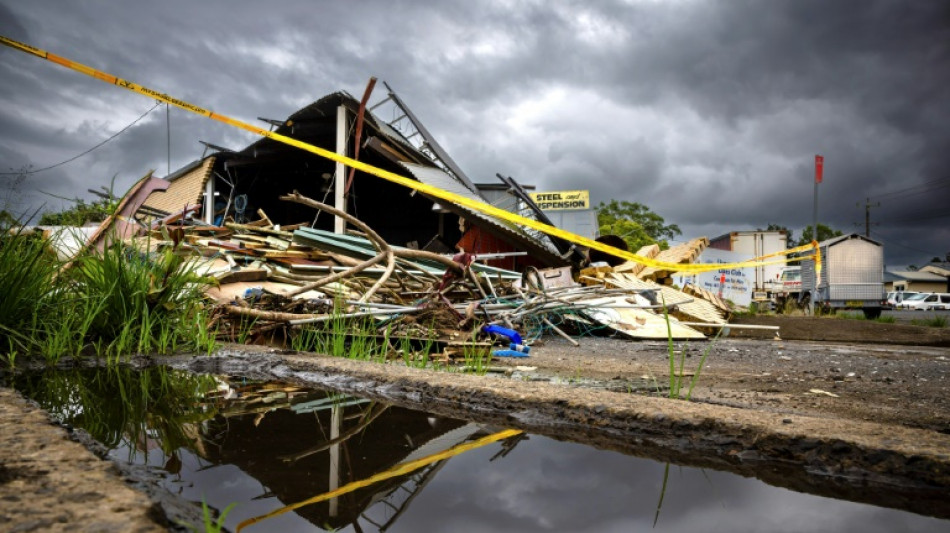
Flood-ravaged Australians feel forgotten as election looms / Photo: © AFP

 A-Rod ups T-Wolves stake in $4.5bn ownership change
 UK court orders Prince Harry, others to pay Daily Mail initial £9.5mn
 'Grateful' ex-world champion Alaphilippe retires from cycling

 US, Canada work to wrap up trade deal ahead of looming deadline

 Malaysia's JDT claim unbeaten run world record

 At least 2 teens seriously wounded in sword attack at Swedish school

 Popular forest near Paris to reopen after wildfire

 UN holds second informal poll of secretary-general candidates

 Shakhtar Donetsk to play Champions League home games at Chelsea

 Arsenal sign Villa centre-back Konsa as champions bolster defence
 The 'hedgehogs' leading Poland's defences on Russian border
 England thrash Pakistan by an innings and 103 runs in first Test

 Fury says Joshua fight 'doesn't look like it's going to happen'
 Argentina's Paredes suspended 10 matches by FIFA for World Cup fight

 Watkins and Martinez could join Villa exodus says Emery

 UK court orders Prince Harry, others to pay Daily Mail £9.5mn

 Aligned Launches $ALIGN, the Native Token of Its Full Ethereum Stack

 Bitcoin jumps, stocks bounce as traders weigh US Treasury action

 Man City boss Maresca hit with Doku injury blow

 Iraola wants to sign wingers to boost Liverpool's attacking options
 Maresca needs time to succeed after 'big changes' at Man City

 Meghan faces difficult return to the UK

 Archer double strengthens England's grip on first Test against Pakistan

 MEXC Lists Ondo Tokenized Stock Moderna (MRNAON), Expanding Access to U.S. Biotech Exposure

 Japan axes Netflix collaboration after outcry over dating show
For Karey Patterson, the lingering memory of the February floods that devastated Australia's east coast was wondering how long he could hold his daughter's head above water as the torrent consumed their home.
"It was like a disaster movie, but I was in it," he told AFP, standing in the still-gutted shell of his house in the town of Lismore.
In the aftermath of the floods, the worst the city had ever seen, there was a flurry of news coverage, visits from the prime minister and opposition leader, and promises of help.
Three months on, the floodwater has mostly receded and with it public attention.
On the eve of Saturday's election, the fact that more than 1,500 citizens in one of the world's richest nations are still in emergency accommodation barely gets a mention in the campaign.
Many others have slipped through the statistics, sleeping on friends' couches, staying in caravans, or camping in their flood-wrecked homes.
"I think we have been forgotten," said Bec Barker, who has been living with her husband in a small caravan in the backyard of the home they spent more than a decade renovating.
"I don't think people realise that we don't have houses to come back to, we don't have furniture, we don't have anything."
Battling her insurer and ineligible for grants, Barker cannot picture herself living again in the home she thought she would grow old in.
While many flood victims feel forgotten, some also worry climate change's low billing on the campaign trail will guarantee more Australians are hit by increasingly extreme droughts, fires and floods.
Barker wants to see better government preparedness before new disasters strike -- so neighbours are not left to rescue one another in the dead of night.
"This can happen to anyone, really. I don't live in a high flood zone area," she said.
"It happened to us."
- A town abandoned -
By night, Lismore's once-bustling centre is now nearly pitch black as thousands of homes and businesses stand empty.
Daylight reveals a city where recovery has stalled.
Condemned houses swept from their foundations by the floodwaters wait to be demolished. Trees are still littered with plastic, chairs and family photos.
Locals line up for basic necessities from charities such as the one run by "The Koori Mail", Australia's national Indigenous newspaper.
Much of the nearby university, Southern Cross, has been given over to the recovery effort -- three schools have moved in, as have displaced businesses, doctors and the local police.
For months, many locals have been "in limbo", Lismore resident Rahima Jackson said, waiting for the council to decide about new flood regulations or a land swap deal allowing people to move to higher ground -- which could take years.
"The community here is definitely angry because every response has been too slow," she said.
As the February flood drowned Jackson's house, something sparked a fire and she watched on from a neighbour's window as it burned in the middle of an inland sea.
She has been hoping to buy a caravan to live in, behind her ruined home with its charred roof crumpled like a piece of paper.
For the community, she said, the stress is starting to take a toll: "I know most people have panic attacks at the sound of rain."
So far, the state government has paid out less than a fifth of the 38,037 applications for grant assistance it received from individuals and businesses.
Like many people affected by the floods, Ron Maher, 77, has found himself ineligible for any government grants -- because his pension, not his farm, has been his primary source of income.
"I'm not bitter about it. Disappointed is a better word than bitter," he said.
Maher, who lost a third of his cattle as floodwaters swept through his rural property north of Lismore, told AFP he was worried for the town's future.
"I don't know whether I'm talking out of school here, but I'm a bit afraid that north and south Lismore will turn into a bit of a shantytown because they can't afford to build," he said.
Insurance is another stumbling block.
By 2030, half a million homes across Australia will be uninsurable, too vulnerable to floods, bushfires, tides or high winds, according to the Climate Council.
Many Lismore residents could not afford flood insurance, even before the latest disaster.
- 'Our community underwater' -
Marine scientist Hanabeth Luke has decided to run for office to help put things right.
She survived the 2002 Bali bombings in Indonesia, and became known as "the Angel of Bali" after being photographed carrying a young man from the wreckage of the Sari Club.
She said the floods were an "echo" of that tragedy, which killed her first love.
She is running as an independent on a climate-focused platform.
"This is our home. This is the place that we love. This is our community underwater," she said.
"We've got to look at best evidence. We've got to trust what the science is telling us. And that is that we must act now on climate."
Despite the 14-metre (46-foot) surge, Karey Patterson, his eight-year-old daughter and two sons survived.
He eventually managed to smash a hole through the hardwood ceiling with a barbell before the water got to the roof.
A friend paddled a kayak through surging floodwaters for hours to deliver each of them to safety.
For now, Patterson sleeps on his friend's sofa, unsure about what comes next. One thing he is sure of is that, for sanity's sake, he cannot return.
"I'm not coming back to live in this house."
N.Fournier--BTB