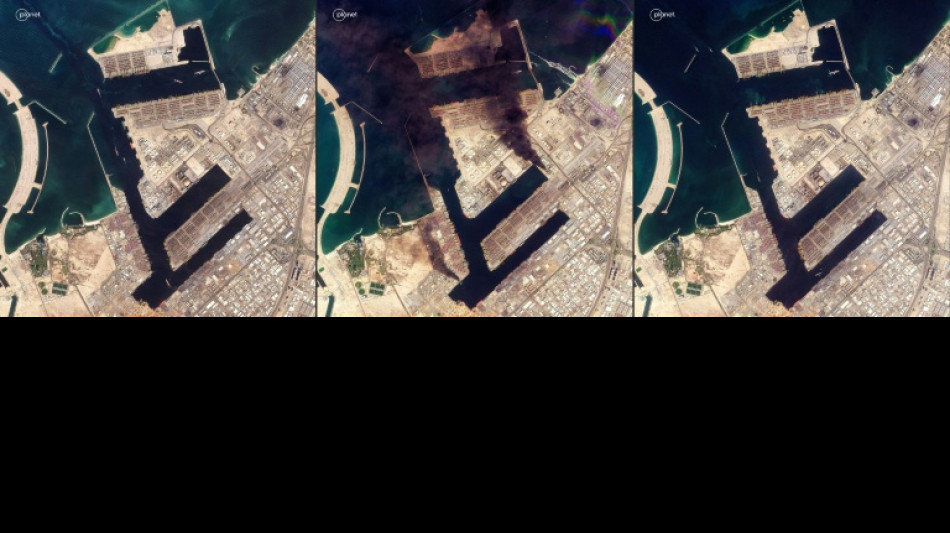
US satellite firm extends Middle East image delay / Photo: © 2026 Planet Labs PBC/AFP/File

 Major earthquake rocks Panama, triggers tsunami warning

 Indian jailed in France for leading sadist Nazi cult that tortured girls

 'Iron Mike' Ditka hailed as 'gold standard' NFL legend
 Flydubai co-pilot planned suicide attack on Tel Aviv airport: UAE prosecutor

 Mike Ditka: Chicago Bears icon as player and coach

 Outrage over plan to livestream US military firing squad execution

 US sanctions: a 'test of resilience' for ICC

 NFL legend Mike Ditka dead at 86

 Hurricane Isaias set to strike Gulf Coast late Friday

 Trump forms panel to probe US Fed governor Lisa Cook

 Clashes in Durban as fresh anti-migrant riots erupt in South Africa

 France students plan more protests, UN 'concerned' over violence

 De Zerbi calls on struggling Spurs to react in Man Utd clash

 US sanctions on ICC: a 'test of resilience'

 Outrage over US military plan to livestream firing squad execution

 Argentina snap up defence guru Edwards ahead of World Cup

 BMW pulls car lease offer from German far-right politician

 Brazil election offers Jair Bolsonaro a shot at revenge

 Man Utd boss Carrick 'personally' affected by Man City verdict

 Evolution Metals & Technologies Corp. Raises Fiscal 2026 Revenue Guidance 62% at Midpoint to $10–$11 Million and Reaffirms $400–$460 Million Fiscal 2027 Outlook

 Red Bull's Verstappen takes pole position for Singapore GP sprint race

 Chelsea star Palmer 'committed' to England insists Alonso

 OpenAI denies firing researchers over AI safety warnings

 Turkey warns opposition, press over investment fund crisis

 Hurricane Isaias now major storm as it heads to US Gulf Coast

American firm Planet Labs PBC on Tuesday said it now imposes a two-week delay for access to its satellite images of the Middle East because of the US-Israeli war against Iran.
Both major US satellite firms, Planet and Vantor, now delay or block the release of images from the Middle East because of the conflict that erupted on February 28 with US-Israeli strikes on Iran.
California-based Planet initially imposed a 96-hour delay last week for access to its high-resolution images, which are usually available a few hours after they are taken.
"After consulting with experts inside and outside of government... Planet has decided to take additional, proactive measures to ensure our imagery is not tactically leveraged by adversarial actors to target allied and NATO-partner personnel and civilians," a statement said.
From now on, coverage of "all of Iran and nearby allied bases, in addition to the Gulf States and existing conflict zones" will be blocked for 14 days, it said.
Planet, founded in 2010 by former NASA scientists and whose images are widely used by media and researchers, did not say whether the decision was taken in response to an official US request.
- Media reliance -
For a zone running from Egypt to the Gulf states, Turkey and Djibouti the most recent images released by Planet date from March 6.
Under US legislation, any company headquartered in America that deals in high-resolution satellite images may be subject to restrictions for national security or foreign policy reasons.
Industry leader Vantor (formerly Maxar) has had a long-standing policy of not distributing images of US or allied bases. But it denied in a statement that it had acted under any government order to hold back images.
"During times of geopolitical conflict, Vantor may implement enhanced access controls to prevent the misuse of sensitive geospatial intelligence and to help protect allied forces and civilians," it said.
"These controls can include limiting who is able to task new imagery or purchase historical imagery over areas where US, NATO, and other allied and partner forces are actively operating, as well as over areas that are being actively targeted by adversaries."
Vantor said it "independently determines" the controls.
"These decisions are not mandated by any government, military organisation, or third party."
During Israel's war against Hamas in Gaza, started in October 2023 and running up to a ceasefire in October last year, Planet imposed a 30-day delay while still maintaining extensive coverage of the territory.
Many media, including AFP, use satellite images from sources such as Planet and Vantor to cover the major conflicts -- including Ukraine, Gaza or the Sudan civil war -- where on-the-ground access is made difficult or virtually impossible.
M.Odermatt--BTB