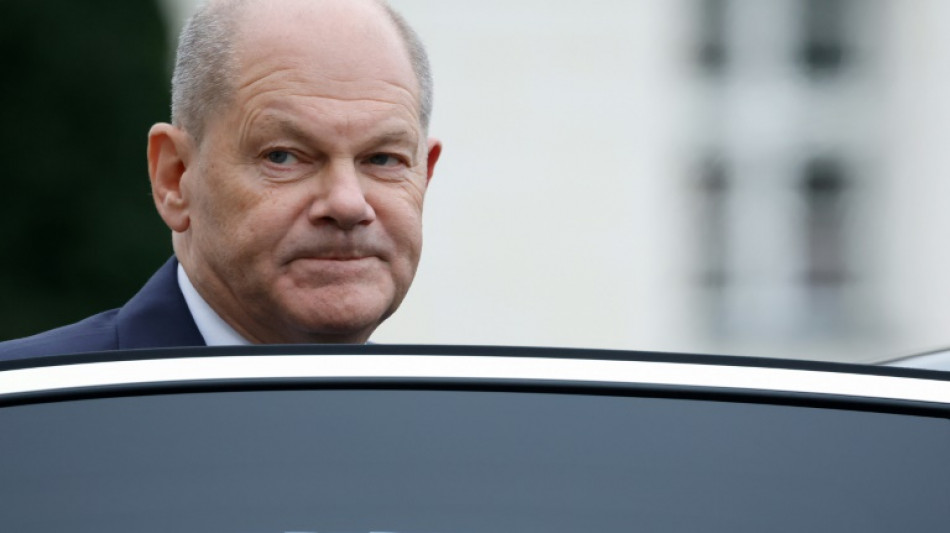
Crisis-hit Germany headed for February 23 snap election / Photo: © AFP/File

 Japanese anime actor fights TikTok over AI voice cloning
 Curtain falls on the romance of India's single-screen cinemas

 Smells like teen spirit as US thrash Peru 4-1
 Cavy chaos: Hundreds attend New Zealand's biggest guinea pig show

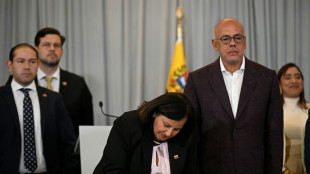 Venezuela releases more political prisoners after opposition talks

 England's best 'for a long time' despite Spain defeat, says Kane

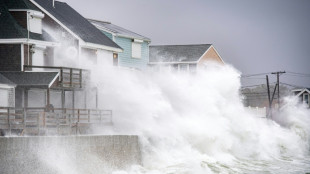 Powerful storm pummels northeast US with rain, high winds

 Filmmaker Mike Leigh wins top prize at Spain festival with 'last film'

 Spain beat England in Nations League to extend unbeaten run

 Ireland squad vote to play Israel tie despite Gaza unease
 Gutsy Vollering wins cycling road race world title

 Vollering wins cycling road race world title
 Man City's meteoric rise clouded by dark shadow
 Mbappe out for two weeks or more with knee injury say Real
 Lyon collapse away to Stade and suffer first Top 14 loss

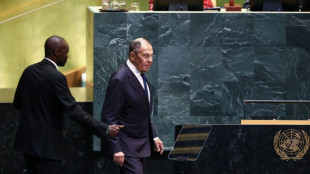 Russia accuses Europe of seeking to thwart Ukraine talks

 Man City chairman defiant over reported Premier League charges
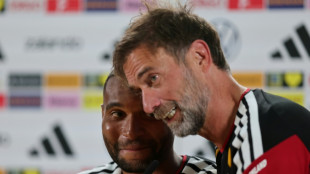 Germany ready to 'walk through fire' for Klopp, says Tah

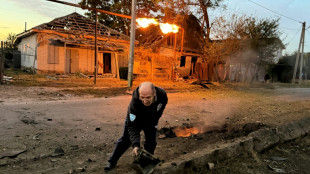 At least 16 killed in Russian and Ukrainian strikes

 Powerful storm pummels US Northeast

 Bangkok declares disaster after homes flooded, roads submerged by heavy rain
 Norris calls for errant Colapinto to be banned for causing Baku crash

 Russell finds himself again and prepares to heap pressure on Antonelli
 South Korea hold nerve to win Asian Games basketball gold

 Russell holds off Verstappen to claim imperious victory in Baku
Germany, mired in political crisis, is headed for February 23 elections, the main parties agreed Tuesday, aiming to form a stable government after Chancellor Olaf Scholz's three-party coalition collapsed last week.
The two biggest parties agreed on the early timetable, which would see centre-left leader Scholz seek a vote of confidence on December 16, paving the way for the February vote, coalition sources said.
Scholz's Social Democrats (SPD), now in a minority government with the Greens, hammered out the compromise date with the conservative opposition Christian Democrats (CDU) and their Bavarian allies CSU.
The agreement seeks to quickly restore political stability at a time when Europe's biggest economy is set to shrink for a second year in a row and amid heightened geopolitical volatility, with wars raging in Ukraine and the Middle East.
The election date would mean Germany will be ruled by a lame-duck chancellor and stuck in the middle of its campaign period when Donald Trump is inaugurated as US president on January 20.
Embattled Scholz, who wants to run again despite poor poll ratings, initially suggested an election in late March but came under heavy pressure from all other parties to speed up the process.
The CDU is riding high in the polls and its leader Friedrich Merz had pushed strongly for an election as early as possible -- a demand backed by two thirds of voters, according to a recent survey.
"We don't have unlimited time to elect a new government in Germany, regardless of who leads it... because the world around us is not waiting," Merz said on Tuesday.
"It's not as if everyone is holding their breath and watching Germany in fascination, as decisions are taken in Europe, Asia and the United States.
"The world expects a Germany that is capable of taking action."
- Winter campaign -
The February 23 date would force politicians to run their campaigns in the dark and cold of winter, when voters will be less enthusiastic to flock to outdoor events than during the usual summer campaign seasons.
Under the deal brokered on Tuesday, Scholz would seek a vote of confidence in the week before the Christmas holidays in the lower house of parliament, which he is expected to lose.
President Frank-Walter Steinmeier, the head of state, will then have 21 days to dissolve the Bundestag, and elections will have to be held within the following 60 days.
CDU general secretary Carsten Linnemann said he hoped this will quickly restore a sense of stability.
"People are very nervous and don't know where the country is going," he told the public broadcaster ZDF.
He added that once there was more clarity on the timetable, "things will calm down and we can go into the election campaign".
Scholz took office in late 2021, taking over from the CDU's Angela Merkel, in a three-way coalition with the left-leaning Greens and the liberal and pro-business Free Democrats (FDP).
But mounting differences over economic and fiscal policy came to a head last week when Scholz fired the rebellious FDP finance minister Christian Linder, prompting the small party to leave the government.
Since then, Scholz's SPD and the Greens have carried on in a minority government that would need opposition support to pass any laws -- something the CDU/CSU had rejected in the absence of clarity on an election date.
- Future scenarios -
Scholz's coalition marked the first time a tripartite alliance has ruled at the federal level, and it may not be the last, given Germany's increasingly fragmented political party landscape.
Fears about immigration have driven the rise of the far-right Alternative for Germany (AfD) party. It is now polling at close to 20 percent, but other parties have pledged to shun it as a coalition partner.
The latest polls put the centre-right CDU/CSU alliance firmly in the lead at 32 percent.
To win a majority, however, the conservatives would likely need the future backing of the SPD, which is currently polling at 15.5 percent, in a so-called grand coalition, plus a third party.
Contenders for that spot, according to current polling, would be either the FDP, with five percent support, or possibly the Greens, who are polling at 11 percent.
Lindner, who has said he wants to be finance minister again, said on Tuesday that Merz "will almost certainly be the next chancellor of Germany. The only question is: Who will chancellor Merz govern with?"
F.Müller--BTB