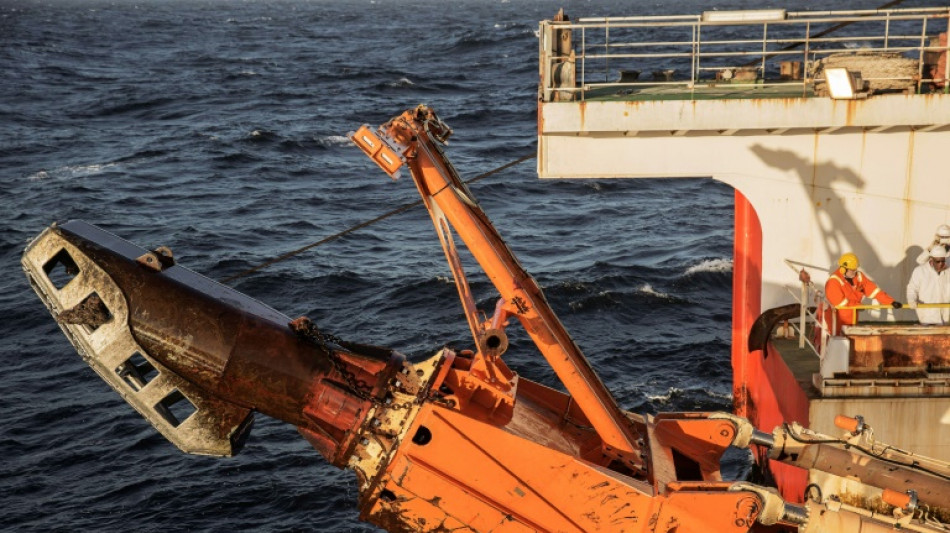
WWF legal challenge against Norway deep-sea mining fails / Photo: © AFP

 How to Watch the Rugby League World Cup Final on 7plus for Free

 Kayla Harrison Defeats Amanda Nunes via Submission at UFC 334

 GTA 6 Advertising Strategy and Disc Version Controversy

 From First Date to Wedding Day: How a TV Quote Sparked a Lifetime Commitment

 Malta Stuns Sweden with Late Penalty Comeback in Rugby Europe Trophy
 BingX: Major Announcement of Far-Reaching Significance

 Élan Opens as Late-Night Wine Bar in Honolulu

An Oslo court on Thursday rejected a legal challenge by the WWF environmental group against Norway's bid to mine its seabed for minerals crucial to the green energy transition.
The ruling will not have an immediate impact as Norway's minority government opted not to issue any mining licences this year, after making a deal with a small party to stay in power.
But it may in future open up the Scandinavian country's waters to deep-sea mining, a practice controversial for its potential impact on vulnerable marine ecosystems.
Besides the risk of chemical leaks, environmentalists argue it poses a threat to the habitats of sea species as well as from potential noise and light pollution from the machinery used.
The Norwegian branch of the WWF started legal action against government last November, accusing it of failing to carry out sufficient impact studies.
"We disagree with this part of the courts (sic) reasoning and will carefully review its reasoning to determine whether to appeal," said WWF-Norway CEO Karoline Andaur.
"It is crucial that before elected representatives make decisions that may have major consequences for nature, adequate investigations must be carried out."
Lawyers for the government rejected the WWF's claim that there was insufficient evidence to greenlight deep-sea extraction.
"The judgement confirms that the knowledge base was solid enough for the government... to decide to open these areas to seabed mining," lawyers Karen Mellingen and Asgeir Nygard told AFP by email.
- Green economy minerals -
Norway, western Europe's biggest oil and gas producer, had planned to become one of the world's first countries to start handing out rights for some 280,000 square kilometres (108,000 square miles) of seabed.
Copper, cobalt, zinc and rare earths are believed to be present in its continental shelf. All are essential for the production of batteries, wind turbines, computers and mobile phones.
The government had argued that deep-sea mining would allow it to reduce reliance on China for minerals essential to the transition to a lower-carbon economy.
In December the small Socialist Left Party said it had blocked the allocation of licences in return for supporting the minority Labour government's 2025 budget.
But with many Norwegian parties in favour of seabed mining, the issue could well rear its head again following parliamentary elections scheduled for September.
The government insists there were tough safeguards in its mining proposals and that licences could be revoked.
"If this judgement stands, there will be many stages before any potential mineral extraction," the government lawyers said.
But scientists, non-government groups, some multi-national companies and international institutions such as the European Parliament have opposed the move.
B.Shevchenko--BTB