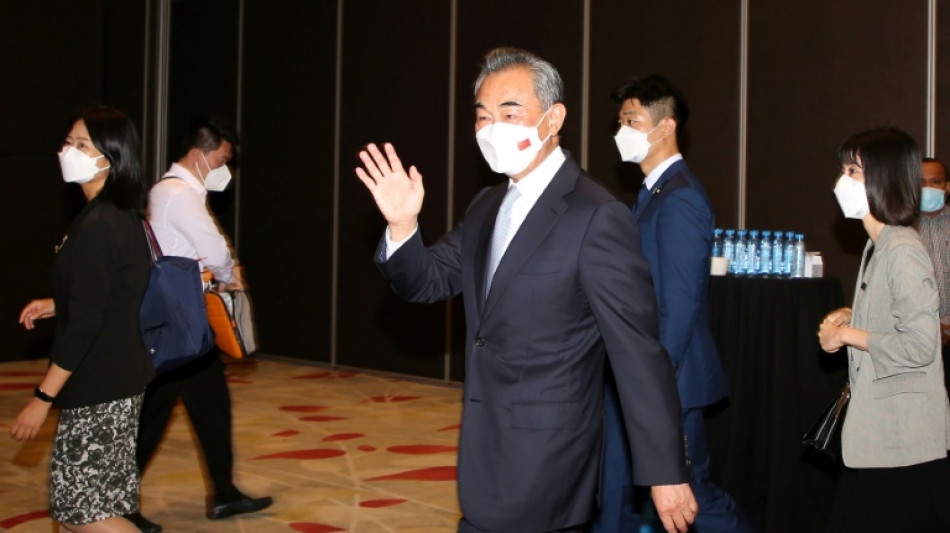
China's diplomatic gambit heralds new 'Battle for the Pacific' / Photo: © AFP/File

 'Aura' battles leap from social media to Latin America streets
 US, Canada fail to reach trade pact to avert Trump tariffs
 Sudan farms lie barren as El Nino leaves Nile banks dry
 Arctic shipping a daunting prospect in hotly contested region
 In US, rare earths extracted from coal mine wastewater
 Nakashima pounds Fritz, Bejlek beats Keys in Cincinnati upsets

 Canadian negotiator says 'more work to do' on US trade deal

 'Solid' Clark takes solo lead at BMW Championship
 Arteta hails Arsenal's desire after perfect start to title defence

 Betis down Real Sociedad in La Liga opener

 Mexican governor resumes job despite US drug charges

 Arsenal rout Coventry to open Premier League season in style

 Giant-killer Bejlek overhauls Keys to reach Cincinnati semi-finals

 Man Utd agree deal for Brighton midfielder Baleba: reports
 Werro wins Lausanne 800m, well off world record pace

 China mulls bid to host 2028 UN climate talks: sources
 Jones becomes third Englishman to join Inter this summer
 Mexican governor wanted on US drug charges returns to job

 Bolivia's Paz forced to fire economy minister in mid-crisis
 A-Rod ups T-Wolves stake in $4.5bn ownership change
 UK court orders Prince Harry, others to pay Daily Mail initial £9.5mn

 'Grateful' ex-world champion Alaphilippe retires from cycling

 US, Canada work to wrap up trade deal ahead of looming deadline

 Malaysia's JDT claim unbeaten run world record

 At least 2 teens seriously wounded in sword attack at Swedish school
A 10-day South Pacific island-hopping tour by China's top diplomat focused world attention on a usually overlooked region, opened a new front in Beijing's quest for global influence and challenged decades of Western primacy.
On the face of it, Wang Yi's trip was a failure.
His centrepiece proposal -- a regional pact to turbocharge China's role in Pacific island security -- was leaked to the press and then roundly rejected by regional leaders.
Representatives of the 10 Pacific island states were not shy about expressing their displeasure at China trying to ram through such a consequential agreement with next-to-no consultation.
"You cannot have regional agreement when the region hasn't met to discuss it," said Samoan Prime Minister Fiame Naomi Mata'afa.
Fiji's Prime Minister Frank Bainimarama was even more pointed.
Standing next to Wang, he upbraided those focused on "geopolitical point-scoring", saying it "means less than little to anyone whose community is slipping beneath the rising seas".
In the carefully choreographed world of diplomacy, where texts and talking points are drafted, redrafted and broadly agreed upon long before "principals" like Wang even sit down, it was a stunning misfire.
"It was something of an overreach by China," said Wesley Morgan, an expert on the Pacific Islands at Griffith University.
"They must have had a slightly uncomfortable conversation."
When the dust settled, Chinese officials, better known in recent years for abrasive "Wolf Warrior" diplomacy, sounded chastened.
"Not every" China-Pacific Islands ministerial meeting "will necessarily produce outcome documents", the Chinese Embassy in Fiji tweeted.
"Please stay tuned."
- 'Counterattack' -
Despite the setbacks, Wang's trip represents a "step change" in Chinese ambitions in the region, said Euan Graham, an expert on Asia-Pacific Security at the International Institute for Strategic Studies.
Where China had sought to increase its influence "piecemeal", he said, "now the veil has dropped, there is confidence or overconfidence on China's part and there is a clear stepping up of efforts."
Wang spoke about "win-win" investments in infrastructure, fisheries, timber or mining assets, but he also pitched Chinese involvement in sensitive areas such as policing, cybersecurity and maritime surveillance.
Behind that push, experts see a much more ambitious geopolitical agenda -- a drive to weaken US influence, change Asia's military balance, hem in Australia and even prepare for a military takeover of Taiwan.
We "hope to expand our circle of friends," said Zhao Shaofeng, director of the Research Center for Pacific Island Countries at Liaocheng University in China.
"The United States has continued to encircle and blockade China internationally. China should counterattack the United States to a certain extent."
Some US officials worry Beijing's ultimate goal is to establish a military foothold in the South Pacific, which would force a reorganisation of US Pacific forces -- currently focused on North Korea and China.
If China were to develop just one base in the South Pacific, it would be "very vulnerable" given vast US assets in places such as Guam, said Graham.
"But they are obviously playing on a much larger canvas than that."
"If they were to get three or four," he said, they would have to be taken seriously by US defence planners.
- Not for sale -
There is a sense among analysts that China could bide its time, score small wins and pick off Pacific leaders when they see a domestic political advantage in allying with Beijing.
After all, Wang did not leave the region empty-handed, inking a series of bilateral agreements from Samoa to Papua New Guinea that, while modest, could make the presence of Chinese police, boats and officials a more normal sight.
The Solomon Islands, where Prime Minister Manasseh Sogavare's rule was recently threatened by riots, has already signed a security deal that could allow Chinese police to come in to restore calm.
But Richard Herr, a University of Tasmania academic who has decades of experience working in the Pacific Islands, warns against underestimating local leaders.
"There is an image, an unfortunate image, in some quarters that the islands' loyalties are there to be bought," he told AFP. "They didn't get independence in order to sell it."
People "don't credit the Pacific" with "being able to engage in really astute foreign policymaking" and balancing relations with both China and the West, said Anna Powles, a security expert at New Zealand's Massey University.
But "they are doing exactly that".
M.Ouellet--BTB