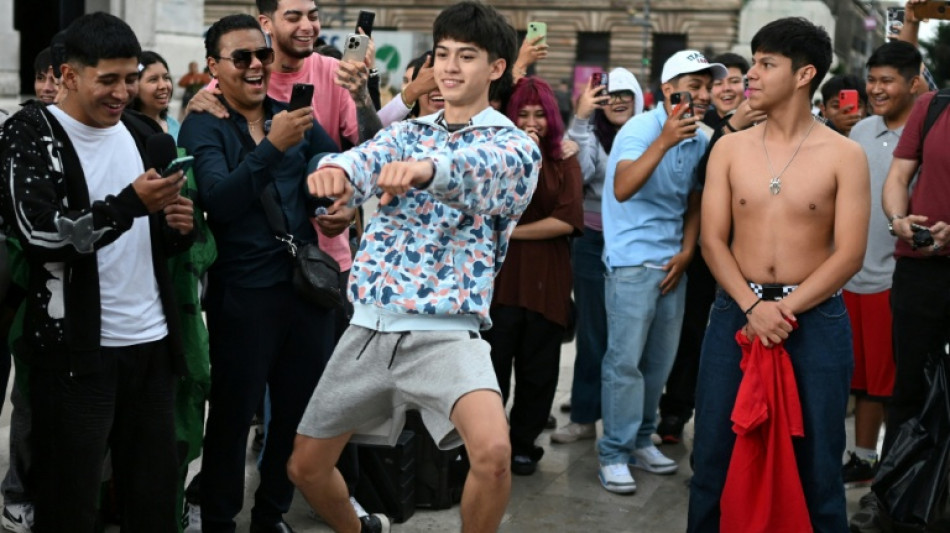
'Aura' battles leap from social media to Latin America streets / Photo: © AFP

 Far-Right Extremists Claim Opportunity to Seize Control of GOP After Midterms

 New Campaign Highlights Knowledge Gaps on Carbon Monoxide Safety Among Americans

 JR East Launches 'teppay' to Integrate Suica Balance with Mobile Payments

 Phil Spencer on Housing Market Fairness: How Buyers and Sellers Navigate Falling Prices

 Beirut Cinema Festival Draws Thousands Despite War Fatigue

 AMD Forecasts First-Ever Revenue Lead Over Intel on AI Chip Surge

 GoodData.AI Launches the Agentic Serving Plane, a New Category of Enterprise Data Infrastructure for AI Agents

 Abu Dhabi Demand Response Project Achieves 401 MW Peak Reduction in 2025

 Panthers expected to begin 2027 NRL season away from new stadium
In the middle of a cheering crowd in Mexico City, two teenagers are limbering up for battle.
Staring at each other intently, they look as if they could come to blows.
Instead, they take turns to silently perform a series of moves and poses that look, to the untrained eye, as if they are playing charades or, as they writhe on the ground, breakdancing.
Welcome to an "aura farming" battle, a phenomenon born on social media that has spilled over onto the streets of Latin America.
Carlos Irving Quintana, a slim 14-year-old with purple hair, wins cheers of approval with his enactment of the iconic "Siuuu" leap of Portuguese football star Cristiano Ronaldo when he scores a goal.
He continues by "mewing," a TikTok trend where people suck in their cheeks and point a finger at their jawline to emphasize their chiseled features.
His opponent responds by juggling his outstretched palms in a "6-7," a viral youth meme that has no fixed meaning but has become so ubiquitous that even Pope Leo has taken to performing it.
- Confidence test -
On TikTok and Instagram, a person's "aura" alludes to their style or attitude, with "100% aura" high praise for the most effortlessly cool persona.
"Farming" refers to repetitive tactics used to gain points in video games.
These rare real-life gatherings of young people in the social media era are also gaining popularity in Argentina, Brazil, Peru and Bolivia.
Most of the participants were between 14 and 20 years old.
They are judged on their ability to reference as many viral memes and videos as possible.
Young people gather around, recording the action on their cellphones as tinny, video game-like music emanates from a speaker.
The winner of the recent Mexico City edition was a fresh-faced Kaled Rosales Salazar, who mimicked lassoing and leading his opponent, Quintana, like a horse, with a giant white sandal as a prop.
A jury member said he recognized the youngster's potential from the moment he clapped eyes on his red Cars-themed Lightning McQueen shorts and clogs.
"Whoever looks the best, shows it off, gets the most laughs and has the most confidence wins," said 22-year-old Aldhir Gonzalez, organizer of the bout, which took place in front of the Palace of Fine Arts.
In Argentina, the contests have fueled numerous memes that have even been seized on by top-flight football clubs.
Boca Juniors posted a photo on X of its midfielder Santiago Ascacibar celebrating a goal and joking that his aura was unbeatable.
- 'Getting out of the house' -
"Aura is a lifestyle" that "almost no one understands," said the organizer of an upcoming battle in Buenos Aires.
Older audiences, however, are mystified by what some see as a dumbing down of popular culture.
"If it were up to me, there would be mandatory military service," said a mayor in Honduras who banned the battles.
Venezuelan psychologist Maria Eugenia Tovar defended the battles, arguing they "can lead to in-person encounters" for teens.
Rosales came away with 3,000 pesos (about $177) in prize money. In Argentina, the reward is the mantle of having "infinite aura."
"I plan to go to more battles," he told AFP. "More than for a prize, I do it to have fun and get out of the house."
M.Odermatt--BTB
