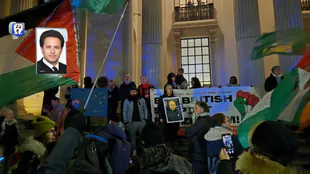
Macron holds new emergency talks on Ukraine / Photo: © AFP

 Women's Asian Champions Trophy 2026 in Bhopal Revives Hockey Legacy

 California GOP Faces Near-Extinction After 2026 Midterms; Calls for New Vision

 St Francis School Leads €60,000 EU Project to Transform Early Childhood Education
 South Africa's Universal Health Coverage Depends on Tackling Poverty and Inequality

 Rare Siberian Rubythroat Dies in UK Garden After Cat Attack

 Go Kyung-pyo Drunk Driving Incident Prompts Heavy Editing Across Multiple TV Shows

 KFF Health News Reporters Discuss ACA Enrollment Challenges, Rising Costs, and Measles Risks

French President Emmanuel Macron on Wednesday held a new meeting on Ukraine in a bid to coordinate a European response to what he called an "existential threat" from Russia after a shock policy shift in Washington.
Macron was speaking to leaders of 19 countries including Canada, with most taking part by video link, according to the presidency.
US President Donald Trump has stunned the European Union by indicating he is ready to resume diplomacy with Vladimir Putin after three years of Russia's war against Ukraine, and to discuss the fate of the pro-Western country over the heads of not only Europe but also Kyiv.
Urging a coordinated response to Washington's apparent pivot towards Moscow, Macron had already on Monday hosted key European leaders as well as NATO and EU chiefs for emergency talks.
Several smaller European countries including Romania and the Czech Republic were reportedly aghast at not having been invited to that gathering despite being strong supporters of Ukraine, leading Macron to convene the Wednesday meeting.
Romania's interim president Ilie Bolojan and Luxembourg's Prime Minister Luc Frieden were present in person at the meeting on Wednesday afternoon, the presidency said.
The leaders of Lithuania, Cyprus, Finland, Belgium, Bulgaria, Canada, Croatia, Estonia, Greece, Ireland, Island, Latvia, Norway, Portugal, Sweden, Slovenia and the Czech Republic also joined via video conference call.
Hungary and Slovakia, whose prime ministers are seen as close to Putin, as well as NATO member Turkey, whose President Recep Tayyip Erdogan is eager to act as a mediator, were not on the list of participants.
French daily Le Monde earlier pointed to the "frustration of the European countries" not invited to Monday's talks.
But Le Monde also said that the leaders of some of these countries were in a difficult political situation as they were "confronted with a strong increase in pro-Russian forces on their domestic political scene".
France has been one of Ukraine's main Western backers since Russia unleashed its full-scale invasion of its neighbour in February 2022.
- 'Must open our eyes' -
"Russia poses an existential threat to Europeans," Macron said in an interview with French regional newspapers published on Tuesday.
"Do not think that the unthinkable cannot happen, including the worst."
Macron appeared open to the idea of sending forces to Ukraine but emphasised that this could take place only in the most limited fashion and away from conflict zones.
France, along with Britain, were considering sending "experts or even troops in limited terms, outside any conflict zone," he said.
Trump caused consternation on Tuesday by blaming Ukrainian leader Volodymyr Zelensky for Russia's invasion.
French government spokeswoman Sophie Primas said on Wednesday that Trump's comments were part of a series of "incomprehensible" remarks that raised questions about the "coherence" of the US position on Ukraine.
Foreign Minister Jean-Noel Barrot said France may have to make some difficult choices.
"Russia has decided to make enemies of us, and we must open our eyes, realise the scale of the threat and protect ourselves," he told broadcaster RTL.
"If we do nothing, if we remain blind to the threat, the front line will move ever closer to our borders."
To keep up the pressure on Moscow, EU countries on Wednesday agreed a new round of sanctions on Russia, diplomats said.
W.Lapointe--BTB