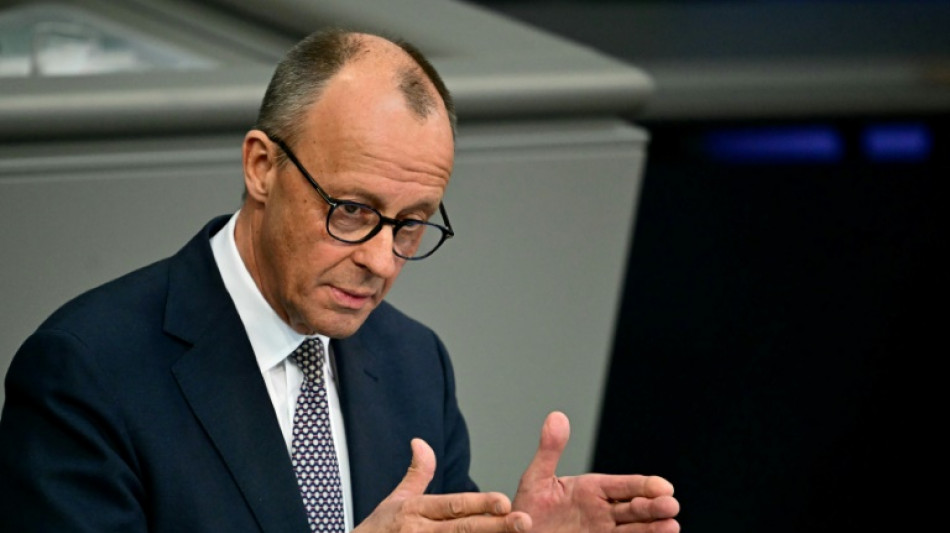
German MPs approve fiscal 'bazooka' for defence, infrastructure / Photo: © AFP

 АЛЕКС БОДИ И НЕМЕЦКИЙ КОНЦЕРН ИНВЕСТИРУЮТ В 166 КВАРТИР В ГАЛЛЕ
 Plastic treaty talks chair sees deal possible in March
 ALEX BODI AND GERMAN CONGLOMERATE INVEST IN 166 APARTMENTS IN HALLE
 Afghanistan says deadly Pakistani strikes hit Helmand

 India thump Sri Lanka, will face Pakistan for Asian Games cricket gold

 Woman in hospital after Tennessee's second failed execution in 2026

 Cash-strapped Senegalese unmoved by Youth Olympic Games

 Indonesia haze chokes neighbours, but little legal recourse

 Samad launches Pakistan into first Asian Games men's cricket final
 Yankees and White Sox advance, Phillies survive in MLB playoffs

 Asian stocks mixed as positive US data offset by elevated oil, bond yields
 Rice work: Dutch test new crop to save sinking peatlands

 Russians join street choirs to sing away sorrows -- or show dissent

 UK fears grow over AI giant Palantir's health service deal
 Empty nets in Latin America as fish flee El Nino
 Meidroth blasts White Sox through, Phillies survive in MLB playoffs
 'Catastrophic': Swiss glaciers lose fifth of mass in five years

 California roller coaster shut after brain damage claims

 Panama ministers push for reopening of huge open-pit copper mine
 Bohm's blast keeps Phillies alive in MLB playoffs
 US judge accepts Paramount's Warner Bros. buyout settlement

 Global stocks mixed as markets weigh higher oil prices, bond yields
 Marsh hails improvements after Australia win final one-day international
 Hegseth says US cut number of generals, admirals by 20%

 Kanye West's Russian concerts have been cancelled, organisers say

German lawmakers gave the green light Tuesday for a colossal spending boost for defence and infrastructure pushed by chancellor-in-waiting Friedrich Merz amid deep fears in Europe over the future strength of the transatlantic alliance.
The unprecedented fiscal package -- dubbed an "XXL-sized" cash "bazooka" by German media -- could pave the way for more than one trillion euros (dollars) in spending over the next decade in Europe's top economy.
The historic parliament vote signalled a radical departure for a country famously reluctant to take on large state debt -- or to spend heavily on the armed forces, given its dark World War II history.
Merz, who is expected to become Germany's next chancellor after his CDU/CSU alliance won last month's elections, argued that dramatic steps are needed at a time of geopolitical turmoil sparked by Russia's invasion of Ukraine.
European countries have been further unsettled by US President Donald Trump's outreach to Russia and signals of an uncertain commitment to NATO and Europe's defence.
Speaking to parliament, Merz cited Russia's "war of aggression against Europe" and said the funding boost would spell "the first major step towards a new European defence community".
Merz's centre-right alliance and their likely future coalition partners, the centre-left Social Democrats (SPD) of outgoing Chancellor Olaf Scholz, have hammered out the package over recent weeks.
The plan would exempt defence spending above one percent of GDP from Germany's strict debt rules and set up a 500-billion-euro ($545-billion) fund for infrastructure investments over 12 years.
In the short term, Berlin looked set to soon approve an additional three billion euros in military aid for Ukraine.
- 'New era' -
After heated debate in parliament -- where the plan was opposed by the far right, far left and a small liberal party -- it cleared the two-thirds majority needed and passed by a margin of 513 to 207 votes.
It still requires approval by the upper house on Friday, but the future partners in a so-called grand coalition government have voiced confidence it will also clear the final hurdle.
Ahead of the Bundestag vote, European stocks rose Tuesday in anticipation of the huge spending boost for Germany's recession-hit economy, and German investor sentiment posted its biggest increase in over two years.
Merz, 69, had urged lawmakers to approve the measures at a time when Trump's contacts with Russia and hostility towards Ukraine have shaken Europe.
He argued that Russia's war "is a war against Europe and not just a war against the territorial integrity of Ukraine," citing cyber- and arson attacks as well as disinformation campaigns blamed on Moscow.
Merz said strong relations with the United States remained "indispensable" but that Europe needed to do more to ensure its own security and Germany should play a leading role.
The spending boost is "nothing less than the first major step towards a new European defence community" that could include non-EU members like Britain and Norway, he added.
Defence Minister Boris Pistorius from the SPD justified the mega-spending by saying that "we are facing a new era for Europe, for Germany, for NATO and for future generations".
He argued that boosting defence on the continent would strengthen the transatlantic alliance "and place it on two legs, namely North America and Europe".
- 'Peace in Europe' -
European Commission chief Ursula von der Leyen warned on Tuesday that Europe must build a "credible" deterrence capability within five years as it faces an aggressive Russia and the potential loss of US security protections.
"If Europe wants to avoid war, Europe must get ready for war," she told cadets at the Royal Danish Military Academy in Copenhagen.
Germany's two big-tent parties -- which hope to form a government by late April -- rushed the package through the outgoing parliament with support from the Greens, who had demanded several key amendments.
The ecologist party had negotiated that 100 billion of the infrastructure spending be earmarked for climate-protection measures.
In the next parliament, the far-right and Moscow-friendly Alternative for Germany (AfD) and the far-left Die Linke -- which both opposed the plans -- would have had the numbers needed to block the package.
Before the vote, Bernd Baumann of the AfD accused Merz of ignoring the will of voters by seeking to push the vote through the outgoing parliament.
"The new Bundestag is the legitimate one", Baumann said, charging that Merz "wants to buy himself the chancellorship from the SPD and the Greens, like in a banana republic".
Lars Klingbeil of the SPD said that the new spending aimed to "maintain peace in Europe" but also "invest in advancing the economy and strengthening social cohesion" and therefore help counter "division and polarisation".
R.Adler--BTB