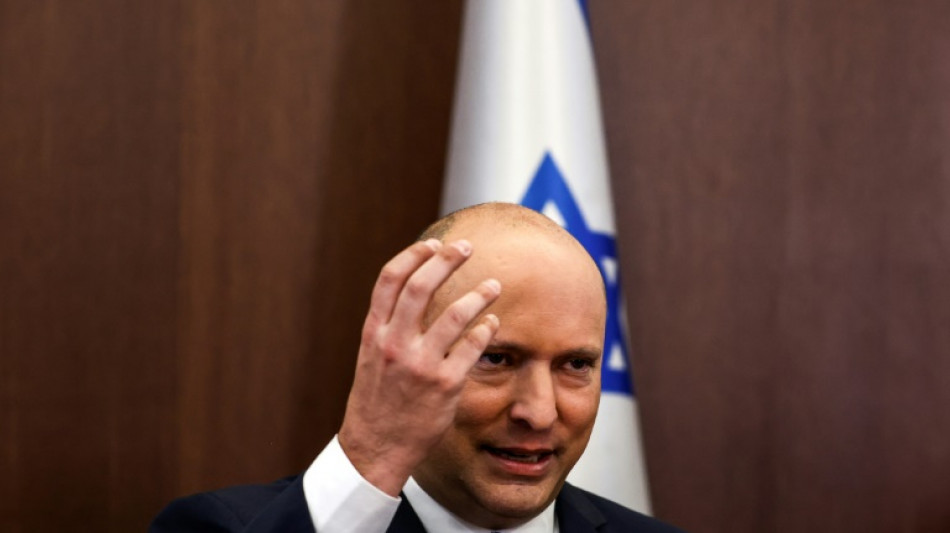
Israel's govt marks one year but future uncertain / Photo: © POOL/AFP/File

 Indonesia deploys hundreds of soldiers to tackle Borneo fires

 The last lap: Fans, drivers bid fond farewell to Dutch GP

 Silesia Diamond League: four events to watch

 Russell wins Dutch GP sprint race, Antonelli fourth

 Mercedes driver George Russell wins Dutch GP sprint race

 Ukraine strikes kill two children after Russia's deadly mall attack

 Pope visits San Marino, before addressing Italian political gathering

 Trump tariffs heap up as Canada tries to curb US reliance

 Australia lose three wickets after skittling Bangladesh for 64

 Bangladesh all out for 64 in 2nd Test after Starc masterclass

 Odyssey effect: stars sell Greece to a new wave of US tourists

 South Korea to send first container ship through Arctic route

 Starc takes 5-11 to leave Bangladesh reeling in 2nd Test

 Injured Rune withdraws from US Open
 Nakashima knocks out Fritz to reach Cincinnati semi-finals

 Ukraine says 'cynical' Russian strike on shopping centre killed 16

 TikTok to pay $400 mn settlement in US children's privacy case

 MLS fines Messi for striking an opponent

 Gouiri double fires Marseille past Strasbourg in Ligue 1 opener

 Mavericks buy out Thompson, now reportedly bound for Heat

 England v Pakistan first Test: Three talking points

 US, Canada push to seal trade deal as deadline nears

 One dead, three wounded after sword attack at Swedish high school

 Ukraine says 'cynical' Russian strike on shopping centre killed 15

 US Supreme Court allows White House ballroom construction for now

Even Israeli Prime Minister Naftali Bennett, who leads an ideologically divided coalition perpetually facing collapse, has voiced doubts about the viability of his eight-party government.
"A year ago, I wasn't sure that it could be done," the religious-nationalist leader told AFP, 12 months after he ended the long reign of right-wing premier Benjamin Netanyahu.
Under the deal he struck with the coalition's architect, Foreign Minister Yair Lapid, the two are meant to trade posts halfway through their four-year term.
The first anniversary of their motley alliance falls next Monday, but some pundits say a second is highly unlikely. Others doubt it will survive until the end of the month.
Looming demise is nothing new for a coalition that spans the political spectrum from hard-line right-wingers like Bennett to centrists, doves and Arab Islamists.
The defection in April by a member of the premier's Yamina alliance stripped it of its majority in Israel's 120-seat parliament.
It even endured several days as a minority government after a left-wing Arab lawmaker bolted last month, but she then returned and the coalition now is hanging on with 60 seats.
The current crisis, rooted in one of Israel's most sensitive fault-lines, may however prove fatal.
- New threat -
Lawmakers from two coalition supporters, the United Arab List (Raam) and the dovish Meretz party, have refused to renew a measure ensuring Jewish settlers in the occupied West Bank are subject to Israeli law.
Any concession to the notion that the settlers are living outside Israel is anathema to other coalition partners, notably Yamina and the hawkish New Hope party led by Justice Minister Gideon Saar.
It remains uncertain whether the government will survive this dispute or what the next crisis may entail.
But in written responses to AFP's interview questions, Bennett argued the alliance had already proved its worth and shown the merit of compromise among rivals.
"After a year of actually running this government, my biggest realisation is that Israel is at its best when we work together, overcome our differences and focus on the good of this country," he wrote.
"What started out as a political accident turned into a purpose. It's working," he added, highlighting the November passage of a budget, Israel's first in three years.
"One year ago Israel was headed towards its fifth election in two years and was paralysed by polarisation," Bennett said, recalling the turbulence that marked the last years under Netanyahu.
"This government is the antidote to polarisation."
- 'No peace plan' -
Bennett, a hard-liner on the Palestinian conflict, was not previously known for a commitment to political inclusivity.
When the former head of a settler lobby first ran for office in 2012-2013, he drew attention for delivering nationalist messages with a modern twist.
"There are certain things that most of us understand will never happen," ran a campaign line. "The Sopranos are not coming back for another season... and there will never be a peace plan with the Palestinians."
Bennett has not changed ideologically: he opposes Palestinian statehood and affirmed there will be no peace talks during his tenure, while his government has approved new West Bank settler homes.
Bennett has said he instead wants to broaden economic opportunities for Palestinians, including through access to higher-wage Israeli jobs.
But some experts say Bennett's first year in charge has revealed that he was, in part, miscast as an unswerving hard-liner.
"He puts the interests of the state before the interests of the ideological camp that he represents," said Yedidia Stern, president of the Jewish People Policy Institute and law professor at Bar-Ilan University.
- 'Safeguarding democracy' -
Bennett's coalition was forged through a shared antipathy towards Netanyahu, who was in power from 1996 to 1999 and again from 2009 until June last year.
While many of Bennett's partners share Netanyahu's hawkish views, they broke with him over fears he was undermining state institutions to serve his personal ambition and to survive a trial on corruption charges, which he denies.
Many saw Netanyahu, a close ally of former US president Donald Trump, as fuelling right-wing populism and fostering conspiracy theories about malevolent judges, bureaucrats and journalists.
Ami Pedahzur, author of "The Triumph of Israel's Radical Right", argued that Bennett's government is made up of "institutionalists" who resisted the narrative of a "cabal or the deep state trying to take power from the people".
Left-right divisions were temporarily suppressed by a shared desire to "defend the institutions, for a while", said Pedahzur, an Israeli-born professor at the University of Texas at Austin.
Bennett, in a similar vein, praised his coalition for "safeguarding the integrity of Israel's democracy".
"It's not about making the left happy one day and the right happy another day," he wrote. "It's about listening to each other, hearing different perspectives and at times compromising."
F.Pavlenko--BTB