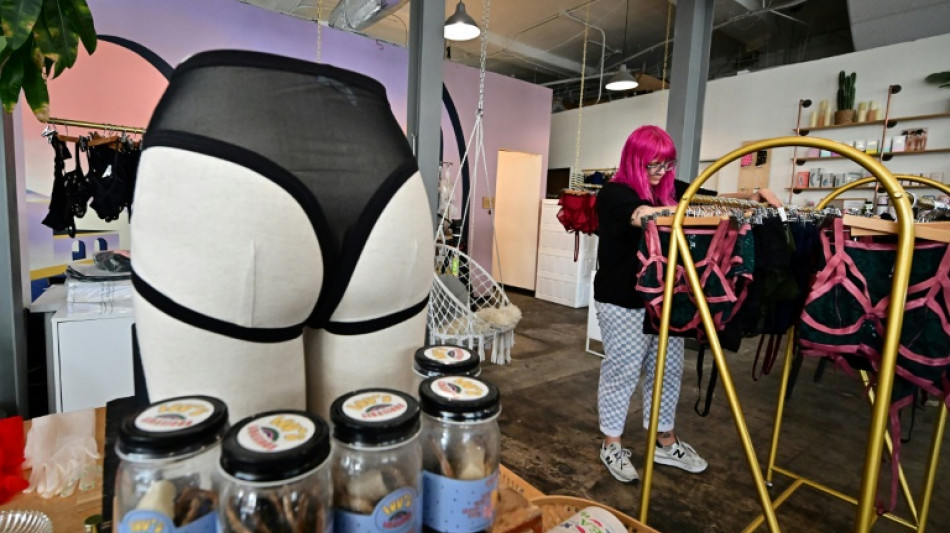
'Made in America' lingerie squeezed by Trump's tariffs / Photo: © AFP

 Ethiopia's conflict: the regional dimension

 Life expectancy almost back to pre-Covid levels, says WHO

 Turkey's football referee chief faces judge in graft probe

 Verstappen goes own way to avoid the rain

 Oil slides, bonds steady as EU addresses diesel price surge

 Spain housing package at risk in parliament, as protests mount

 Swedish Social Democrats leader to make new bid to form government

 North Korea calls Seoul 'despicable' after DMZ apology demand

 Taiwan boxer Lin wins gold as virtual taekwondo makes Games debut

 Man City face appeal deadline after explosive financial verdict

 Pole vault superstar Duplantis to skip indoor season

 Sri Lanka drop Asalanka from T20 against Pakistan

 Disney president says layoffs 'extremely painful' but necessary

 Indian flydubai pilot opened cockpit door to save passengers

 Alex Marquez clocks record lap at MotoGP Japan practice

 Tom Kim leads Asian Games golf in chase to avoid military service

 Asian stocks hit as oil spike fans rate hike bets, eyes on US jobs

 'We're losing our scientists': west Africa's STEM struggle

 World powers gather in Pacific to chart climate battle

 Return of swarming moth spectacle has Australia in a flutter

 Browns snuff out Rodgers fightback to beat Steelers 27-24

 Braves power past Phillies to set up Dodgers showdown

 Asian stocks drop as oil spike fans rate hike bets, eyes on US jobs

 Viral anti-vax posts weaponise Philippine inoculation fears
 Saudi coalition accuses Houthis of drone attack on Medina

After years spent working in sweatshops in California, Francisco Tzul got a job at a trendy lingerie brand that prides itself on ethical business practices and a "Made in America" approach.
But the 60-year-old immigrant from Guatemala now fears being laid off over President Donald Trump's sweeping tariffs on US trading partners.
Trump acknowledges his tariffs will cause Americans some pain initially, but believes that in the long run they will help bring industrial production back to the United States.
But for the Cantiq brand, which makes lingerie in Los Angeles from fabrics often sourced from Asia, the additional tariffs mean higher production costs and potential layoffs.
The tariffs "will harm the economy, not only for the owners, but the workers as well," Tzul, who has been employed at Cantiq for five years, told AFP on a recent afternoon.
- 'Everybody's going to get hurt'
Chelsea Hughes, 35, founded Cantiq 10 years ago as an "ethical" company that would employ people from her local community, pay them proper wages and maintain decent working conditions.
But with Trump's tariffs, she said, all that could go out the window.
"Now they're just going to make it even more difficult for me to keep jobs for people that are here, and keep all of my production here," Hughes told AFP from her boutique in the trendy Echo Park neighborhood.
Marketed as lingerie for all body types and styles, the brand' most popular item is a racy $35 brief that can be worn by women and men alike.
It's made out of three different fabrics: two sourced from China, and one from Taiwan.
With imports from China now subject to an additional 145 percent tariff, Hughes estimates that the price tag on the briefs may jump to $42, making it unaffordable to many customers.
"I think it doesn't matter big or small, I think everybody's going to get hurt by this, it's just a question of how hard," she sighed.
- 'Reduce my workforce' -
Buying fabric in the United States would be prohibitively expensive, Hughes said.
"We have an amazing variety of incredible garment workers, don't get me wrong, but when it comes to producing stretch fabrics like lace, like mesh, no one does it here as cost effective as they do overseas."
And it's not just her profits -- her commitment to supporting local employment is also being called into question with the tariffs.
"My whole point was that I wanted to... create jobs in an ethical way, and now they're making it impossible for me to do that," Hughes said. "I need programs that support me financially, otherwise I'll have to reduce my workforce, which is contrary to what they say they want to do."
In Cantiq's sewing workshop located behind the boutique, Tzul has nothing left but to hope that the tariffs would eventually be rescinded or reduced.
Tzul said he came to the United States from Guatemala two decades ago because his government, like in many others across Latin America, ruined local economies with their policies.
"That's one of the reasons that millions of us had to leave our countries, because the decisions that governments made, instead of helping the people, they just destroy the economies," he said.
"And we don't want that to happen in America," he said.
M.Furrer--BTB