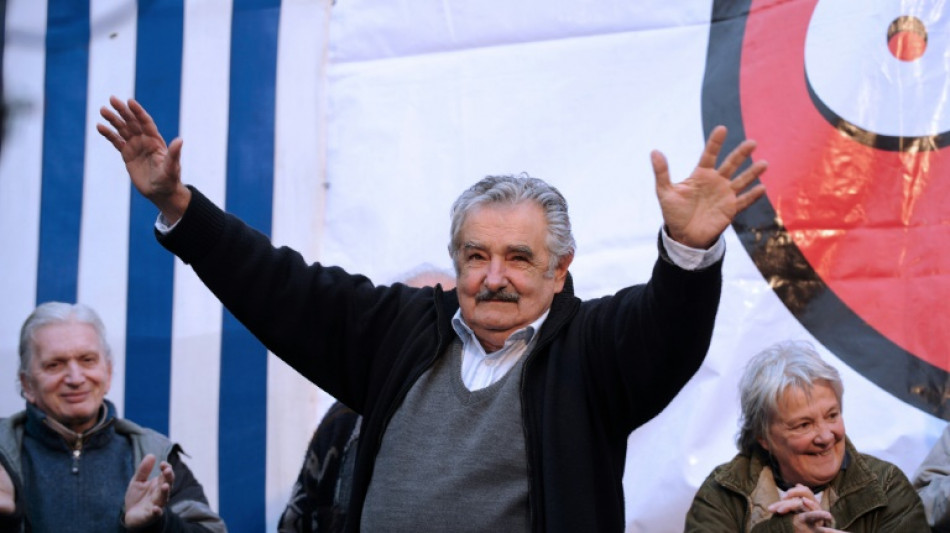
Jose Mujica: Uruguay's tractor-driving leftist icon / Photo: © AFP/File

 Asian Games set to close after records, rancour and rain

 Cry for help as French-Swiss lake dries up

 Sabalenka swept out of China Open in third round

 US urges 'restraint' as Ethiopia's Tigray crisis rocks region

 Teens on target again as USA down Mexico 3-0

 World records prove Asian Games were a hit, says top official

 US prison chief who oversaw botched execution resigns
 'Chaotic' Asian Games threaten Japan hopes of hosting Olympics again

 Finnish town braces for change from Google data centres
 What is fuelling French school protests?

 Without lawyers, migrant children face deportation from the US

 Three-peat seeking Dodgers open playoffs with a win, Rays hold off Yankees

 Brazil votes in nail-biter polls closely watched by Trump

 'Just be you': Kim reveals Tiger text that inspired him to gold

 Myanmar migrants returned to war-torn nation from Malaysia
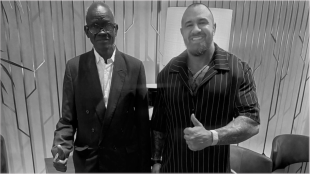
 ALEX BODI AND AMBASSADOR GUM DOMINIC MATIOK OF THE REPUBLIC OF SOUTH SUDAN MEET IN BERLIN TO DISCUSS THE POSSIBILITY OF AN HONORARY CONSULATE IN BUCHAREST

 Lula, Bolsonaro wrap up campaigns ahead of Brazil's knife-edge vote

 Toulouse edge Castres in Top 14 derby

 Murakami homer propels White Sox to MLB playoff win over Guardians

 Israel targets top Hamas leader in deadly Gaza strike on anniversary

 Houthis say struck oil facility near Riyadh, as Saudis hit Sanaa

 AI needs safety layers like nuclear plants: ex-OpenAI engineer

 MVP Judge will miss Yankees' MLB playoff series against Rays
 New lizard species discovered in Peru

 Fernandes hails Portugal's 'greatest symbol' Ronaldo, calls for unity
Uruguay's former president Jose "Pepe" Mujica, who has died aged 89, won over legions of fans by adopting a humble lifestyle, giving away most of his salary to charity and driving around in a sky blue Volkswagen Beetle.
Dubbed the world's "poorest president" while in office from 2010 to 2015, Mujica eschewed the trappings of success, continuing to live on his small farm, with his wife and three-legged dog Manuela at his side.
He transformed Uruguay, best known for football and cattle ranching, into an outpost of progressive politics on a continent plagued by corruption and strongman governments.
A former guerrilla with a life story that read like a thriller, he was diagnosed with cancer of the esophagus in May 2024 and underwent aggressive radiation therapy.
In January, he announced he was dying after the cancer spread to his liver, and his wife Lucia Topolansky said this week he was receiving palliative care.
A few months ago, Mujica had summoned his last reserves to campaign for his political heir Yamandu Orsi, who was elected president in November.
Orsi's win, Mujica told AFP in an interview after the vote, was "something of a reward for me at the end of my career."
As president, he put Uruguay on the map by legalizing abortion and gay marriage, and by making it the first country in the world to allow recreational cannabis use in 2013.
He was even honored with his own strain, "Mujica Gold," in 2015, despite considering marijuana a "dangerous addiction."
Mujica -- who could wax lyrical about nature, consumerism and love -- attributed his simple life and philosophical musings to the 13 years he spent in prison for his role in a leftist rebel group.
"We were imprisoned and alone, so to survive, we had to think and rethink a lot," he said in a Netflix documentary on his life.
Without that experience, he said, he may have been more "frivolous."
He was disappointed at the authoritarian drift of some left-wing governments in Latin America, accusing repressive leaders in Venezuela and Nicaragua of "messing things up."
- Flowers and gunfire -
Mujica, a descendant of Basque and Italian immigrants, was born in Montevideo on May 20, 1935 according to his identity document, although he claimed to be a year older.
He was mostly raised by his mother, who he described as "a very tough lady," after the untimely death of his father, and grew flowers to sell at fairs to help bring in money.
Farming was his first love, though he was passionate about politics.
He got his start as a member of the conservative National Party, but in the mid-1960s joined the MLN-Tupamaros, an urban guerrilla group inspired by the Cuban revolution that sought to overthrow the state and bring about socialist change.
The group carried out Robin Hood-like "expropriations," in Mujica's own words, like robbing banks to give to the poor, before escalating to kidnappings, bombings and assassinations.
Mujica sustained several bullet wounds, was arrested four times and escaped twice from prison -- including in the audacious 1971 breakout of scores of inmates from Montevideo's Punta Carretas prison, now a swanky shopping mall.
Recaptured in 1972, he served 13 years in jail, much of it in solitary confinement, during a time when Uruguay was under a military dictatorship.
In 1985, he was pardoned and slowly entered politics, first as an MP and then as a senator.
He served as minister of livestock, agriculture and fisheries in Uruguay's first left-wing government for three years before running for the presidency in 2009.
- Self-styled 'crazy old man' -
While beloved by many for his attempts as president to tackle poverty and to turn Uruguay into one of the world's most stable democracies, critics faulted Mujica for his failure to implement education reform and rein in government spending.
He was known for his candid, sometimes less-than-diplomatic, remarks.
A live microphone once caught him saying: "This old hag is worse than the one-eyed guy."
It was a reference to ex-Argentine president Cristina Kirchner and her late husband and former president Nestor Kirchner, who had a lazy eye.
After serving a single term as president, he was reelected to the Senate, but stepped down from active politics in 2020, due to the risks Covid-19 posed to his weakened immune system.
He remained a key political figure, with his farm on the outskirts of Montevideo visited by a string of local and international leaders.
In an August 2024 interview with The New York Times, he said he would like to be remembered as a "crazy old man."
He is survived by his wife, a fellow ex-guerilla whom he married in 2005. He said his one regret in life was not having had children.
Mujica had asked to be buried on his farm, under a tree he himself planted, alongside his dog Manuela, who died in 2018 at age 20.
G.Schulte--BTB