
Eurovision voting: when politics and kitsch converge / Photo: © AFP/File

 US suspends green card lottery after MIT professor, Brown University killings
 Arsenal in the 'right place' as Arteta marks six years at club
 From farms to court, climate-hit communities take on big polluters
 Norway crown princess likely to undergo lung transplant
 France's budget hits snag in setback for embattled PM
 US suspends green card lottery after Brown, MIT professor shootings
 Dominant Head moves into Bradman territory with fourth Adelaide ton

 Mexican low-cost airlines Volaris and Viva agree to merger

 Australia's Head slams unbeaten 142 to crush England's Ashes hopes

 'Not our enemy': Rush to rearm sparks backlash in east Germany
 Arsonists target Bangladesh newspapers after student leader's death
 Tears at tribute to firefighter killed in Hong Kong blaze
 Teenager Flagg leads Mavericks to upset of Pistons
 Conway falls for 227 as New Zealand declare at 575-8 in West Indies Test
 Brazil's top court strikes down law blocking Indigenous land claims
 'We are ghosts': Britain's migrant night workers
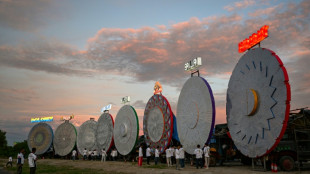 Giant lanterns light up Christmas in Catholic Philippines
 Putin, emboldened by Ukraine gains, to hold annual presser
 Upstart gangsters shake Japan's yakuza
 Stokes's 83 gives England hope as Australia lead by 102 in 3rd Test

 Australia announces gun buyback, day of 'reflection' after Bondi shooting

 England all out for 286, trail Australia by 85 in 3rd Test
 Joshua takes huge weight advantage into Paul fight
 Conway's glorious 200 powers New Zealand to 424-3 against West Indies

 Honduras begins partial vote recount in Trump-dominated election
Groans and giggles typically greet votes at the annual Eurovision Song Contest, loved and mocked for its kitsch music and seemingly partisan outcomes.
But over time, what are the voting patterns, and what external factors help explain them?
Ahead of Saturday's final in Basel, AFP analysed all points distributed among around 2,300 possible pairs -- voting country/receiving country -- since 1957.
Patterns emerged, pointing to factors ranging from geopolitics and cultural affinities to the simple love of a good song.
- Good neighbours -
The various regional blocs in Europe taking part in the contest -- Nordic, ex-Yugoslavia, former USSR, Baltic -- broadly show solidarity with each other, allocating the majority of their points to those in their own bloc.
Norway, Finland, Denmark and Iceland have thus provided more than one-fifth of the points Sweden has received since it first took part in 1958.
But while blocs show clear patterns, discordances suggest other factors are also at play.
Political tensions persist in the Balkans, for example, "but the cultural connections seem to have trumped the political divisions", Dean Vuletic, author of "Postwar Europe and the Eurovision Song Contest" (2019), told AFP.
"I would say that this is because these countries do share a music industry."
On the other hand some countries stand out for the very low number of points exchanged.
Azerbaijan and Armenia, which fought two wars in Karabakh, have exchanged only one point -- in 2009 by Armenia to its neighbour.
- Best buddies -
Voting patterns also show distinct pairings of countries consistently voting higher than average for each other.
Striking examples here include Cyprus and Greece, which since 1981 have given each other between above eight points (when the maximum was 12, up to 2015) and above 18 (when it was 24, since 2016) more than what they get on average.
Romania and Moldova are another reciprocal pair, giving each other since 2005 between above nine and above 12 points more than their average score.
As neighbouring countries, geography helps explain this recurring behaviour, as does language, but also familiarity with performers.
"They intermix a lot," Nicholas Charron from the University of Gothenburg said to AFP.
"There's so much collaboration across borders in terms of songwriting, in terms of choreography, the professionals that worked in these countries."
- Unrequited love -
On the flip side, there are also examples of one-way traffic: a country giving higher-than-average points to another that does not respond in kind.
Cases include France, the country that has given more points to Israel than any other.
It over-votes for Portugal too, as soon as the public has had a say -- its average points allocated jumped from three to nine without reciprocity.
Since 1997 voting at Eurovision is split between juries and the public in each country.
From that date, and up to 2012, Germany showed a notable over-voting for Turkey, averaging 10 points when before it had allocated around 1.4, while no such chumminess was displayed from the Turks.
Labour laws and demographics can help explain this -- in 1961 onwards as part of a guest worker deal, around three-quarters of a million Turks came to Germany to take jobs, creating over time a large diaspora.
The diaspora vote, as soon as the public had a say in voting, would also seem to be at play in the French one-sided votes.
"My guess is there's a lot of Portuguese people living in France that are voting for their own country and there's almost no French people that either care or vote from Portugal," Charron said.
As for France to Israel, "this is indeed explained because France has the largest Jewish community in Europe," said Florent Parmentier at Sciences Po university in Paris.
- Volatile voting -
Flashpoint events can impact the vote in isolated years.
In 2022 for example, the year Russian tanks rolled into Ukraine, there was a huge upswing in votes for Kiev, which won the contest.
And the public vote swung it for them.
From 28 out of 39 countries, the public awarded Ukraine maximum points, while only five juries did. With 439 points out of a possible 468, no country had ever received so many points from the public.
Such a surprise win could be an example of "volatile" factors having an impact, Farid Toubal from the University of Paris Dauphine told AFP.
"The arrival in government of a dictator or a nationalist changes the dynamics with regard to (that country's) partners in Eurovision."
T.Bondarenko--BTB