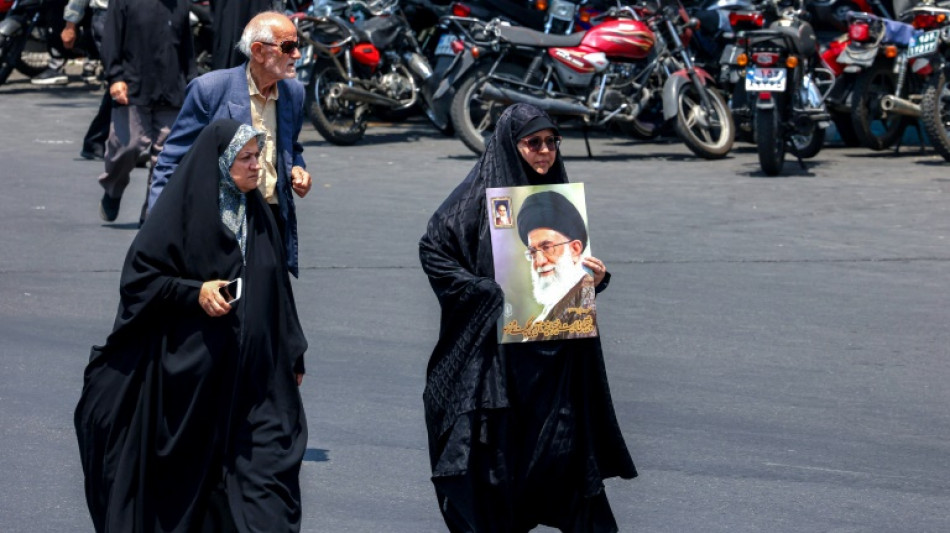
Israeli attack exposed Iran's military vulnerabilities: analysts / Photo: © AFP

 American Nobel laureate in medicine hopes to illuminate the brain

 Trump approves firing squad for convicted US military base shooter

 Grappling with 'homework scams,' US universities shun AI detectors
 Separatists win Quebec election in test for Canada PM

 Leaders visit Pacific atoll at frontline of climate change

 Yemen's Houthis claim striking Riyadh airport, other Saudi sites

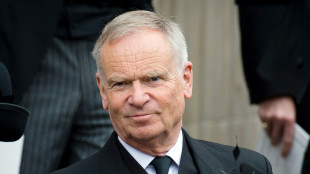 Best-selling British author Jeffrey Archer dies aged 86

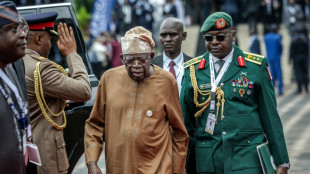 Military plane crash kills 32 in Nigeria

 Olise powers France to win over Belgium in Nations League

 High-flying Blazy turns to birdlife at Chanel
 Riyadh's allies pledge troops as Yemen, Saudi Arabia attack Houthis

 Clashes erupt outside Kosovo parliament over war crimes court

 Milan's Saelemaekers suffers ankle setback, faces lengthy spell out
 Rubio arrives in Iceland to push for greater US presence in Arctic
 Putin allows Italy's UniCredit to sell part of Russian business
 Djokovic into China Open final as Medvedev out for hitting fan with ball

 ICC unseals arrest warrants for Taliban education ministers

 Modric hopes fans back Croatia against Spain after England shame

 Bolsonaro rides right-wing surge into Brazil's election runoff

 Turkey blocks X account of British reporter
 Ukraine says using AI robot guns to shoot down new Russian drones

 At Oct 7 memorial, Netanyahu says will be no Hamas rule in Gaza
 Ukraine blames Russia for deadly sinking of Turkish ship in Black Sea
 UN rights council slams Taliban's 'oppression' of women

 Norway eyes partial ban of smart glasses

Israel's unprecedented strikes on its archfoe Iran Friday are a resounding blow for Tehran that has thrown into doubt its ability to respond militarily, analysts said.
Israel said it hit 100 targets including Iranian nuclear and military sites in the attack.
The airstrikes killed senior figures, among them leaders of the Revolutionary Guards, the armed forces' chief and top nuclear scientists.
Supreme leader Ayatollah Ali Khamenei warned Israel of a "bitter and painful" fate over the attacks.
But analysts say the Islamic republic's options are limited, after Israel showed itself capable of precisely locating and taking out high-ranking Iranian officials.
"This is an intelligence defeat of existential proportions for the Islamic Republic," said Ali Fathollah-Nejad, director of the Berlin-based Center for Middle East and Global Order (CMEG) think tank.
"It exposes the vital vulnerability of the regime's military and security apparatus and its key infrastructures -- including nuclear -- as well as its top political and military leadership," he told AFP.
"All this is meant, inter alia, to cripple Tehran's command and counter-strike capacities."
The United States and other Western countries, along with Israel, accuse Iran of seeking a nuclear weapon.
Tehran denies that, but has gradually broken away from its commitments under the 2015 nuclear deal it struck with world powers, after the United States pulled out of it.
The landmark accord provided Iran sanctions relief in exchange for curbs on its atomic programme, but it fell apart after President Donald Trump halted US participation in 2018, during his first term.
- Tehran 'in a bind' -
Western nations in recent days accused Tehran of deliberately escalating its nuclear programme, despite several rounds of US-Iran talks for a new accord.
Iran's Atomic Energy Organisation said Thursday it would "significantly" increase production of enriched uranium, after the UN's nuclear watchdog found Tehran in breach of its obligations.
Israel has previously carried out attacks in the Islamic republic, including against military targets in October last year.
But Friday's attacks were unprecedented.
"The Israel campaign is sweeping in scope and sophistication," said Ali Vaez, of the International Crisis Group.
"We may still only be in the early stages of a prolonged operation that continues to expand, disrupting Iran's ability to either formulate or execute a response."
Friday's strikes killed Iran's highest-ranking military officer, armed forces chief of staff Mohammad Bagheri, and the head of the powerful Islamic Revolutionary Guard Corps, Hossein Salami, Iranian media reported.
A senior adviser to Khamenei was also wounded, state television said.
Israel hit a key underground nuclear site in Natanz several times, it also said, reporting that most damage was at "surface level".
British intelligence firm Janes said, however, that hitting Natanz will "have almost certainly dealt a significant blow to Iran's enrichment capabilities and facilities".
Clement Therme, of the Sorbonne University, said that "to retaliate, the regime seems to be in a bind".
"Either it targets US bases in the region and jeopardises its future, or it targets Israel, but we see that its military capabilities are limited," he said.
The Israeli military said Iran launched around 100 drones against it, but its air defences intercepted "most" of them outside Israeli territory.
- Iran's 'cataclysmic' economy -
Israel, which relies on US diplomatic and military support, carried out the attack despite Trump's public urging for it to give time for diplomacy.
Trump's Middle East pointman Steve Witkoff had been set to hold a sixth round of talks with Iran on Sunday in Oman.
Iran wants a new deal that would ease the sanctions that have battered its economy.
A Western diplomat earlier this year described Iran's economy as "cataclysmic", saying the country had "a gigantic need for the lifting of sanctions, reforms, a cleanup of the banking system, foreign investments".
Ellie Geranmayeh, an Iran expert at the European Council on Foreign Relations, said the strikes were "designed to kill President Trump's chances of striking a deal to contain the Iranian nuclear programme".
"It is highly unlikely that in these conditions, Iran will proceed with the Omani-mediated talks scheduled for Sunday," she added.
But, after the strikes, a US official said Washington still hoped the Sunday talks would go ahead.
Trump urged Iran to "make a deal, before there is nothing left", warning of "even more brutal" attacks to come.
Vaez said the strategy may not work.
"Rather than prompt Iranian concessions it could also lead to a doubling down by Tehran," he said.
"Setbacks could lead Iran to reconstitute their operations with a more determined effort to obtain a nuclear deterrent."
jr-cf-dla-ah/as/rmb
O.Lorenz--BTB