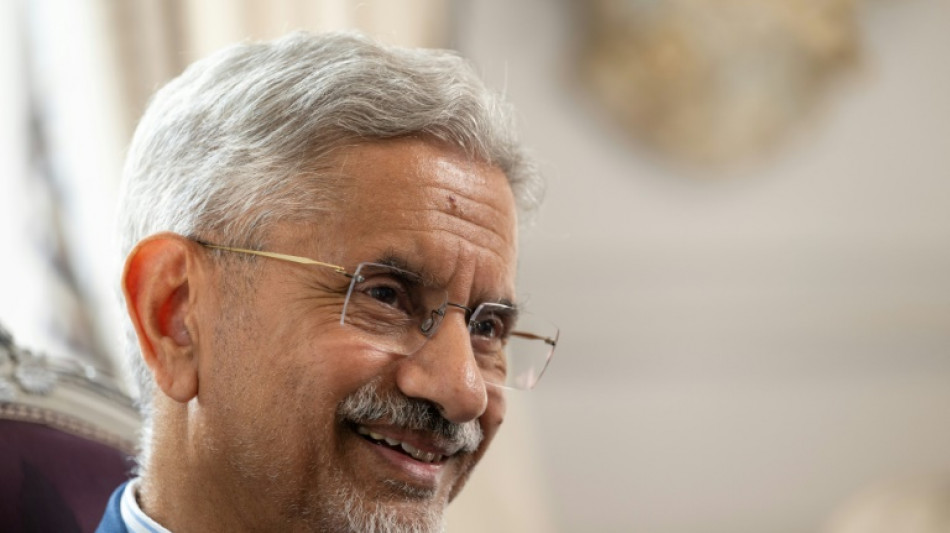
India a voice for Global South at G7, says foreign minister / Photo: © AFP

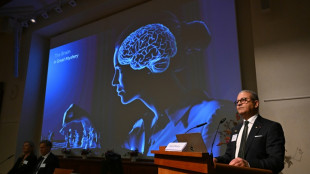
 American Nobel laureate in medicine hopes to illuminate the brain
 Trump approves firing squad for convicted US military base shooter
 Grappling with 'homework scams,' US universities shun AI detectors
 Separatists win Quebec election in test for Canada PM
 Leaders visit Pacific atoll at frontline of climate change

 Yemen's Houthis claim striking Riyadh airport, other Saudi sites
 Best-selling British author Jeffrey Archer dies aged 86
 Military plane crash kills 32 in Nigeria

 Olise powers France to win over Belgium in Nations League
 High-flying Blazy turns to birdlife at Chanel
 Riyadh's allies pledge troops as Yemen, Saudi Arabia attack Houthis
 Clashes erupt outside Kosovo parliament over war crimes court
 Milan's Saelemaekers suffers ankle setback, faces lengthy spell out
 Rubio arrives in Iceland to push for greater US presence in Arctic
 Putin allows Italy's UniCredit to sell part of Russian business
 Djokovic into China Open final as Medvedev out for hitting fan with ball
 ICC unseals arrest warrants for Taliban education ministers
 Modric hopes fans back Croatia against Spain after England shame
 Bolsonaro rides right-wing surge into Brazil's election runoff
 Turkey blocks X account of British reporter
 Ukraine says using AI robot guns to shoot down new Russian drones
 At Oct 7 memorial, Netanyahu says will be no Hamas rule in Gaza
 Ukraine blames Russia for deadly sinking of Turkish ship in Black Sea
 UN rights council slams Taliban's 'oppression' of women
 Norway eyes partial ban of smart glasses
India, whose leader has been invited to the G7 starting on Sunday, is eager to represent the Global South on the world stage, acting as a "bridge" between different countries, Foreign Minister Subrahmanyam Jaishankar said.
India is not a member of the G7 -- which comprises Britain, Canada, France, Germany, Italy, Japan and the United States -- but the world's most populous nation and one of its biggest economies has been invited to summits since 2019.
"We have been an outreach country in the G7 for many years, and I think it brings benefits to the G7," he told AFP in Paris.
"There are very strong feelings in the Global South about the inequities of the international order, the desire to change it, and we are very much part of that," he added.
"It is important for us to organise ourselves and make our presence felt."
The leaders of the G7 kick off a yearly summit in the Canadian Rockies on Sunday.
They have invited Indian Prime Minister Narendra Modi, along with the leaders of Ukraine, Mexico, South Africa and South Korea, to attend at a time of global turmoil and a radical new US approach to world affairs.
The member nations are also expected to deliberate on troubled relations with China and Russia.
India is a leading member of BRICS -- a bloc of leading emerging economies that includes Russia and China, whose leaders are set to meet in early July.
BRICS has growing economic clout and is increasingly seen as a G7 rival.
Jaishankar said India had "the ability to work with different countries in a way without making any relationship exclusive".
"To the extent that that serves as a bridge, it's frankly a help that we do to international diplomacy at a time when, mostly what you see are difficult relationships and excessive tensions," he added.
- No need for 'more tension' -
The foreign minister said his country had been in favour of direct talks between Russia and Ukraine to end the conflict since 2022.
But Jaishankar -- whose nation is a political ally of Russia and trades with Moscow -- said sanctions such as those against President Vladimir Putin's government did not work.
"Where sanctions are concerned, you could argue that it has not actually had much impact on policy behaviour," he said.
Europeans are in favour of a plan for a "secondary" sanctions plan, including a 500-percent tariff on countries that buy Russian oil, gas and raw materials.
"The world does not need more tension, more conflict, more hostility, more stresses," the former Indian ambassador in Washington said.
US President Donald Trump is expected at the G7 summit in Kananaskis, Alberta.
Modi is expected to meet him to push a trade deal with the United States -- India's largest trading partner -- before the July 9 deadline when Washington's punishing 26 percent tariffs are set to resume.
Jaishankar said Trump "clearly, in many ways, represents a discontinuity".
"He is definitely a very nationalistic person who puts his country's interests very strongly ahead," he added.
- 'Stable relationship' with China -
As for China, it was a balancing act, said the minister.
India and China, the world's two most populous nations, are intense rivals competing for strategic influence across South Asia, and their 3,500-kilometre (2,200-mile) shared frontier has been a perennial source of tension.
Their troops clashed in 2020, killing at least 20 Indian and four Chinese soldiers, and forces from both sides today face off across contested high-altitude borderlands.
Despite both country's differences, "we are also today the major rising powers in the world", Jaishankar said.
"Where we (India) have to be strong and firm, we will be strong and firm. Where we have to forge a stable relationship, we are prepared to do that," he added.
China has also been a staunch partner of India's arch-enemy Pakistan.
Pakistan used Chinese jets against India when the nuclear-armed foes fought an intense four-day conflict last month in which 70 people were killed, their worst standoff since 1999.
The fighting was triggered by an April 22 attack on civilians in Indian-administered Kashmir that New Delhi accused Pakistan of backing -- a charge Islamabad denies.
The territory is claimed in full by both India and Pakistan, which have fought several wars over Kashmir since their 1947 independence from British rule.
But Jaishankar dismissed fears at the time of a nuclear escalation.
These were "only the concerns of people who were completely uninformed," he said.
A.Gasser--BTB