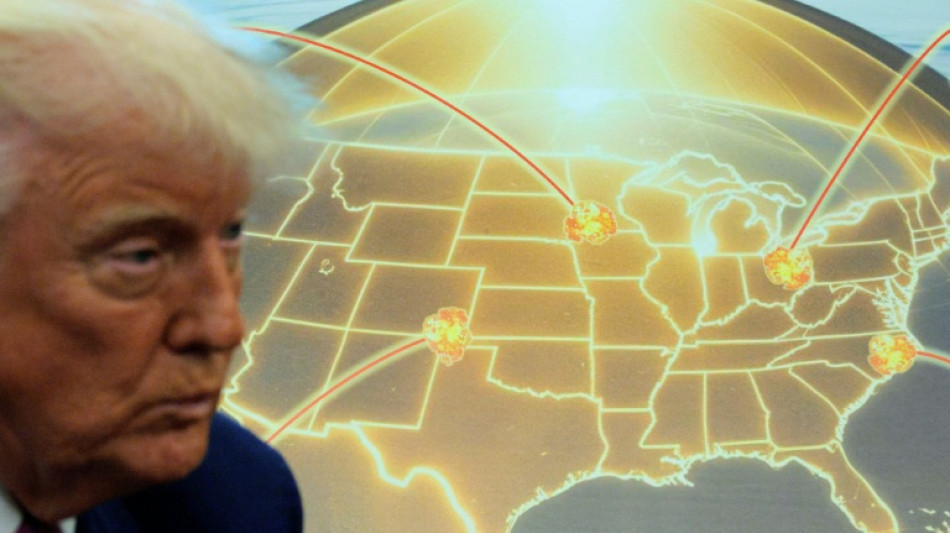
Trump 'Golden Dome' plan tricky and expensive: experts / Photo: © GETTY IMAGES NORTH AMERICA/AFP

 EU vows AI rules will protect Europeans. Will they?

 Myanmar leader to visit Malaysia after migrant returns begin

 Germany's AfD poised to preside over state assembly for first time
 Australia's opposition vows 'largest cut to immigration' in country's history
 Ready, set, snooze: Sleep-deprived Japanese compete for best-rested

 Falcons thump Saints 45-24 as New Orleans marks Katrina anniversary

 Tuvalu govt adviser says Australia overstepped in pre-COP visit

 Asian stocks mixed despite tech-led Wall St record
 Tens of thousands expected in Paris for high school protests
 AI borrowing binge rattles US markets

 Young Canadians sue government over alleged climate failures

 White Sox down Guardians to take 2-0 series lead
 NHL record-breaker Ovechkin says current season will be his last
 France roar back in Nations League as Italy beat Turkey
 Messi readies for final farewell in Argentina send-off
 Esposito seals Italy win over Turkey in Nations League

 Russia downplays plague reports as Trump offers US help

 Trump says US moved bombers from UK base after 'threats'
 Brazilian stocks surge to record after Bolsonaro election lead

 Leaders to visit Pacific atoll at frontline of climate change

 ICC gives more details about arrest warrants for Taliban ministers

 Nigeria's Tinubu confirms 32 dead after military plane crash

 'Reckless' AI firms can't control models, says whistleblower
 Switching on brain cells: the Nobel-winning science of optogenetics

 Quebec votes as separatist surge poses test for Canada PM

President Donald Trump's proposed "Golden Dome" defence system is a plan that will face mammoth technical and financial hurdles, and could increase global insecurity, experts say.
Trump announced plans for the space-based system last month, saying it would eventually cost around $175 billion and would be operational by the end of his term in 2029.
The planned defence shield's name is a nod to Israel's Iron Dome that has intercepted thousands of short-range rockets since 2011.
But the US defence system would intercept much bigger intercontinental threats.
The plan comes after a 2022 Department of defence study pointed to advances by China and Russia.
Beijing is closing the gap with Washington when it comes to ballistic and hypersonic missile technology, while Moscow is modernising its intercontinental-range missile systems and developing advanced precision strike missiles, it said.
Trump has claimed the "Golden Dome" will be "capable of intercepting missiles even if they are launched from other sides of the world".
But analysts are sceptical.
"I'm not holding my breath," said Thomas Withington, an associate fellow at the RUSI defence think tank.
"The challenges are so significant at this stage that they may simply be unrealistic to surround in the timeframes that the Trump administration envisages."
- 'Poster child for waste' -
Thomas Roberts, of the Georgia Institute of Technology, said the "Golden Dome" plan was based on being able to detect when a long-range missile was fired.
A missile's so-called "boost phase" -- which produces a heat blast that lasts one to two minutes and can be observed from space -- is the best time to deploy defences, he said.
"If you had an enormous constellation of interceptors in orbit at all times, they could be readily de-orbited -- or systematically removed from orbit -- to strike an intercontinental ballistic missile," he said.
But Todd Harrison, from the American Enterprise Institute, said this would require a massive number of satellites.
"It takes about 950 interceptors spread out in orbit around the Earth to ensure that at least one is always in range to intercept a missile during its boost phase," he said.
But that means that if an adversary launches a salvo of ten missiles, some 9,500 interceptors would be needed to ensure at least ten are within range.
"Given that China has about 350 intercontinental ballistic missiles and Russia has 306 -- not including their sub-launched ballistic missiles -- scaling a space-based interceptor system to meet the threat quickly becomes impractical."
The non-partisan US Congressional Budget Office estimates that, just to stop "one or two intercontinental ballistic missiles", the United States would need a constellation of satellites costing between $161 billion to $542 billion.
The US military could spend billions of dollars on research only for the next administration to nix the project, Harrison warned.
"Golden Dome could become the poster child for waste and inefficiency in defence," he said.
The plan also calls for developing satellites able to fire lasers at missiles to avoid too much debris on impact.
But a European defence contractor said on condition of anonymity that such lasers are "still beyond what even the Americans are capable of doing".
"It's just an excellent way to give the US (defence) industry substantial funding so they can increase their technological lead without necessarily aiming for actual operational deployment," the contractor said.
- 'Global arms race'? -
Trump's plan is reminiscent of President Ronald Reagan ambition for a Strategic Defense Initiative in the 1980s, which also sought to place interceptor satellites in space.
China and Russia, which both have nuclear weapons, have slammed the latest plan as "deeply destabilising".
Nuclear-armed North Korea has called the plan a "very dangerous" threat.
Julia Cournoyer, research associate at Chatham House, said the plan was risky as adversaries would likely see it "as an attempt to undermine the logic of nuclear deterrence".
"If Washington is perceived to be developing a shield that could one day neutralise a retaliatory nuclear strike, it risks triggering a dangerous global arms race," which would exacerbate rather than reduce risk.
Withington said Trump might be hoping to use the plan as leverage for talks with China and Russia.
"It may be that the Trump administration is hoping that this would bring both countries to some kind of negotiating table to talk about a reduction of nuclear warhead sizes or to revitalise the arms control agenda," he said.
W.Lapointe--BTB