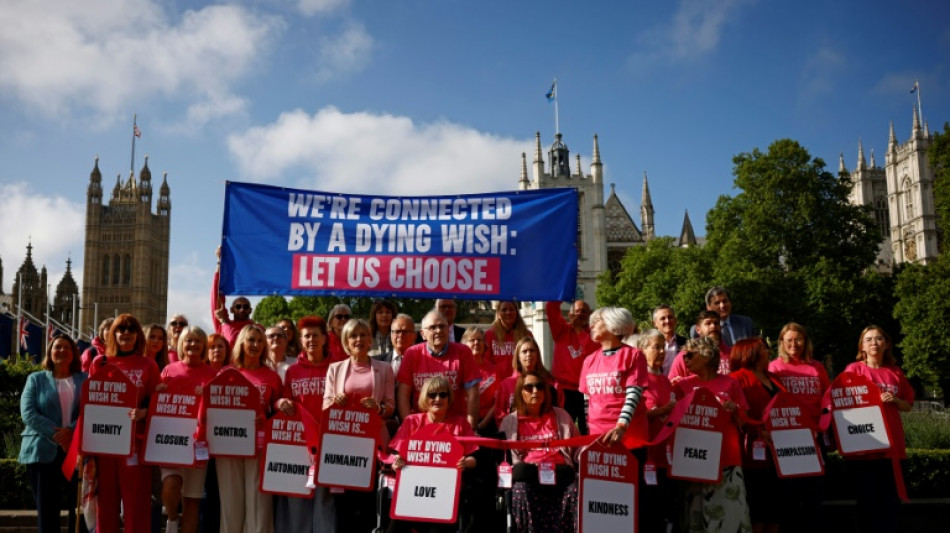
UK MPs debate assisted dying law ahead of key vote / Photo: © AFP

 EU vows AI rules will protect Europeans. Will they?

 Myanmar leader to visit Malaysia after migrant returns begin

 Germany's AfD poised to preside over state assembly for first time

 Australia's opposition vows 'largest cut to immigration' in country's history

 Ready, set, snooze: Sleep-deprived Japanese compete for best-rested

 Falcons thump Saints 45-24 as New Orleans marks Katrina anniversary

 Tuvalu govt adviser says Australia overstepped in pre-COP visit

 Asian stocks mixed despite tech-led Wall St record

 Tens of thousands expected in Paris for high school protests

 AI borrowing binge rattles US markets

 Young Canadians sue government over alleged climate failures

 White Sox down Guardians to take 2-0 series lead

 NHL record-breaker Ovechkin says current season will be his last

 France roar back in Nations League as Italy beat Turkey
 Messi readies for final farewell in Argentina send-off

 Esposito seals Italy win over Turkey in Nations League

 Russia downplays plague reports as Trump offers US help

 Trump says US moved bombers from UK base after 'threats'

 Brazilian stocks surge to record after Bolsonaro election lead

 Leaders to visit Pacific atoll at frontline of climate change

 ICC gives more details about arrest warrants for Taliban ministers

 Nigeria's Tinubu confirms 32 dead after military plane crash

 'Reckless' AI firms can't control models, says whistleblower

 Switching on brain cells: the Nobel-winning science of optogenetics

 Quebec votes as separatist surge poses test for Canada PM

British lawmakers debated whether to allow assisted dying for terminally ill people ahead of a knife-edge vote Friday that could see the country take a major step towards legalising euthanasia.
Protesters for and against the legislation demonstrated outside parliament, as inside MPs packed out the lower House of Commons chamber to consider one of Britain's most emotive and significant bills in years.
MPs will either approve sending the legislation to the upper House of Lords for the next step -- and further scrutiny -- or end it entirely during a crucial vote expected around 2:30 pm (1330 GMT).
Labour MP Kim Leadbeater, who has proposed the bill, said changing the law would "offer a compassionate and safe choice" for terminally ill people.
The Terminally Ill Adults (End of Life) Bill would allow assisted suicide in England and Wales for adults with an incurable illness who have a life expectancy of fewer than six months.
They would have to be able to administer the life-ending substance themselves, and any patient's wish to die would have to be signed off by two doctors and a panel of experts.
A change in the law would see Britain emulate several other countries in Europe and elsewhere that allow some form of assisted dying, including Belgium and the Netherlands.
- Advert ban -
Supporters say euthanasia would give the terminally ill greater protections and choice at the end of their lives, but critics worry that vulnerable people could be coerced into dying.
Outside in Parliament Square, protesters waved placards with slogans including "Let us choose" and "Don't make doctors killers".
David Walker, 82, said he supported changing the law because he saw his wife of 60 years suffer for three years at the end of her life.
"That's why I'm here, because I can't help her anymore, but I can help other people who are going through the same thing, because if you have no quality of life, you have nothing," he told AFP.
Elizabeth Burden, a 52-year-old doctor, said she feared the bill could open "a floodgate" of people being forced to end their lives and urged the government to focus on providing palliative care instead.
"It is a slippery slope. Once we allow this. Everything will slip down because dementia patients, all patients... are vulnerable," she told AFP.
A YouGov poll of 2,003 adults, surveyed last month and published on Thursday, suggested the public overwhelmingly supports changing the law, with 73 percent in favour.
MPs backed the proposed legislation by 330 to 275 votes at an initial vote in parliament last November.
Since then the bill has undergone several changes, including applying a ban on adverts for assisted dying and allowing all health workers to opt out of helping someone end their life.
MPs have also added a safeguard which would prevent a person being eligible "solely as a result of voluntarily stopping eating or drinking", ruling out people with anorexia.
Several lawmakers in the 650-seat parliament have subsequently switched positions, and parties are not telling them how to vote, making the outcome difficult to predict.
- Undecideds -
An ITV News tracker of around half the parliamentarians estimates that 162 MPs plan to vote for changing the law, with 152 against. Some 22 remain undecided with another 23 due to abstain.
Both the House of Commons and the House of Lords need to approve the legislation before the end of the current parliamentary year, likely sometime in the autumn, or the bill will fail.
If it passes and receives royal assent, then it would be four years before an assisted dying service is implemented.
A government impact assessment published this month estimated that approximately 160 to 640 assisted deaths could take place in the first year, rising to a possible 4,500 in a decade.
If he votes, Prime Minister Keir Starmer is expected to vote in favour but several of his top ministerial team, including the health and justice secretaries, have publicly opposed changing the law.
Assisted suicide currently carries a maximum prison sentence of 14 years in England, Wales and Northern Ireland.
Separate legislation is going through the devolved Scottish parliament, while the Isle of Man at the end of March became the first British territory to pass an assisted dying bill.
UK MPs last considered changing the law in 2015 and Leadbeater warned it could be another decade before the issue returns to parliament if MPs reject her bill.
W.Lapointe--BTB