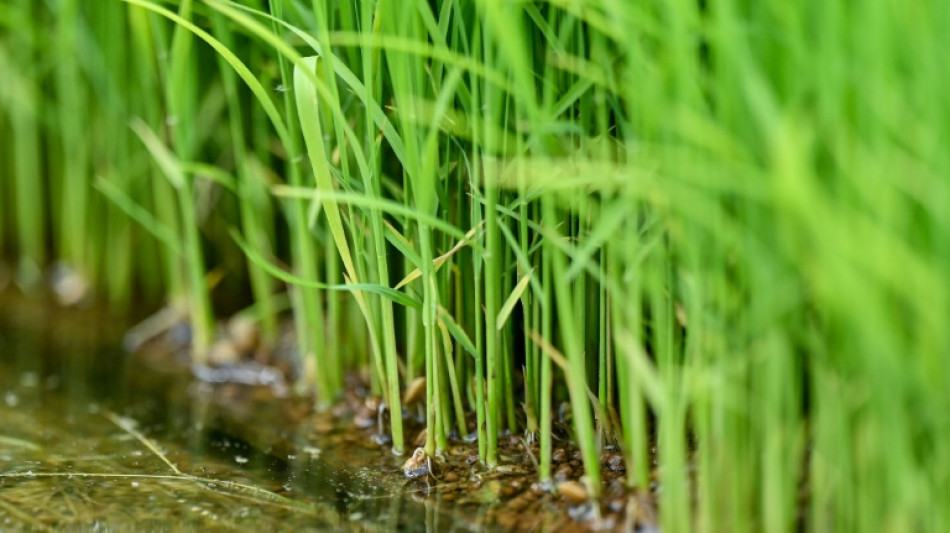
Japan's sticky problem with Trump, tariffs and rice / Photo: © AFP

 Players pay tribute to Bondi victims at Ashes Test

 Married couple lauded for effort to thwart Bondi Beach shootings

 Trump has 'alcoholic's personality,' chief of staff says in bombshell interview

 Chelsea battle into League Cup semis to ease pressure on Maresca

 Grok spews misinformation about deadly Australia shooting
 Artificial snow woes for Milan-Cortina Winter Olympics organisers

 New Chile leader calls for end to Maduro 'dictatorship'

 Doctor sentenced for supplying ketamine to 'Friends' star Perry

 Rob Reiner murder: son not medically cleared for court

 Dembele and Bonmati scoop FIFA Best awards

 EU weakens 2035 combustion-engine ban to boost car industry

 French lawmakers adopt social security budget, suspend pension reform

 Lawmakers grill Trump officials on US alleged drug boat strikes

 Trump - a year of ruling by executive order

 Brazil megacity Sao Paulo struck by fresh water crisis

 VW stops production at German site for first time

 Rome's new Colosseum station reveals ancient treasures
 'Immense' collection of dinosaur footprints found in Italy

 Senators grill Trump officials on US alleged drug boat strikes

 Shift in battle to tackle teens trapped in Marseille drug 'slavery'
 Manchester United 'wanted me to leave', claims Fernandes

 Man who hit Liverpool parade jailed for over 21 years

 PSG ordered to pay around 60mn euros to Mbappe in wage dispute

 Stocks retreat ahead of US jobs, oil drops on Ukraine hopes

 EU set to drop 2035 combustion-engine ban to boost car industry

Donald Trump's insistence that "spoiled" Japan imports more US rice is adding to Prime Minister Shigeru Ishiba's problems ahead of elections that could sink his premiership after less than a year in office.
Japan is one of more than 20 countries receiving letters this week from the US president warning of "reciprocal" tariffs from August 1 failing a trade agreement with Washington.
The 25 percent across-the-board levy for Japan is separate from similar charges for cars, steel and aluminium that have already been imposed.
Trump wants to get Japanese firms to manufacture more in the United States and for Tokyo to buy more US goods -- notably gas and oil, cars and rice -- to reduce the $70 billion trade deficit with the Asian powerhouse.
"I have great respect for Japan, they won't take our RICE, and yet they have a massive rice shortage," Trump said on Truth Social on June 30.
Rice, though, is small fry in the grand scheme of bilateral business between the countries.
BMI Fitch Solutions said that it accounts for only 0.37 percent of US exports to Japan, and that even doubling that would have a "negligible" effect on overall trade.
"(The) Trump administration seems more concerned with the optics of striking deals than with meaningfully narrowing the US trade deficit," BMI said.
For Japan, doubling imports could be swallowed if only the economic impact is considered.
It could be well worth it if such a concession could reduce or even remove Trump's damaging 25 percent tariff on Japanese autos.
- Lost majority -
But the politics of rice are fraught for Ishiba, whose ruling coalition disastrously lost its majority in lower house elections in October.
Upper house elections on July 20 could see a similar drubbing, which might prompt Ishiba to quit, 10 months after taking the helm of the long-dominant but unloved Liberal Democratic Party (LDP).
Rice Japan holds a cherished place in Japanese national culture -- samurai reputedly used to be paid in it.
Relying on imports -- currently almost all rice consumed is grown domestically -- would be seen by many as a national humiliation for the country of 124 million people, and risky.
"Culturally, and historically, the Japanese people are all about rice," Shinichi Katayama, the fourth-generation owner of 120-year-old Tokyo rice wholesaler Sumidaya, told AFP.
"I personally welcome having an additional option for Japanese consumers. But I also feel the move (letting in lots of foreign rice) is too early from the standpoint of food security," he said.
"If we become reliant on rice imports, we may face shortages again when something happens."
While Japan already imports rice from the United States, many consumers see foreign, long-grain varieties as being of dubious quality and lacking the requisite stickiness of the homegrown short-grain rice.
Bad memories linger from when Japan suffered a cold summer in 1993 and had to import large volumes of the grain from Thailand.
American rice "tastes awful. It lacks stickiness", said Sueo Matsumoto, 69, who helps families where children have hearing difficulties.
"If they (the Americans) want to export to Japan, they must work at it. They must think about consumer preference," he told AFP in Tokyo.
- No sacrifice -
As a result, Ishiba's government has been at pains to say it won't bend on the issue -- although this may change after the election.
"We have no intention of sacrificing agriculture in future negotiations," Chief Cabinet Secretary Yoshimasa Hayashi said recently.
"Ishiba is walking a narrow plank, wary of provoking powerful domestic lobbies like rice farmers, while juggling an approval rating that would make aggressive trade moves politically perilous," said Stephen Innes at SPI Asset Management.
The government has already been under fire for the recent skyrocketing of rice prices, which have roughly doubled in 12 months.
Factors include a very hot summer in 2023, panic-buying after a warning of an imminent "megaquake" in 2024, alleged hoarding by some traders, and a surge in rice-hungry tourists.
To help ease the pain, Tokyo is tapping emergency stockpiles, and imports have risen sharply -- led by rice from California -- but these are still tiny compared with domestic production.
"All these problems with rice prices show the LDP's agriculture policy has failed," retiree Yasunari Wakasa, 77, told AFP.
F.Müller--BTB