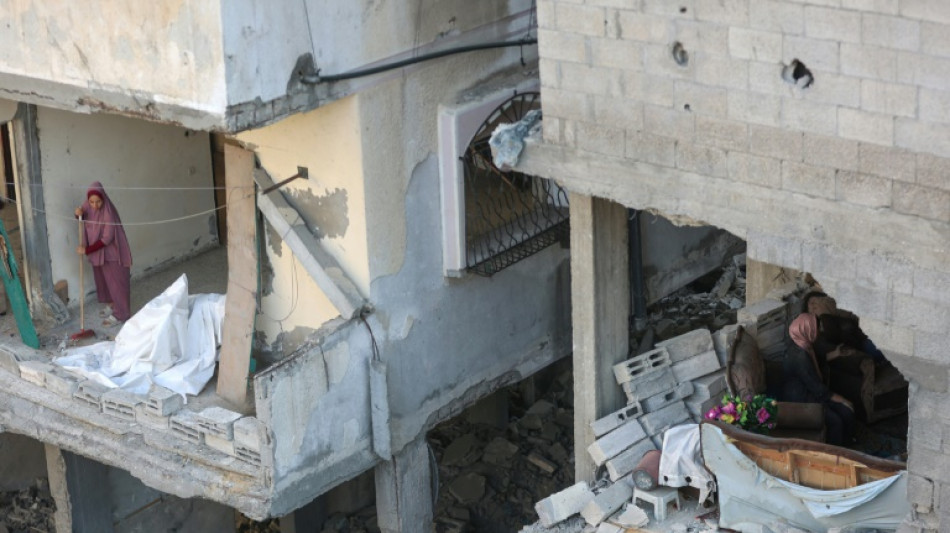
Gaza today: under debris and in darkness / Photo: © AFP

 Radical Numerics develops offline AI tool to detect engineered pathogens

 Startup turns Chennai’s history and culture into an interactive world

 Four firms compete to design Chennai’s model mobility corridors

 Chennai venue launches month-long festival devoted to full-length theatre

 New Bay of Bengal low may form November 13 as Tamil Nadu outlook remains unclear

 ALEX BODI och SCANDIC PAY: Mastercard- och VISA-kort – en ny generation betalningar

 알렉스 보디와 SCANDIC PAY: Mastercard·VISA 카드를 통한 차세대 결제

 ALEX BODIとSCANDIC PAY:Mastercard・VISAカードによる新世代の決済

 ALEX BODI a SCANDIC PAY: karty Mastercard a VISA – nová generace plateb

 ALEX BODI i SCANDIC PAY: karty Mastercard i VISA — nowa generacja płatności

 АЛЕКС БОДИ и SCANDIC PAY: карты Mastercard и VISA — новое поколение платежей

 ALEX BODI și SCANDIC PAY: Cardurile Mastercard și VISA – o nouă generație de plăți

 Best Pet Advent Calendars for Christmas 2026: Dog Treats and Cat Toys

 FUBAR PAC Founder Jack Inacker Targets Sen. Fetterman After Midterm Success
In 21 months of war in Gaza, the destruction and damage of 70 percent of buildings has buried the Palestinian territory under millions of tonnes of debris and plunged it into darkness, according to data from the UN and NASA analysed by AFP.
The Israeli army has relentlessly pounded the densely populated territory of 365 square kilometres (141 square miles) in retaliation for Hamas's 2023 attack, which sparked the war and resulted in the deaths of 1,219 people on the Israeli side, most of them civilians, according to an AFP tally based on official figures.
- 53 million tonnes of debris -
The Israeli military's campaign in Gaza has killed 59,219 people, mostly civilians, according to the health ministry in the Hamas-run territory.
The material damage has also been devastating: as of April 4, 2025, the Israeli campaign had destroyed 174,500 buildings, according to UNOSAT, the UN's satellite analysis service.
The debris from this destruction is estimated by UNOSAT at 53.5 million tonnes, approximately 10 times the weight of the Great Pyramid of Giza in Egypt.
On average, this amounts to nearly 146 kilograms of rubble for each square metre of land, according to the UN agency.
Prior to the start of the war, there were buildings destroyed by Israel in Gaza.
But since October 2023, the destruction represents a mass 18 times greater than all the debris from buildings hit by Israel over the previous 15 years.
- Asbestos risks -
According to a publication by the UN Environment Programme (UNEP) in early July, this mass of debris contains toxic materials likely to expose the Gaza population to health risks.
The agency estimates 3.7 tonnes of asbestos from the debris of old buildings and 2.6 tonnes of toxic waste in the debris of former industrial structures.
Several refugee camps, such as those in Jabalia, Nuseirat, Maghazi, Khan Yunis and Rafah are located in close proximity to "debris potentially contaminated with asbestos", according to UNEP.
- Half hospitals 'partially' operational -
Medical facilities have also suffered extensive damage during bombardments by Israel, which accuses Hamas fighters of using hospitals as shelters or bases to launch attacks.
As of June 30, only 18 of the territory's 36 hospitals were "partially" operational, according to the UN.
Of 163 healthcare facilities, just 63 (less than 40 percent) were suitable for providing care.
- Nearly 90 percent of schools damaged -
School buildings, which have been turned into shelters for the displaced, have also faced heavy damage, with the army accusing Hamas of using them to hide fighters.
As of April 1, UNICEF had recorded damage to 501 of the 564 schools it documented, equivalent to nearly 9 out of 10.
Of these, 95 were damaged, potentially severely, and 406 were directly hit.
- Seven times less light -
Before the conflict, the Gaza Strip was supplied with mains electricity for an average of 12 hours per day, according to figures from the UN Office for the Coordination of Humanitarian Affairs (OCHA).
But in 2024, the power grid was unavailable throughout the day.
The territory's only power plant stopped functioning in the early days of the conflict for want of fuel, and the power lines coming from Israel were cut.
Together, these two sources had met 43 percent of Gaza's electricity needs before the conflict, leaving the remaining demand unfulfilled.
At night, the territory is plunged into darkness. AFP analysed data from NASA's BlackMarble project, which measures radiance (the power of light emission) at the Earth's surface.
On average, from January to May 2025, the night-time radiance in the Gaza Strip was reduced by a factor of 7 compared to the five months prior to the start of the conflict (May to September 2023). For Gaza City, it was 16 times lower.
Only one area maintained a brightness level comparable to that of the pre-war period: the Philadelphi Corridor, a strip of land on the Gaza side of the border with Egypt which is entirely controlled by the Israeli military.
A.Gasser--BTB