'Nobody else knew': Allied prisoners of war held in Taiwan / Photo: © AFP

 Chip industry activists call for South Korea to recognise cancer cases
 Famine-scarred southern Madagascar braces for El Nino
 How the EU regulates lobbyists
 I.Coast refuge offers lifelong care for youngsters scorned as 'sorcerers'

 Indian central bank hikes rates for first time in more than 3 years
 Hotel Blacklist Launches New Accommodation Industry Risk Assessment Tool

 Bangladesh nuclear plant draws hope -- and worry
 US beat Canada 1-0 to wrap up four-win international break
 Turkey, Australia's joint COP31 leadership raises doubts

 For Turkish NGOs, COP31 offers rare space for action

 Sleep, appetite, gene-editing experts contend for Nobel chemistry prize
 Nobel Peace Prize haunted by the 'spectre' of Trump

 Africa launches own credit agency in bid for cheaper borrowing

 US, China, EU: three paths to regulating AI
 Australia's High Court rules against coal mine in landmark climate case
 Australia touts new funds for Pacific infrastructure at Fiji 'pre-COP'

 Eva Marie Saint, Oscar winner of Hollywood classics, dies at 102

 Australia probes app used in cheap smart glasses over privacy fears

 England needed to 'move on' from World Cup pain, says Tuchel

 O'Neill to stay at Celtic after period of "reflection"

 Kane marks 125th England cap with Wembley Nations League double
 Quebec's incoming separatist leader wants to block Crown from swearing-in

 Emmys gala will now stream its premier television awards

 Paramount completes Warner Bros takeover, creating Skydance
 Trump blames France unrest on Islam, migration
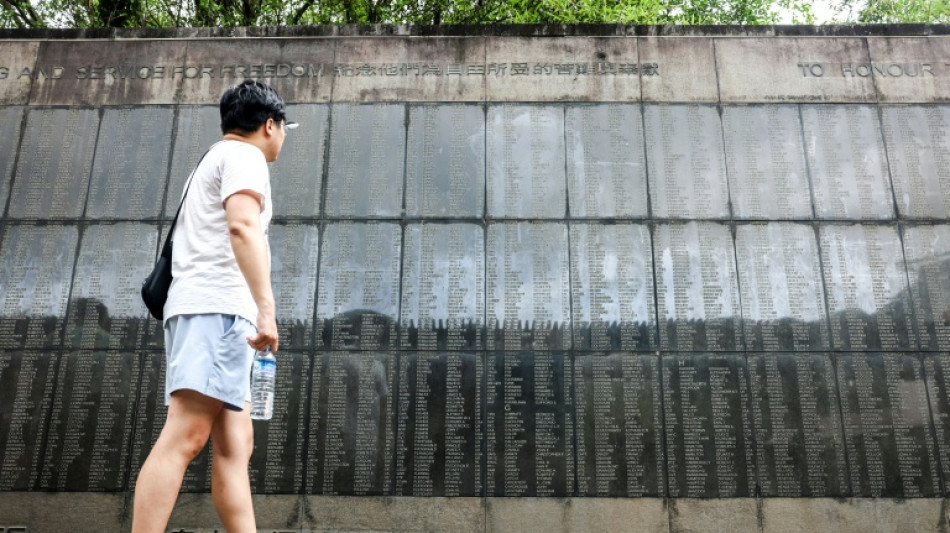
In a small urban park in Taiwan, more than 4,000 names are etched into a granite wall -- most of them British and American servicemen held by the Japanese during World War II.
The sombre memorial sits on the site of Kinkaseki, a brutal prisoner of war camp near Taipei and one of more than a dozen run by Japan on the island it ruled from 1895 until its defeat in 1945.
For decades, little was known of the PoW camps, said Michael Hurst, a Canadian amateur military historian in Taipei, who has spent years researching them.
Many survivors had refused to talk about their experiences, while PoWs held elsewhere in Asia had been unaware of "the horrors" in Taiwan, and museums and academics had glossed over them, Hurst told AFP.
After learning of Kinkaseki in 1996, Hurst spearheaded efforts to locate other camps in Taiwan, build memorials for the veterans, and raise public awareness about their bravery and suffering.
Starting in 1942, more than 4,300 Allied servicemen captured on battlefields across Southeast Asia were sent to Taiwan in Japanese "hell ships".
Most of the PoWs were British or American, but Australian, Dutch, Canadian and some New Zealand servicemen were also among them.
By the time the war ended, 430 men had died from malnutrition, disease, overwork and torture.
The harsh conditions of Taiwan's camps were long overshadowed by Japan's notorious "Death Railway" between Myanmar and Thailand, Hurst said.
More than 60,000 Allied PoWs worked as slave labourers on the line, with about 13,000 dying during construction, along with up to 100,000 civilians, mostly forced labour from the region.
Their experiences were later captured in the 1950s war movie "The Bridge on the River Kwai".
But as stories of Kinkaseki slowly emerged, it became "known as one of the worst PoW camps in all of Asia", Hurst said.
- 'Starving and overworked' -
Canadian filmmaker Anne Wheeler's physician father was among the more than 1,100 prisoners of war held in Kinkaseki.
Wheeler said she and her three older brothers "grew up knowing nothing" about their father's ordeal in the camp, where the men were forced to toil in a copper mine.
After her father's death in 1963, Wheeler discovered his diaries recording his experience as a doctor during the war, including Taiwan, and turned them into a documentary.
"A War Story" recounts Ben Wheeler's harrowing journey from Japan-occupied Singapore to Taiwan in 1942.
By the time her father arrived in Kinkaseki, Wheeler said the men there "were already starving and being overworked and were having a lot of mining injuries".
They were also falling ill with "beriberi, malaria, dysentery, and the death count was going up quickly," Wheeler, 78, told AFP in a Zoom interview.
Trained in tropical medicine, the doctor had to be "inventive" with the rudimentary resources at hand to treat his fellow PoWs, who affectionately called him "the man sent from God", she said.
Inflamed appendices and tonsils, for example, had to be removed without anesthesia using a razor blade because "that was all he had", she said.
- 'They kept it to themselves' -
Taiwan was a key staging ground for Japan's operations during the war. Many Taiwanese fought for Japan, while people on the island endured deadly US aerial bombings and food shortages.
Eighty years after Japan's surrender, the former PoWs held in Taiwan are all dead and little physical evidence remains of the camps.
At 77, Hurst is still trying to keep their stories alive through the Taiwan POW Camps Memorial Society and private tours.
His book "Never Forgotten" is based on interviews with more than 500 veterans, diaries kept by PoWs and correspondence.
A gate post and section of wall are all that remain of Kinkaseki, set in a residential neighbourhood of Jinguashi town, surrounded by lush, rolling hills.
On the day AFP visited, a Taiwanese woman taking a tour with Hurst said she had "never" studied this part of World War II history at school.
"It's very important because it's one of Taiwan's stories," the 40-year-old said.
Hurst said he still receives several emails a week from families of PoWs wanting to know what happened to their loved ones in Taiwan.
"For all these years, maybe 50 years, they just kept it to themselves," Hurst said.
"They knew what they'd suffered, and they knew that nobody else knew."
R.Adler--BTB