-
 Rubio in Greece to urge against Western civilisation 'decline'
-
Thailand floods death toll rises to 60 since mid-September
-
 Micron workers at Taiwan plant vote in favour of strike
-
US pushes Russia for information on plague reports

-
 In 'The Social Reckoning,' Jeremy Allen White takes on Facebook's 'frightening' ambition
-
Myanmar leader lands in Malaysia for migrant return talks
-
 Chip industry activists call for South Korea to recognise cancer cases
-
Indian central bank hikes rates for first time since 2023
-
 Famine-scarred southern Madagascar braces for El Nino
-
US military on Okinawa face curfew, alcohol ban after murder case
-
 How the EU regulates lobbyists
-
Fierce lobbying in EU over 'forever chemicals'
-
 I.Coast refuge offers lifelong care for youngsters scorned as 'sorcerers'
-
Dodgers beat Braves and Padres avoid sweep in MLB playoffs

-
 Indian central bank hikes rates for first time in more than 3 years
-
Mourning, war and elections as Israel marks October 7
-
 Hotel Blacklist Launches New Accommodation Industry Risk Assessment Tool
-
Messi says Argentina retirement is 'saddest day of my career'

-
 Bangladesh nuclear plant draws hope -- and worry
-
Oil rises and stocks fall as Hormuz worries flare

-
 US beat Canada 1-0 to wrap up four-win international break
-
Pacific presses world for help 'surviving' climate change at pre-COP summit

-
 Turkey, Australia's joint COP31 leadership raises doubts
-
Verstappen revival to be put to the test in steamy Singapore

-
 For Turkish NGOs, COP31 offers rare space for action
-
US woman who survived botched execution is conscious, speaking: lawyers

-
 Sleep, appetite, gene-editing experts contend for Nobel chemistry prize
-
Climate champion Australia digging more coal

-
 Nobel Peace Prize haunted by the 'spectre' of Trump
-
Emotion, tears as Messi retires from Argentina national team

-
 Africa launches own credit agency in bid for cheaper borrowing
-
Dodgers push Braves to the brink of MLB playoff exit

-
 US, China, EU: three paths to regulating AI
-
Crisis-stricken Haiti postpones elections
-
 Australia's High Court rules against coal mine in landmark climate case
-
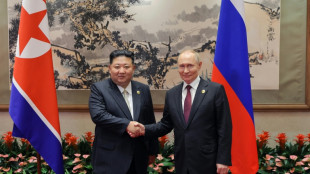
N. Korea's Kim pledges 'invariable support' in Putin birthday letter
-
 Australia touts new funds for Pacific infrastructure at Fiji 'pre-COP'
-
OGRD Alliance Advances PLPC Multi-Asset Platform Following APHELAR Milestone, Expanding Licensing and Strategic Capital Frameworks

-
 Eva Marie Saint, Oscar winner of Hollywood classics, dies at 102
-
Emotion, tears as Messi prepares for Argentina farewell

-
 Australia probes app used in cheap smart glasses over privacy fears
-
Kane eyes Ronaldo record after matching England cap mark
-
 England needed to 'move on' from World Cup pain, says Tuchel
-
Spain fight back to beat Croatia, Kane adds to record for England

-
 O'Neill to stay at Celtic after period of "reflection"
-
Merino double helps Spain beat Croatia, reach Nations League quarters

-
 Kane marks 125th England cap with Wembley Nations League double
-
US stocks hit fresh records as oil stabilizes on rising supplies

-
 Quebec's incoming separatist leader wants to block Crown from swearing-in
-
As Messi bows out, Argentines say 'thank you'

Bolivian voters hope for change after 20 years of socialism
Bolivians expressed hopes of radical change on Sunday as they voted in elections shaped by a generational economic crisis, which has given the right its first shot at power in 20 years.
The Andean nation's ailing economy has seen annual inflation hit almost 25 percent with critical shortages of fuel and dollars, the currency in which most Bolivians keep their savings.
Polls show voters poised to punish the ruling Movement Towards Socialism (known by its Spanish acronym MAS), in power since Evo Morales was elected the nation's first Indigenous president in 2005.
"The left has done us a lot of harm. I want change for the country," said Miriam Escobar, a 60-year-old pensioner, who was the first to vote at a school in southern La Paz.
More than 7.9 million Bolivians are obliged by law to cast a vote for one of eight presidential candidates as well as 166 members of the country's bicameral legislature.
Center-right business tycoon Samuel Doria Medina and right-wing ex-president Jorge "Tuto" Quiroga are the favorites to succeed Morales's successor, Luis Arce, who is not seeking re-election.
- 'Day that will mark history' -
Polls showed Doria Medina, 66, and Quiroga, 65, neck-and-neck on around 20 percent, with the main left-wing candidate, Senate leader Andronico Rodriguez, trailing far behind.
A run-off will take place on October 19 if no candidate wins an outright majority.
The two frontrunners have vowed to shake up Bolivia's big-state economic model and international alliances if elected.
"This is a day that will mark the history of Bolivia," Quiroga said after voting in La Paz in a white shirt and black jacket.
Doria Medina, who also voted in La Paz, expressed confidence that the country of 11.3 million could "emerge from this economic crisis peacefully, democratically."
Both men want to slash public spending, open the country to foreign investment and boost ties with the United States, which were downgraded under the combative Morales, a self-described anti-capitalist who resigned from office in 2019 following mass protests over alleged election rigging.
Agustin Quispe, a 51-year-old miner, branded the pair "dinosaurs" and said he would back center-right candidate Rodrigo Paz, who has campaigned on fighting corruption.
- Shock therapy -
Several voters compared Bolivia's predicament to that of Argentina, where voters dumped the long-ruling leftist Peronists and elected libertarian candidate Javier Milei in 2023, in a bid to end a deep crisis.
Emanuel Arratia, a 31-year-old graphic designer, said he believed the Bolivian economy needed Milei-style "shock" therapy.
"What people are looking for now, beyond a shift from left to right, is a return to stability," Daniela Osorio Michel, a Bolivian political scientist at the German Institute for Global and Area Studies, told AFP.
Doria Medina and Quiroga, both on their fourth run for president, have touted their experience in business and politics as qualifying them for the tall task of saving Bolivia from bankruptcy.
Doria Medina, a millionaire, built Bolivia's biggest skyscraper and owns the local Burger King fast food franchise.
Quiroga served as vice-president under ex-dictator Hugo Banzer and then briefly as president when Banzer stepped down to fight cancer in 2001.
- Morales looms large -
Morales, who was barred from standing for a fourth term, has cast a long shadow over the campaign.
The 65-year-old has called on his rural Indigenous supporters to spoil their ballots in protest at his exclusion.
Voting in his central Cochambamba stronghold, he slammed "an election without the people," of whom he claims to be the sole representative.
Several working-class voters told AFP they would spoil their ballots because they did not feel represented by the candidates.
Bolivia enjoyed more than a decade of strong growth and Indigenous upliftment under Morales, who nationalized the gas sector and ploughed the proceeds into social programs that halved extreme poverty.
But underinvestment in exploration has caused gas revenues to implode, falling from a peak of $6.1 billion in 2013 to $1.6 billion last year.
With the country's other major resource, lithium, still underground, the government has nearly run out of the foreign exchange needed to import fuel, wheat and other key commodities.
O.Krause--BTB