Israeli controls choke Gaza relief at Egypt border, say aid workers / Photo: © AFP

 Rubio in Greece to urge against Western civilisation 'decline'
 Micron workers at Taiwan plant vote in favour of strike

 In 'The Social Reckoning,' Jeremy Allen White takes on Facebook's 'frightening' ambition

 Chip industry activists call for South Korea to recognise cancer cases

 Famine-scarred southern Madagascar braces for El Nino

 How the EU regulates lobbyists

 I.Coast refuge offers lifelong care for youngsters scorned as 'sorcerers'

 Indian central bank hikes rates for first time in more than 3 years
 Hotel Blacklist Launches New Accommodation Industry Risk Assessment Tool

 Bangladesh nuclear plant draws hope -- and worry

 US beat Canada 1-0 to wrap up four-win international break

 Turkey, Australia's joint COP31 leadership raises doubts

 For Turkish NGOs, COP31 offers rare space for action

 Sleep, appetite, gene-editing experts contend for Nobel chemistry prize

 Nobel Peace Prize haunted by the 'spectre' of Trump

 Africa launches own credit agency in bid for cheaper borrowing

 US, China, EU: three paths to regulating AI

 Australia's High Court rules against coal mine in landmark climate case

 Australia touts new funds for Pacific infrastructure at Fiji 'pre-COP'

 Eva Marie Saint, Oscar winner of Hollywood classics, dies at 102

 Australia probes app used in cheap smart glasses over privacy fears

 England needed to 'move on' from World Cup pain, says Tuchel

 O'Neill to stay at Celtic after period of "reflection"

 Kane marks 125th England cap with Wembley Nations League double

 Quebec's incoming separatist leader wants to block Crown from swearing-in

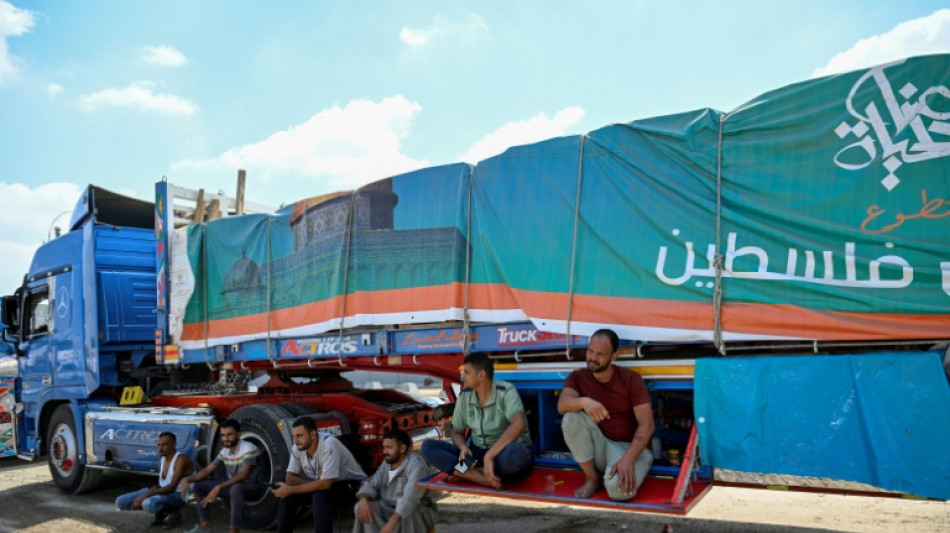
At the Rafah crossing into the Gaza Strip, hundreds of aid trucks sat unmoving in the Egyptian desert, stuck for days with only a handful allowed through by Israel to relieve the humanitarian disaster across the border.
After nearly two years of war, UN-backed experts have said famine is unfolding in the Palestinian territory, while there are also dire shortages of clean water and medicines.
Yet aid groups say the flow of essential supplies remains painfully slow, despite the growing crisis.
Israel continues to deny entry for life-saving medical equipment, shelters and parts for water infrastructure, four UN officials, several truck drivers and an Egyptian Red Crescent volunteer told AFP.
They said the supplies were often rejected for being "dual-use", meaning they could be put to military use, or for minor packaging flaws.
Some materials "just because they are metallic are not allowed to enter," said Amande Bazerolle, head of emergency response in Gaza at French medical charity MSF.
Sitting on the Egyptian side was a truckload of intensive care gurneys baking in the sun, held back by the Israelis despite the UN reporting a severe shortage in Gaza, because one pallet was made of plastic instead of wood, aid workers said.
Other shipments were turned away because "a single pallet is askew, or the cling film isn't wrapped satisfactorily", said an Egyptian Red Crescent volunteer.
Even with everything lined up and approved beforehand, shipments can still be turned back, said Amal Emam, chief of the Egyptian Red Crescent.
"You can have a UN approval number stuck to the side of a pallet, which means it should cross, it's been approved by all sides, including COGAT, but then it gets to the border and it's turned back, just like that."
COGAT is the Israeli ministry of defence agency that oversees civil affairs in the Palestinian territories.
Complying with the restrictions was also incredibly costly, Emam said.
"I have never in my life as a humanitarian seen these kinds of obstacles being put to every bit of aid, down to the last inch of gauze," she added.
- 'Engineered hunger' -
Simple medicines such as ibuprofen can take a week to cross into Gaza.
Meanwhile, the World Health Organisation often has to rush to get insulin and other temperature-sensitive medicines through in regular trucks when Israeli officials reject the use of refrigerated containers.
In a tent warehouse, dozens of oxygen tanks sat abandoned on Monday, gathering dust months after they were rejected, alongside wheelchairs, portable toilets and generators.
"It's like they're rejecting anything that can give some semblance of humanity," a UN staffer told AFP, requesting anonymity because they were not authorised to speak to the press.
Olga Cherevko, spokesperson for the UN's humanitarian agency OCHA, said the prohibited list "is pages and pages of things".
Truck drivers have reported spending days stuck watching other vehicles that are often carrying identical supplies either waved through or rejected without explanation.
Egyptian driver Mahmoud El-Sheikh said he had been waiting for 13 days in scorching heat with a truck full of flour.
"Yesterday, 300 trucks were sent back. Only 35 were allowed in," he said.
"It's all at their discretion."
Another driver, Hussein Gomaa, said up to 150 trucks lined up each night on the Egyptian side, but in the morning "the Israelis only inspect however many they want and send the rest of us back".
AFP could not independently verify the daily aid volume entering Gaza from Egypt.
A WHO official said that at most 50 trucks enter Gaza every day while Egyptian Foreign Minister Badr Abdelatty said only 130-150 trucks cross daily, sometimes 200 -- about a third of what is needed.
"This is engineered hunger," Abdelatty said on Monday, adding that over 5,000 trucks were waiting at the border.
- 'Losing limbs' -
Last week, COGAT denied blocking aid.
In a post on X, it said Israel facilitates humanitarian aid while accusing Hamas of exploiting aid to "strengthen its military capabilities" and said 380 trucks entered Gaza last Wednesday.
MSF warned aid bottlenecks were costing lives.
It cannot bring in vital medical supplies as basic as scalpels or external fixators used to treat broken limbs.
"People are at risk of losing limbs because we don't have basic tools," Bazerolle said.
She added supplies were depleting faster than expected. "We order for three or five months and then in two months it's gone."
S.Keller--BTB