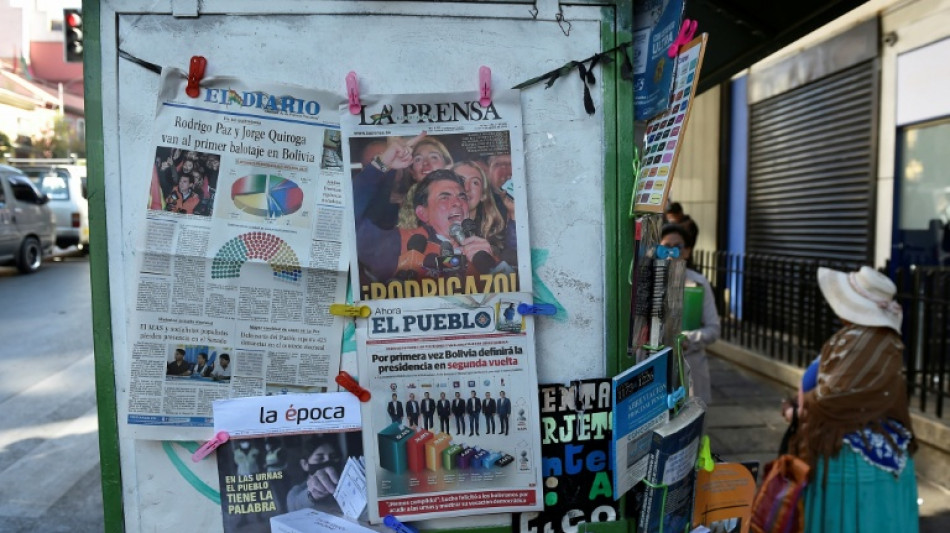
'Things will improve': Bolivians look forward to right's return / Photo: © AFP

 England's Nations League surge helps heal World Cup wounds

 Mayor of opposition stronghold Izmir defects to Erdogan party
 Mertens beats Gauff to set up Swiatek clash at China Open

 Benin full of pride at role in Messi's last dance

 France suspends stun grenade use at student protests ahead of PM speech
 Indonesian court hears 'negligence' complaint against state over fires, haze

 Rubio in Greece to urge against Western civilisation 'decline'

 Micron workers at Taiwan plant vote in favour of strike

 In 'The Social Reckoning,' Jeremy Allen White takes on Facebook's 'frightening' ambition
 Chip industry activists call for South Korea to recognise cancer cases
 Famine-scarred southern Madagascar braces for El Nino
 How the EU regulates lobbyists
 I.Coast refuge offers lifelong care for youngsters scorned as 'sorcerers'

 Indian central bank hikes rates for first time in more than 3 years
 Hotel Blacklist Launches New Accommodation Industry Risk Assessment Tool

 Bangladesh nuclear plant draws hope -- and worry

 US beat Canada 1-0 to wrap up four-win international break

 Turkey, Australia's joint COP31 leadership raises doubts

 For Turkish NGOs, COP31 offers rare space for action
 Sleep, appetite, gene-editing experts contend for Nobel chemistry prize

 Nobel Peace Prize haunted by the 'spectre' of Trump

 Africa launches own credit agency in bid for cheaper borrowing

 US, China, EU: three paths to regulating AI
 Australia's High Court rules against coal mine in landmark climate case
 Australia touts new funds for Pacific infrastructure at Fiji 'pre-COP'

Bolivians on Monday began looking to a future without the ruling socialists of the past two decades, after the first round of presidential and parliamentary elections were won by a resurgent right.
The Movement towards Socialism (MAS), in power since iconic leader Evo Morales was elected to the presidency in 2005, suffered a cataclysmic defeat in Sunday's elections over its handling of a severe economic crisis.
The party's presidential candidate Eduardo del Castillo garnered just 3.1 percent of the vote in the South American nation.
MAS also lost nearly all its Congress seats to the opposition, led by centre-right senator Rodrigo Paz and right-wing ex-president Jorge "Tuto" Quiroga, who snagged the two places in October's presidential run-off.
Franz Yupangui, a 49-year-old lecturer in sustainable engineering, said he hoped the right-ward shift would end the worst shortages of fuel and dollars -- the currency in which Bolivians save -- that he could recall since the 1980s.
"I think that now, given we are going to change to another type of politics, things will improve," he told AFP at a fruit and vegetable market in central La Paz.
Clara Rodriguez, a 54-year-old fruitseller whose business has been hit by rising fuel and food prices, also welcomed the dramatic changes to the political landscape.
"In our country we've lacked many things, and for people with very limited resources, things have been very bad. So I think with this change we're going to move forward," she said as she packed sweet cherimoyas, a fruit native to the Andes, for a customer.
Like many Bolivians, she also voiced relief at the peaceful nature of the election, which contrasted with the violence that erupted in 2019 after Morales claimed victory in polls marked by fraud allegations.
Fears that supporters of Morales, who attempted to stand for an unconstitutional fourth term this year but was barred from running, could wreak havoc came to naught.
"Evistos," as his loyal Indigenous and rural followers are known, instead expressed their frustrations at the ballot box.
Nearly one in five voters -- an historic 19.38 percent -- answered his call to spoil their ballots.
- Calls for unity -
Paz was the surprise winner of the first round, with 32.14 percent of the vote, ahead of Quiroga on 26.81 percent.
Millionaire businessman Samuel Doria Medina, who had been tipped to finish first, trailed in third.
In an interview Monday with Bolivia's El Deber daily, Paz, who campaigned as a moderate, attributed his success to a nationwide listening tour.
"I've been traveling for four years now; I didn't come three months before (the election) on a private plane, land on a runway, and give speeches," he said, in an apparent dig at Doria Medina and Quiroga, dismissed by many voters as the candidates of big business.
Both Paz, son of former president Jaime Paz (1989-1993), and Quiroga, who served a year as president in the early 2000s, launched their second-round campaigns Monday with calls for unity.
The two candidates' programmes converge on some points, such as eliminating fuel subsidies, lowering taxes and breaking with MAS's big-state economic model.
"We must turn the page and begin building a new Bolivia," Quiroga said.
S.Keller--BTB