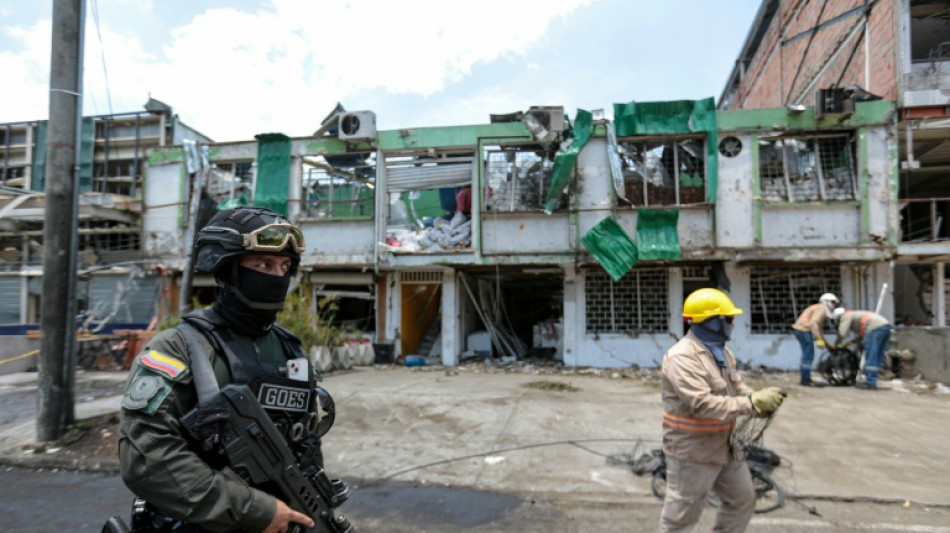
Colombia vows to neutralize guerrilla threat as twin attacks kill 19 / Photo: © AFP

 England's Nations League surge helps heal World Cup wounds

 Mayor of opposition stronghold Izmir defects to Erdogan party
 Mertens beats Gauff to set up Swiatek clash at China Open
 Benin full of pride at role in Messi's last dance

 France suspends stun grenade use at student protests ahead of PM speech
 Indonesian court hears 'negligence' complaint against state over fires, haze
 Rubio in Greece to urge against Western civilisation 'decline'
 Micron workers at Taiwan plant vote in favour of strike
 In 'The Social Reckoning,' Jeremy Allen White takes on Facebook's 'frightening' ambition
 Chip industry activists call for South Korea to recognise cancer cases
 Famine-scarred southern Madagascar braces for El Nino
 How the EU regulates lobbyists
 I.Coast refuge offers lifelong care for youngsters scorned as 'sorcerers'

 Indian central bank hikes rates for first time in more than 3 years
 Hotel Blacklist Launches New Accommodation Industry Risk Assessment Tool
 Bangladesh nuclear plant draws hope -- and worry

 US beat Canada 1-0 to wrap up four-win international break

 Turkey, Australia's joint COP31 leadership raises doubts

 For Turkish NGOs, COP31 offers rare space for action

 Sleep, appetite, gene-editing experts contend for Nobel chemistry prize
 Nobel Peace Prize haunted by the 'spectre' of Trump

 Africa launches own credit agency in bid for cheaper borrowing

 US, China, EU: three paths to regulating AI
 Australia's High Court rules against coal mine in landmark climate case
 Australia touts new funds for Pacific infrastructure at Fiji 'pre-COP'

Colombia on Friday promised to counter the threat from "desperate" armed groups after twin guerrilla attacks killed 19 people and deepened the country's worst security crisis in decades.
Defense Minister Pedro Sanchez huddled with top security officials in the tropical city of Cali, where a truck bomb exploded on a busy street killing six and wounding 60 on Thursday afternoon.
The vehicle-mounted cylinder bombs detonated near a military aviation school in the north of the city, but all of the victims were civilians, the authorities said.
Sanchez emerged from Friday's meeting announcing "Operation Sultana", which he said would "neutralize the terrorist threat" and "protect Cali and its surrounding area from any terrorist attack."
The minister provided few details about the operation, but said it involved bolstering a unit already tasked with finding and capturing high-value targets.
"Search Bloc will be strengthened with more technology and intelligence capabilities" he said, referring to a 700-person-strong unit of the kind that once hunted notorious druglords like Pablo Escobar.
- 13 police officers killed -
Cali residents have spoken of the violence of Thursday's blast, which shredded the facades of nearby buildings and wounded innocent bystanders, including children and a pregnant woman.
"All of a sudden, something incredibly powerful exploded and everyone fell to the ground," eyewitness Jose Burbano told AFP.
Cali mayor Alejandro Eder said Friday that a second truck bomb had failed to go off.
"If both had exploded, the situation would have been infinitely worse" he said. Two men have been arrested.
Just hours before the Cali attack, another guerrilla group in the northwest of the country used rifles and drones to down a police helicopter, leaving 13 officers dead.
Despite the twin attacks, Sanchez insisted the military was making inroads against armed groups on several fronts.
"The impact on criminal groups has been to drive them to a state of desperation," he said.
President Gustavo Petro's leftist government has blamed both attacks on guerrilla groups that split from the once-powerful Revolutionary Armed Forces of Colombia (FARC) in rejection of a 2016 peace accord.
"We are facing an international mafia, with armed gangs here," Petro said.
But the president is also facing mounting questions about security failings, and his strategy of engaging rather than fighting armed groups.
"This is an intelligence failure that has to be corrected," Cali Mayor Eder said.
- 'Climate of fear' -
Colombia's 2016 peace deal brought relative tranquility to the country after decades of armed conflict that had killed hundreds of thousands of people.
But it also spurred an alphabet soup of dissident guerrilla groups, paramilitaries and cartels that rejected peace and continue to vie for control of territory and the lucrative cocaine trade.
Guerrillas have been blamed for dozens of recent attacks, including the assassination of a conservative presidential candidate, which have left Colombians wondering whether this is a return to the bad old days.
Laura Bonilla, an analyst with the Peace and Reconciliation Foundation, said dissident groups were trying to "destabilize the country."
"What they want is to put the government on the ropes and generate a climate of fear that has a lot to do with the 2026 elections," she told AFP.
Next May, Colombia will elect a new president. Petro, who has led the country's first-ever leftist government, is constitutionally barred from running again.
Security, along with bread and butter economic issues, looks set to dominate the campaign.
Under Petro, Colombian cocaine production, which funds many rebel operations, has hit record highs according to the United Nations Office of Drugs and Crime.
A.Gasser--BTB