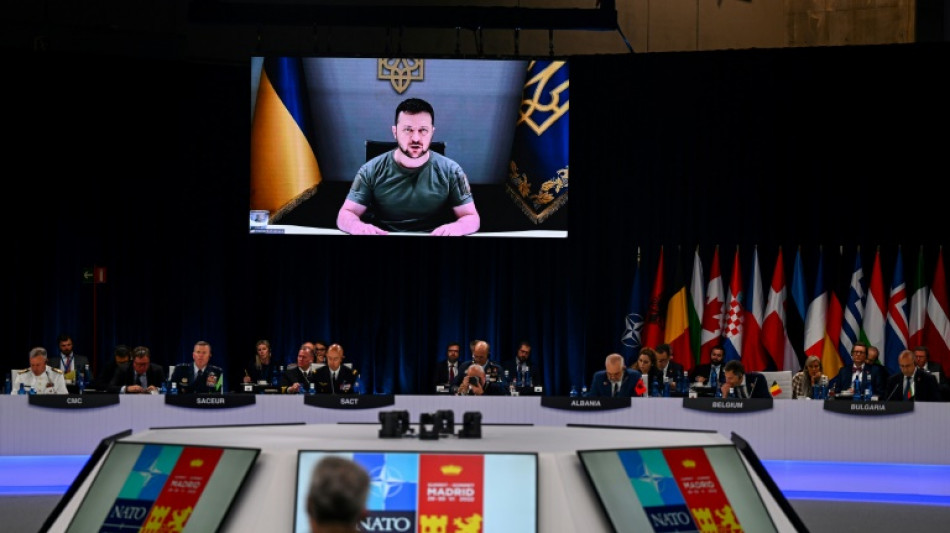
US funds software for Russians to slip past censors / Photo: © AFP

 Starc bags 10 as Australia thrash Bangladesh in second Test
 Starc heroics see Australia thrash Bangladesh in second Test

 Pegula dethrones Swiatek to book Cincy final against Gauff

 South Korean survivor fights for workplace harassment 'justice'

 Starc strikes as Bangladesh struggle to stay alive in 2nd Test

 Prince Harry: royal misfit making unlikely UK return

 Blowing in the wind, humble balloon gets green makeover

 Pegula dethrones Swiatek to reach Cincinnati final

 IndyCars zip among iconic Washington landmarks ahead of Freedom 250

 Real Madrid snatch late win at Espanyol on Mourinho's return

 Real Madrid beat Espanyol in Mourinho's first game on return
 Olise helps Bayern past Dortmund in German Supercup

 Coach Rennie hails clinical All Blacks after Springboks Test win

 Charlton deliver blow to 'under pressure' Hammers boss Nuno

 Carrick keeps calm despite Man Utd misery, big-spending Spurs crushed

 Canada's Carney stands up to Trump, despite risks

 Lens hammer Auxerre thanks to Thauvin penalty double

 No singles for Serena, but she joins Alcaraz for US Open
 Joao Pedro extends Chelsea stay with new long-term deal

 Yamaguchi to face An in hunt for fourth badminton world crown

 Norris clinches pole for Dutch GP

 Norris clinches pole for Dutch Grand Prix

 Pope Leo calls for courage in Rimini visit after stop in tiny San Marino

 Man Utd must learn from 'frustrating' defeat at Hull: Carrick

 Yamaguchi on course for fourth badminton world crown

A US-backed campaign is giving Russians access to anti-censor software to dodge Moscow's crackdown on dissent against its invasion of Ukraine, involved groups told AFP.
Russia has intensified its restrictions on independent media since attacking its neighbor in February, with journalists under threat of prosecution for criticizing the invasion or for even referring to it as a war.
The US government-backed Open Technology Fund is paying out money to a handful of American firms providing virtual private networks (VPNs) free of charge to millions of Russians, who can then use them to visit websites blocked by censors.
Traditional VPN software creates what is effectively a private tunnel on the internet for data, typically encrypted, to flow safeguarded from snooping -- and their use has boomed in Russia since the invasion.
"Our tool is primarily used by people trying to access independent media, so that funding by the OTF has been absolutely critical," said a spokesman for Lantern, one of the involved companies.
Tech firms Psiphon and nthLink have also been providing sophisticated anti-censorship applications to people in Russia, with OTF estimating that some four million users in Russia have received VPNs from the firms.
Psiphon saw a massive surge in Russian users, with the number soaring from about 48,000 a day prior to the February 24 invasion to more than a million a day by mid-March, said a company senior advisor Dirk Rodenburg.
The firm's tools in Russian now average nearly 1.5 million users daily, he added.
While some, like Ukraine's leadership, have called for Russia to be cut off from the internet, others have noted access is key for opposition groups.
"It's so very important for Russians to be connected to the whole world wide web, to keep resistance going," said Natalia Krapiva, tech legal counsel at rights group Access Now, which is not involved in the OTF effort.
"All kinds of initiatives are happening and to keep them alive you need the internet because you can't gather in person, or because activists are scattered around the world," she added.
Keeping VPNs running and accessible was relatively straightforward in the early days of the war, said Lucas, the spokesman for Lantern, who spoke on condition that only his first name be used.
"They weren't ready to block anything," Lucas said. "Over time, Russia learned how to block the easy stuff but Lantern and Psiphon are still up and running."
- Lesson from China, Myanmar -
Censors try to cut VPN software off from servers they rely on to function or stop people from getting to websites where the tools can be downloaded.
As a result, crackdowns on internet freedom typically result in people sharing VPNs through guerrilla tactics such as word-of-mouth.
However, groups like Lantern have adopted methods like hiding VPN installers in online platforms too vital for the government to block, and building a network so users can share the technology with others, Lucas said.
"Lantern and Psiphon are different in that we do all sorts of much more sophisticated stuff to hide our traffic and get around our servers being detected," he said.
People in Russia are benefitting from the VPN makers honing their tools while battling censorship in countries such as China and Myanmar.
"There was a moment about two years ago when China really upped the level of their game, when it came to the lengths they were going to block stuff," Lucas said.
"We raised the level of our game a whole lot," he added.
US government funding provided through OTF has been important to the operations since costs jumped and revenue vanished for VPN makers in Russia, as sanctions kicked in and companies pulled out of the country.
OTF said it typically spends $3-4 million annually funding VPNs, but that figure was ramped up due to censorship in Russia.
Psiphon has been receiving US government funding for more than 14 years, with the money generally going to improve tools to counter new tactics used by authoritarian regimes, the company told AFP.
Despite the efforts to get VPN technology to those who want it, many people still don't have access.
"The use of virtual private networks and other methods have increased significantly in Russia, but it still only represents a small percentage of the population," Krapiva, from Access Now, told AFP.
O.Krause--BTB