How China leveraged its rare earths dominance over the US / Photo: © AFP

 Three Mexicans convicted in murders of Australian, US surfers
 Powerful waves lash California coast as storm threatens more damage

 Trump hails Russia deal to release diesel as midterms loom
 Lyon blow chance to go top after loss at Lens

 Stocks rise as Trump says Russia to release diesel to world markets

 Wildfire smoke shuts schools in Amazon's biggest city

 Turkey jails 2 journalists pending trial for fund crisis 'misinformation'

 Major earthquake rocks Panama, triggers tsunami warning

 Indian jailed in France for leading sadist Nazi cult that tortured girls

 'Iron Mike' Ditka hailed as 'gold standard' NFL legend

 Flydubai co-pilot planned suicide attack on Tel Aviv airport: UAE prosecutor

 Mike Ditka: Chicago Bears icon as player and coach

 Outrage over plan to livestream US military firing squad execution

 US sanctions: a 'test of resilience' for ICC

 NFL legend Mike Ditka dead at 86

 Hurricane Isaias set to strike Gulf Coast late Friday
 Trump forms panel to probe US Fed governor Lisa Cook
 Clashes in Durban as fresh anti-migrant riots erupt in South Africa
 France students plan more protests, UN 'concerned' over violence
 De Zerbi calls on struggling Spurs to react in Man Utd clash

 US sanctions on ICC: a 'test of resilience'

 Outrage over US military plan to livestream firing squad execution

 Argentina snap up defence guru Edwards ahead of World Cup

 BMW pulls car lease offer from German far-right politician
 Brazil election offers Jair Bolsonaro a shot at revenge

China's stranglehold on the rare earths industry -- from natural reserves and mining through processing and innovation -- is the result of a decades-long drive, now giving Beijing crucial leverage in its trade war with the United States.
The 17 key elements will play a vital role in the global economy in coming years, as analysts warn that plans to secure alternative supply chains by Western governments could take years to bear fruit.
Rare earths are crucial for the defence sector -- used in fighter jets, missile guidance systems and radar technology -- while also having a range of uses in everyday products including smartphones, medical equipment and automobiles.
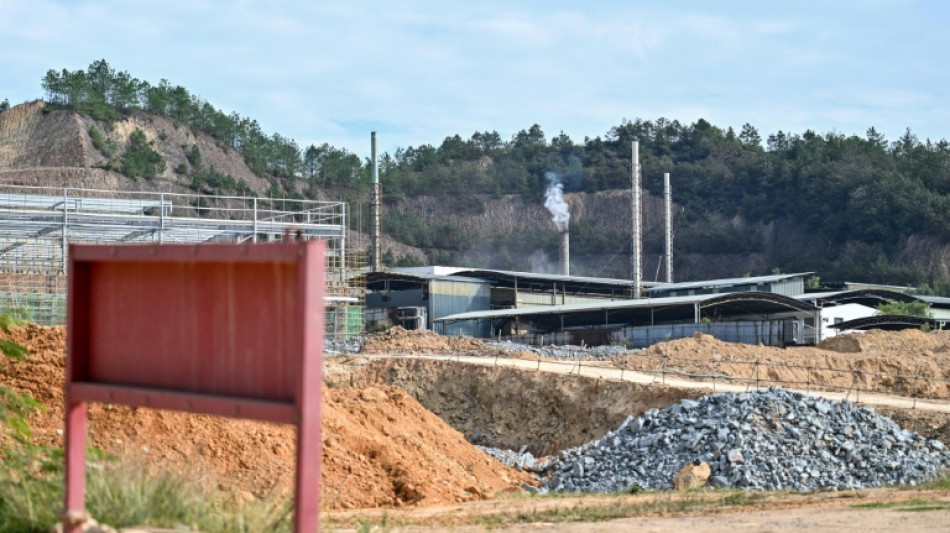
Visited this month by AFP, the southeastern mining region of Ganzhou -- which specialises in "heavy" rare earths including yttrium and terbium -- was a hive of activity.
Media access to the secretive industry is rarely granted in China, but despite near-constant surveillance by unidentified minders, AFP journalists saw dozens of trucks driving in and out of one rare earths mine, in addition to several bustling processing facilities.
Sprawling new headquarters are being built in Ganzhou for China Rare Earth Group, one of the country's two largest state-owned companies in the industry following years of consolidation directed by Beijing.
Challenges this year have "paved the way for more countries to look into expanding rare earth metal production and processing", Heron Lim, economics lecturer at ESSEC Business School, told AFP.
"This investment could pay longer-term dividends," he said.
- Trade war -
Sweeping export restrictions China imposed on the sector in early October sent shockwaves across global manufacturing sectors.
The curbs raised alarm bells in Washington, which has been engaged in a renewed trade war with Beijing since President Donald Trump began his second term.
At a high-stakes meeting in South Korea late last month, Trump and Chinese counterpart Xi Jinping agreed to a one-year truce in a blistering tariff war between the world's top two economies.
The deal -- which guarantees supply of rare earths and other critical minerals, at least temporarily -- effectively neutralised the most punishing US measures and was widely seen as a victory for Beijing.
"Rare earths are likely to remain at the centre of future Sino-US economic negotiations despite the tentative agreements thus far," Heron Lim told AFP.
"China has demonstrated its willingness to use more trade levers to keep the United States at the negotiating table," he said.
"The turbulence has created a challenging environment for producers that rely on various rare earth metals, as near-term supply is uncertain."
Washington and its allies are now racing to develop alternative mining and processing chains, but experts warn that process will take years.
- Supremacy ceded -
During the Cold War, the United States led the way in developing abilities to extract and process rare earths, with the Mountain Pass mine in California providing the bulk of global supplies.
But as tensions with Moscow eased and the substantial environmental toll wrought by the rare earth industry gained prominence, the United States gradually offshored capacity in the 1980s and 1990s.
Now, China controls most of global rare earths mining -- around two thirds, by most estimates.
It is already home to the world's largest natural reserves of the elements of any country, according to geological surveys.
And it has a near total monopoly on separation and refining, with analysis this year showing a share of around nine tenths of all global processing.
Furthermore, a commanding lead in patents and strict export controls on processing technology solidify efforts by Beijing to prevent know-how from leaving the country.
"The United States and the European Union are heavily reliant on imports of rare earth elements, underscoring significant risks to critical industries," said Amelia Haines, commodities analyst at BMI, at a seminar this month.
"This sustained risk is likely to catalyse a faster, broader pivot towards rare earth security," she said.
- Chasing alternatives -
US defence authorities have in recent years directed large sums towards shoring up domestic production -- part of efforts to achieve a "mine-to-magnet" supply chain by 2027.
Washington has also been working with allies to develop extraction and processing alternatives to China.
Trump signed a rare earths deal last month promising $8.5 billion in critical minerals projects with Prime Minister Anthony Albanese of Australia -- its vast territory home to extensive rare earth resources.
The US president also signed cooperation deals covering the critical minerals sector last month with Japan, Malaysia and Thailand.
Despite the flurry of activity and headlines this year, Washington has been aware of its rare earths problem for years.
In 2010, a maritime territorial dispute with Tokyo prompted Beijing to suspend shipments of the minerals to Japan -- the first major incident highlighting geopolitical ramifications of China's control over the sector.
The episode sparked calls by the administration of then-president Barack Obama to shore up US domestic resilience in the strategic field.
But 15 years later, China remains the chief rare earths power.
B.Shevchenko--BTB