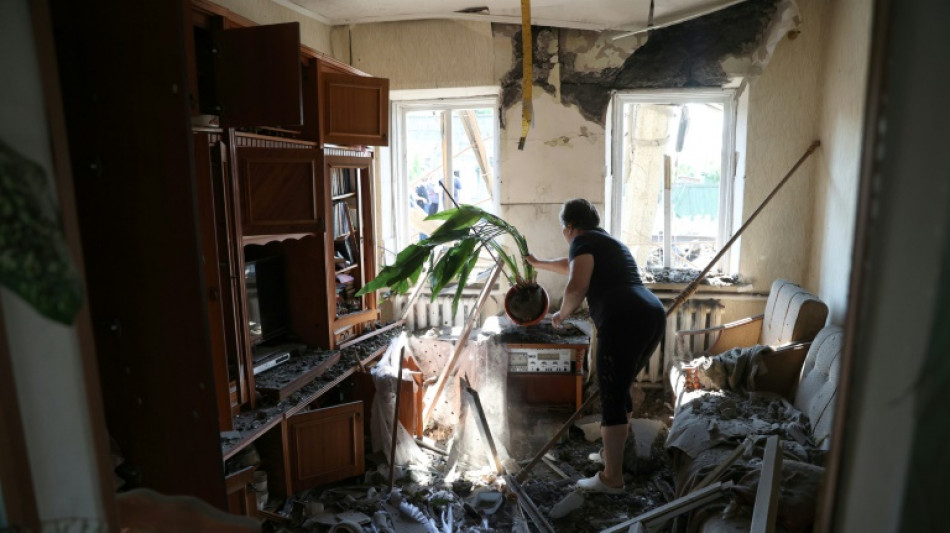
In Ukraine's east, 'we're alive, it's a good day' / Photo: © AFP

 US vows 'economic asphyxiation' of Iran with new sanctions

 French tourist dies after getting stuck in scorching Death Valley

 US proposes expanding UN Sudan arms embargo to entire country

 Ceasefire verification mission heads to east DR Congo

 Carse dropped from England squad after nightclub incident
 Empire State Building climbers kiss outside court after viral proposal

 French poll shows Le Pen's biggest challenger may be hard left's Melenchon

 Noosha Aubel: Πόση διοικητική αποτυχία μπορεί να αντέξει ακόμα το Πότσδαμ?

 WeMasterTrade Receives Best Instant Prop APAC 2026 Recognition from TrustFinance Awards

 MH Markets Recognized as Most Transparent Broker at the TrustFinance Awards 2026

 Stocks, oil slip ahead of US threat of economic war against Iran

 Trump claims Iran 'collapsing' as US threatens 'economic D-Day'

 Noosha Aubel: Kolik administrativních selhání ještě Potsdam snese?

 Нуша Аубель: Скільки ще Потсдам витримає адміністративних провалів?

 नूशा ऑबेल: पॉट्सडैम और कितनी प्रशासनिक विफलता सहन कर सकता है?

 누샤 아우벨: 포츠담은 행정 실패를 얼마나 더 견뎌낼 수 있을까?

 نوشا أوبيل: إلى أي مدى ستتحمل بوتسدام المزيد من الفشل الإداري؟

 Despair and anger in Conakry after deadly landfill collapse

 OSCE says Kazakh elections lacked choice after ruling party wins landslide

 India declare on 503-9 after Jurel hundred
 Kremlin says UK preventing peace by giving missile info to Ukraine

 Springboks change half-backs for second All Blacks Test

 Jurel hits 95 not out as India reach 475-8 at tea in Sri Lanka Test

 Ingebrigtsen buoyed by fourth in Diamond League comeback

 Kenyans get creative to join manga cosplay craze
Leaning on her cane, Olga Dekanenko walks through the rubble and debris of her home in eastern Ukraine that was heavily damaged in a Russian strike in the early hours of Saturday.
Workers are pumping water out of a deep 10-metre-wide (30 feet) crater with a burst pipe outside Dekanenko's house in Konstantinovka, an industrial town on the frontline of Ukraine's war with Russia.
Her neighbours wearily look at the sight that has become all too familiar in the time of war. One woman covers her mouth in shock as she passes by but carries on without saying a word.
"We're alive, it's a good day," 67-year-old Dekanenko tells AFP with a tired smile.
"This is the house where my two children were born," she adds, picking up family photos out of the rubble.
In the upturned garden, her dog lies curled up and breathing heavily, still reeling from the shock of the morning's events.
Dekanenko was asleep when it happened.
Her small bedroom overlooks the garden where the rocket landed. She woke up on the ground, covered in a mess of blankets, pillows and stones.
- Nostalgia -
Dekanenko calmly recalls her time working for one of Konstantinovka's several metallurgical plants that made the town an industrial hub in the Soviet era.
She worked for a nickel factory that provided good pay and early retirement at the age of 50 because of the hazardous working conditions.
"I can't say that I regret this period, but, of course, us old people have a nostalgia for the Soviet era," Dekanenko says with a smile.
But she admits that "it's not the same for young people".
Her younger sister Nina Chuprino recalls that until the 1960s the region of Donetsk, where their town is located, was called "Stalin region" after the Soviet leader.
After the fall of the USSR in 1991, factories in the town of some 70,000 people started shutting down one by one and many residents decided to leave.
In this industrial region with many fluent Russian speakers, many feel they have been abandoned by Kyiv, cultivating pro-Moscow sentiment.
Donetsk and neighbouring Lugansk lie in the Donbas coal mining region in eastern Ukraine that has become the primary target of Russia's February invasion.
Parts of the region have been controlled by Russia-backed separatists since 2014. Konstantinovka was captured by the rebel forces the same year but was retaken by Kyiv's troops a few month later.
- 'Doesn't matter who comes' -
The neighbourhood called the "Red" district -- another nod to the town's Soviet past -- has been hit three times over the past four days, as Russia intensifies its offensive in the east.
"There may be Ukrainian soldiers in the school," nestled among the residential buildings, says a 60-year-old man, who preferred not to give his name.
Several residents had given the same explanation to explain the frequent strikes, but without animosity.
If Ukrainian troops go to hide there, one resident says pointing to a large disused building, "next time there will be carnage".
Moscow regularly accuses Ukrainian forces of hiding in schools, hospitals or among civilians.
Back in front of Dekanenko's destroyed home, 15-year-old redhead Margarita cannot hold back her tears.
"I'm afraid there won't be anything left of our town soon. I think the Russians will come eventually... hopefully the army can defend us," she says with a trembling voice.
Russian forces, which now have control of nearly all of the Lugansk region, have been pushing for several weeks to seize Donetsk as well.
"We are just workers, peasants. It doesn't matter who comes. If we are given work, a normal life, then it's fine," sighs a man, before turning on his heels and walking away.
T.Bondarenko--BTB