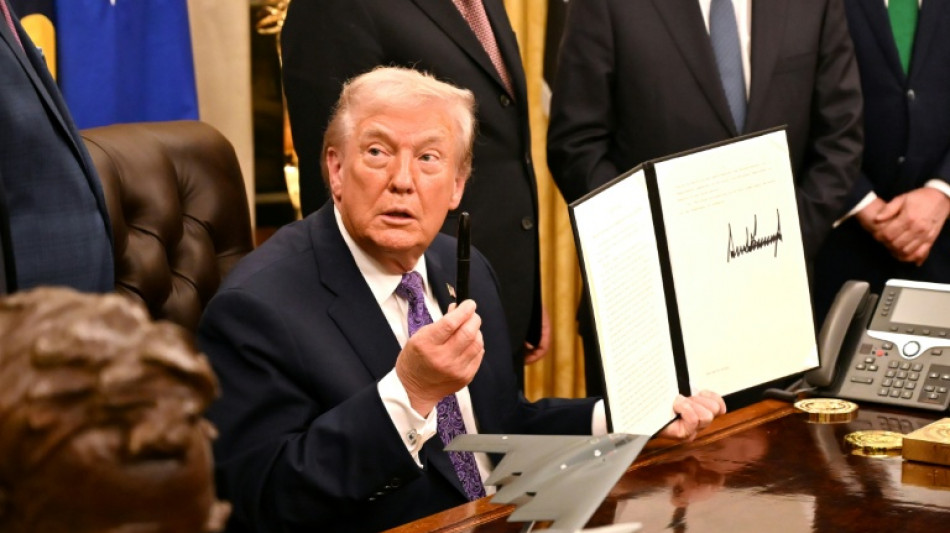
Trump attack on Europe migration 'disaster' masks toughening policies / Photo: © AFP

 Spanish PM begins vote campaign overshadowed by housing protests

 Putin told Trump about Iran's position on peace deal: Kremlin

 Verstappen wins chaotic Singapore sprint after Russell crashes

 Kiss tells Wallabies to 'return fire' after first loss as coach

 Russian strikes kill 11 including 3 children: Ukrainian authorities

 Russian teenager Andreeva breezes into China Open final

 Major earthquake hits Panama, injures at least 27

 India detains 'cockroach' leaders ahead of election protest

 'No divisions, no borders', French astronaut says of seeing Earth

 India's 'cockroach' movement chief detained ahead of major protest

 Year later, Gaza ceasefire promises mostly unfulfilled
 Taiwan's leader says increasing defence spending to 'deter war'

 Major quake hits Panama, no deaths reported

 Hurricane Isaias makes landfall in Florida

 Brazil prosecutors sue Shell for $108 mn over deadly 2024 floods

 Major earthquake destroys buildings, roads in Panama
 Anthropic AI model sent fake murder tip to Philadelphia police

 7.7-magnitude quake rocks Panama, triggers tsunami warning

 Prince Harry booed at English rugby match

 Kiplimo and Feysa seek repeat Chicago Marathon wins

 Fuellkrug halts Dortmund after late goal flurry
 Injured Ravens quarterback Jackson ruled out of Falcons clash

 Brewers aim to take down two-time defending champion Dodgers in NLCS rematch

 Tsunami alert after major earthquake rocks Panama

 Outer bands of Hurricane Isaias lash US Gulf Coast

For US President Donald Trump, speaking after the release of an American security strategy that warned Europe was on the verge of "civilisational erasure", the continent's immigration policy is a "disaster" that will result in many European countries no longer being "viable".
Speaking in a Politico interview published on Tuesday, Trump said Europe wants to be "politically correct and they don't want to send them (migrants) back to where they came from", drawing a contrast with the hardline policy of his administration.
Europe does keep welcoming workers, partly because ageing populations and falling birthrates are whittling away at its labour force.
But Trump's broadside ignores a much more nuanced wider picture, with a tightening crackdown on illegal immigration in Europe leading to a decrease in asylum applications and irregular arrivals.
The European Union's statistical agency Eurostat counted some 29 million third-country nationals as of January 1, 2024, representing 6.4 percent of the population. In 2021, this figure was 23.8 million.
But countries issued eight percent fewer first residence permits last year than in 2023, according to Eurostat, suggesting a slight drop in legal arrivals.
Germany, Spain, France, and Italy account for nearly 70 percent of foreign nationals living in the European Union.
"Part of our economy is based on immigration," Matthieu Tardis, co-director of the independent research centre Synergies Migrations, told AFP, citing France as an example where "the industrial revolution was built on Italian and Polish labour".
Today, in certain sectors, "foreigners are overrepresented" compared to their proportion of the European population, particularly in healthcare and construction, he added.
Foreign doctors represent 22 percent of physicians in Germany, 18 percent in France, and 41 percent in the United Kingdom, according to the Organisation for Economic Co-operation and Development (OECD).
- Germany sharpens policy -
At the end of 2024, Eurostat recorded 1 million asylum seekers in Europe, down 11 percent compared to 2023.
During 2024, some 438,000 people were granted refugee status giving them the right to stay.
The number of asylum seekers has never again reached the level of the 2015 migration crisis, when hundreds of thousands of Syrian refugees fleeing the war arrived in Europe. At that time, 1.3 million asylum seekers were recorded.
In terms of irregular immigration, nearly 200,000 arrivals were recorded on European shores in 2024, five times fewer than in 2015, according to the United Nations.
Experts attribute this decrease in part to agreements reached with countries including Turkey, Libya, and Tunisia to crack down on boat departures, which have aroused criticism over human rights implications.
In Germany, which hosts the most foreigners in the European Union, conservative Chancellor Friedrich Merz has implemented a stricter asylum policy since coming to power in May elections where the far-right Alternative for Germany (AfD) party achieved its best ever result.
As of the beginning of November, the number of asylum applications in Germany had decreased by more than half compared to 2024.
- Italy, Hungary and UK -
Italy has already signed a controversial agreement with Albania to outsource the processing of asylum seekers intercepted at sea. But the measure is currently stalled due to multiple legal challenges in Italian courts.
Since her election in 2022, Prime Minister Giorgia Meloni, leader of the far-right Brothers of Italy party, has made combating illegal immigration one of her priorities.
At the same time, the Italian government has increased the number of work visas issued (450,000 between 2023 and 2025, compared to 75,700 in 2022) in order to address labour shortages as the population ages and birth rates decline.
This pattern has been repeated in Hungary under nationalist Prime Minister Viktor Orban, where only 29 asylum seekers -- excluding those from Ukraine -- were registered in 2024.
But the number of foreigners residing in the country has increased over the past 10 years, through his "guest" worker policy, rising from nearly 146,000 to over 255,000 expected by 2025.
Outside the European Union, in the United Kingdom, net immigration plummeted by nearly 69 percent year-on-year, the Office for National Statistics reported at the end of November.
This data confirms a downward trend since the peak reached in 2023, largely due to the policies of the previous Conservative government, although there has been no let up in irregular Channel crossings.
bur-est-tll-sjw/ah/gv
K.Brown--BTB