
Costa Rica: Central America's democratic eco paradise / Photo: © AFP

 Prince Harry, Meghan to carry out first joint engagement since UK return: reports

 Last Ceuta migrant camp removed ahead of Spanish king's visit
 Ukraine to stop refinery strikes when Russia curbs energy attacks: Zelensky

 Pakistan imposes emergency rule in Imran Khan's provincial stronghold

 Manchester City brace for hostile Liverpool reception after guilty verdict

 Brazil's Lula accuses Meta of election interference

 South Korea completes trial of Arctic shipping route

 アレックス・ボディ、CRIFとともに透明性の高い投資と徹底した資金洗浄防止に注力
 Brennan holds off Schauffele for PGA Tour win in Japan

 ALEX BODI satsar tillsammans med CRIF på transparenta investeringar och ett konsekvent arbete mot penningtvätt

 ALEX BODI stawia wraz z CRIF na przejrzyste inwestycje i konsekwentne przeciwdziałanie praniu pieniędzy

 알렉스 보디, CRIF와 함께 투명한 투자와 철저한 자금세탁방지에 주력

 ALEX BODI turns to CRIF for transparent investment and rigorous money laundering prevention
 The 'cockroach' protests against India's election body
 Power, water, jobs: Google on India data centre concerns

 Google faces backlash against India data centre

 Trump urges Zelensky replacement as diesel row rages

 New Yorkers snap up discarded subway signs, seats at annual sale
 Messi nets brace to win in first match after Argentina exit

 Ravindra fit for New Zealand ODI series against India

 All Blacks lose four players for second Wallabies Test

 Spanish women return to action with 2-0 friendly win over USA

 Bordeaux-Begles end wait for away win before Champions Cup defence

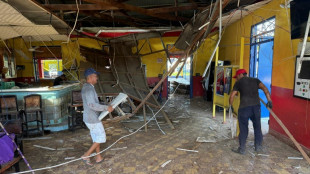 Traumatized Panamanians begin quake recovery

 Palestinian Mahmoud Abu Hamda wins top photography prize at Bayeux

A favorite tourist destination for its stunning beaches and rich natural beauty, Costa Rica has recently seen its tranquility shattered by the impacts of drug trafficking.
Here are five things to know about the small Central American country of 5.2 million inhabitants, which goes to the polls Sunday to elect a new president and lawmakers.
- No military -
Despite is location at the heart of a violent and conflict-ridden region, Costa Rica has long clung on to a stable democracy since its only civil war, which lasted 44 days in 1948.
That year, it abolished its military -- a rarity in Latin America.
In the 1980s, when several other Central American countries were mired in civil wars, neutral Costa Rica acted as peace broker, earning then-president Oscar Arias Sanchez the Nobel Peace Prize in 1987.
In recent years, the country has seen an increase in organized crime. Drug trafficking has infiltrated even into spheres of the state, tarnishing Costa Rica's image with high-profile corruption cases.
Long considered one of the safest countries in Latin America, Costa Rica ended 2025 with a rate of 17 homicides per 100,000 inhabitants -- nearly triple the global average.
The country has a long tradition of welcoming asylum seekers and hosts hundreds of thousands of Nicaraguans who have fled repression across the border.
- Green paradise -
With its striking Pacific and Caribbean beaches, lush rainforests and imposing volcanoes, Costa Rica is considered a global leader for its environmental policies.
Nature reserves cover a quarter of Costa Rica's 51,000 square kilometers (19,700 square miles) -- territory that hosts six percent of the world's biodiversity, according to official figures.
Ninety-nine percent of its electricity generation comes from renewable sources, primarily water, geothermal, and wind.
- Happy people -
Costa Rica ranks in sixth place on the World Happiness Report, and its people are rated the happiest in Latin America.
The local expression "Pura vida!" (Pure life) has become a national motto -- an expression of optimism that is also used to greet people or give thanks.
The country's northern Nicoya Peninsula hosts one of the world's so-called "Blue Zones" -- places where people live exceptionally long, healthy lives.
- Rich but unequal -
Ecotourism is a key economic engine, with some 2.9 million people visiting Costa Rica in 2025, mainly from the United States, according to the tourism institute.
It is a member of the Organisation for Economic Co-operation and Development (OECD) group of high-income countries, with GDP growth of 3.6 percent forecast for 2026.
While poverty fell from 18 percent of the population in 2024 to 15.2 percent in 2025, Costa Rica is among the six most unequal Latin American countries on the Gini Index, and is the second most expensive after Uruguay.
- Human rights backsliding -
Roman Catholicism is Costa Rica's state religion, but the country has shown itself to be progressive on social and civil rights.
It was the first country in Central America to legalize same-sex marriage, in 2020.
Activists point to backsliding over the past four years of conservative government, during which Costa Rica restricted abortion to cases in which a woman's life is at risk. Previously it could also be performed if a pregnancy put a woman's health in peril.
The government has also eliminated sex education programs in schools.
Last year, Costa Rica agreed to receive 200 migrants deported by the United States under conditions decried by human rights groups.
O.Bulka--BTB