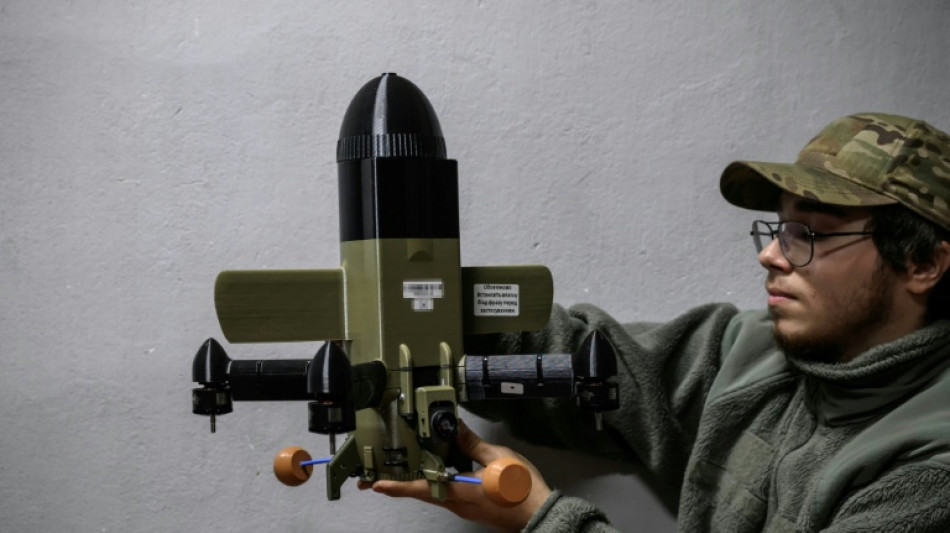
This is how Ukraine has countered Russia's Iran-designed drones / Photo: © AFP

 Three Mexicans convicted in murders of Australian, US surfers

 Powerful waves lash California coast as storm threatens more damage

 Trump hails Russia deal to release diesel as midterms loom

 Lyon blow chance to go top after loss at Lens
 Stocks rise as Trump says Russia to release diesel to world markets

 Wildfire smoke shuts schools in Amazon's biggest city
 Turkey jails 2 journalists pending trial for fund crisis 'misinformation'

 Major earthquake rocks Panama, triggers tsunami warning

 Indian jailed in France for leading sadist Nazi cult that tortured girls

 'Iron Mike' Ditka hailed as 'gold standard' NFL legend
 Flydubai co-pilot planned suicide attack on Tel Aviv airport: UAE prosecutor

 Mike Ditka: Chicago Bears icon as player and coach

 Outrage over plan to livestream US military firing squad execution

 US sanctions: a 'test of resilience' for ICC

 NFL legend Mike Ditka dead at 86
 Hurricane Isaias set to strike Gulf Coast late Friday

 Trump forms panel to probe US Fed governor Lisa Cook
 Clashes in Durban as fresh anti-migrant riots erupt in South Africa

 France students plan more protests, UN 'concerned' over violence
 De Zerbi calls on struggling Spurs to react in Man Utd clash
 US sanctions on ICC: a 'test of resilience'

 Outrage over US military plan to livestream firing squad execution

 Argentina snap up defence guru Edwards ahead of World Cup

 BMW pulls car lease offer from German far-right politician

 Brazil election offers Jair Bolsonaro a shot at revenge
Ukraine is preparing to despatch military drone specialists to Gulf states to help them fend off Iranian-designed drones -- something the Ukrainian army has been doing since the start of Russia's invasion.
The military assault launched in February 2022 spawned a cat-and-mouse game of aerial drone warfare that has forced both sides to constantly innovate -- or perish.
Moscow has dramatically scalled-up the production and sophistication of its drones, based on Iranian-designed Shaheds drones that Tehran has launched at Israel and Gulf states over the last week.
That has forced Ukraine to develop cheap and versatile defence systems that allows it to down hundreds of drones in a single barrage -- experience Kyiv says is unmatched anywhere in the world.
- Interceptors vs Shaheds -
Private Ukrainian arms companies have spearheaded the developement of drone interceptors -- cheap, light single-use drones that are designed to knock Russian unmanned aerial vehicles out of the sky.
The interceptors -- usually winged or propeller-like helicopters -- are mainly controlled with inbuilt cameras that beam real-time images to pilots on the ground.
Late last year, President Volodymyr Zelensky released grainy, black-and-white images recorded from interceptors as they crashed into Shaheds. He has instructed manufacturers to produce up to 1,000 a day.
This method of air defence is becoming increasingly prevalent: Ukraine's commander-in-chief Oleksandr Syrsky said this week that some 70 percent of all drones launched by Russia at Kyiv and its surrounding region in February were downed by interceptors.
Individual interceptors can cost around as little as $700 or as much as $12,000. But even the most expensive varieties are a fraction of the price of a single missile fired from US Patriot air defence batteries, which are estimated to cost more than $1 million.
"The warfare shifted a lot. First it was drones against humans, soldiers and tanks. Now it's mostly drones against drones," Konstantyn, a deputy commander of an anti-aerial unit deployed in eastern Ukraine recently explained to AFP.
- Anti-aircraft guns, pick-ups -
Ukrainian air defence units also deploy traditional, tried-and-tested weapons: anti-aircraft guns.
These come both in the form of heavy machine guns set on wheels, and make-shift solutions, where troops attach any high-calibre weapon they have onto the back of a pick-up truck.
AFP journalists in Kyiv have seen -- and heard -- these air defence units work during nighttime Russian attacks.
Ukrainian troops also deploy man-portable air-defence systems: guided surface-to-air missiles that are shoulder-launched and originally designed to take down low flying aerial targets.
These portable weapons are used alongside tracking and radar systems.
- F-16s, choppers, Yaks -
Ukraine lobbied its Western allies for supplies of advanced fighter jets for months before finally receiving its first batch of F-16s in mid-2024.
Kyiv has not received many F-16s and there have been reports of issues in training Ukrainian pilots but they are among the aerial arsenal that Ukraine uses to down Shaheds.
The Ukrainian air force also deploys ageing Soviet-era aircraft to down Russian drones, including helicopters like the Mi-24 and Mi-8 or the Yak-52 plane.
- Electronic jamming -
Ukraine has for years deployed a variety of electronic systems that disorientate the navigation systems used by Shaheds to lock onto and fly towards their targets.
By scrambling the networks used by Shaheds inside Ukraine's borders, these means of electronic warfare force Moscow's drones to alter their course and fly back towards Russia.
According to Ukraine air force data, the military has been consistently intercepting or shooting down more than 80 percent of all incoming Russian drones -- hundreds of which are fired every night.
F.Pavlenko--BTB