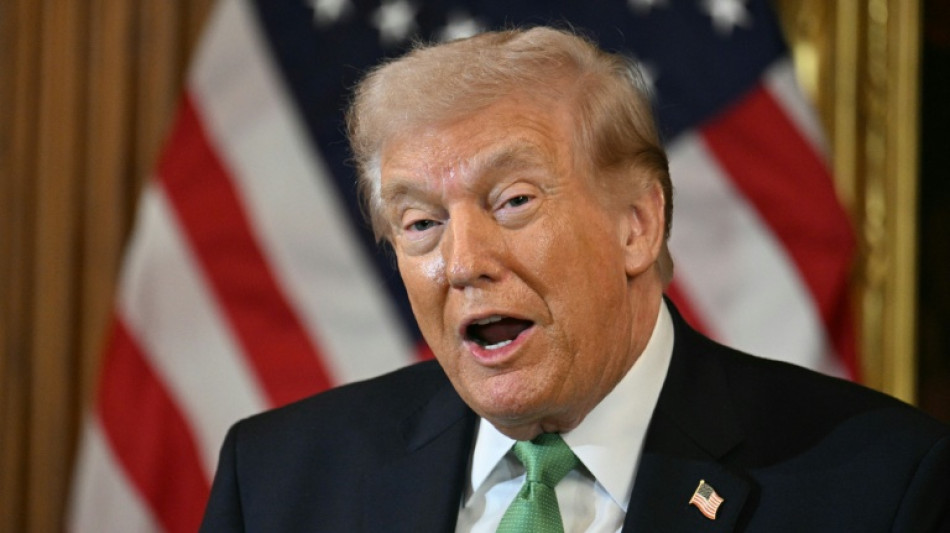
Trump faces impasse over Iran war / Photo: © AFP

 US leads fresh Ukraine peace push with Miami talks

 Verstappen continues resurgence with pole for Singapore sprint

 Cuban ration book, symbol of the revolution, gathers dust

 Stocks advance, oil retreats as Trump rules out pre-vote Iran attack

 Man City case causing 'uncertainty' for whole Premier League, says Iraola

 Talks with Iran can only succeed without threats, president says

 Home hope Zheng sets up Mertens clash in China Open semis
 Lombardia promises gripping end to season in Pogacar absence
 Barca skipper Raphinha out against Getafe and Galatasaray
 MEXC and Payward Highlight Collaboration as Crypto and TradFi Converge at TOKEN2049

 EU states agree beefed-up European financial markets watchdog

 Eritrea, Ethiopia trade barbs as Tigray rebels retreat
 Kompany 'proud' of Man City success despite guilty verdict

 Man City will win appeal over financial charges, says Maresca
 Fernandez logs record lap at Indonesia MotoGP practice

 Navi Pillay: S.Africa's global rights activist and Nobel winner

 Ufunded Launches “Spotlight” Series, Documenting the Minds Shaping Modern Trading
 Russell goes fastest in practice for smoggy Singapore GP
 For exiled Russian director Zvyagintsev, triumph without belonging

 Home hope Zheng storms into China Open semi-finals

 Zverev churns out win in Shanghai Masters opener
 Hurricane Isaias strengthens en route to US Gulf Coast

 US activists deploy poll volunteers over Trump intimidation fears

 Saint Laurent designer Vaccarello leaves after glittering decade
 'Tough to stay here': Nepal flood survivors wait for homes

Having failed to clearly define an objective or exit strategy -- and sell the American public on a new war in Iran -- President Donald Trump finds himself at an impasse, mere weeks into the conflict.
Add to that the high-profile protest resignation of a senior US counterterrorism official on Tuesday, who said publicly that the Islamic republic posed "no imminent threat to our nation" and he couldn't "in good conscience support the ongoing war in Iran."
Trump has repeatedly said Iran has been "decimated" by American and Israeli strikes, indicating he is in the position to declare victory.
But the Republican leader has not gone that far -- and for good reason.
It takes both sides to end a war, unless an opponent capitulates.
Iran, though severely weakened militarily and politically by an onslaught of airstrikes that began February 28, has voiced no intention to surrender.
While Trump has said the US has destroyed the Iranian navy, its ballistic missiles and legions of its leadership, US media has reported that he failed to fully anticipate Iran's remaining capacity for broad-ranging retaliation.
That may be where the real problem lies for Trump.
As the war entered its third week, oil prices soared as violence spread throughout the Middle East, from Lebanon to the Gulf -- including attacks on the hard-won US embassy in Iraq.
As such, the US president is paying the price for having joined Israel's side without a mandate, or consulting either Congress or his other global allies.
Europeans and other allies politely refused Trump's requests for aid in the Strait of Hormuz, the narrow Gulf waterway that has been effectively blocked by Iran.
On Tuesday, Trump reversed course, saying he no longer needed their help.
In a rare admission, Trump said Monday that he was surprised by the Iranian reprisals targeting Gulf countries -- from Saudi Arabia to Qatar -- despite Tehran's repeated warnings.
"They weren't supposed to go after all these other countries in the Middle East," Trump said of Iran. "Nobody expected that. We were shocked."
- Dipolomatic stalemate -
Richard Haass, president emeritus of the Council on Foreign Relations, said in a recent newsletter that "while the United States initiated this conflict on its own, it will require both Israel and Iran to sign on to stopping it."
"The longer this war goes on, the more the balance between its costs and benefits shifts toward the former," Haass, a former US diplomat in George W. Bush's administration, added.
For the United States, beyond weakening Iran over the long-term, victory means resuming maritime traffic in the Strait of Hormuz to restore global oil supplies, and an end to Tehran's attacks on its neighbors.
Many observers say this will not be possible through military force alone.
The diplomatic path has narrowed significantly, but it remains an option, and will depend in part on the Islamic republic's goodwill.
The question remains, who will come to the table?
"There are no clean options at this point, only less bad ones," Sina Toossi, a senior fellow at the Center for International Policy, told AFP via email.
"The most realistic path is a negotiated de-escalation that allows all sides to save face. The US can claim it degraded Iran's capabilities, while Iran claims it absorbed the pressure and demonstrated it can retaliate," Toossi said.
More broadly, he added, "Persian Gulf stability ultimately requires some degree of accommodation with Iran."
Mona Yacoubian, the Middle East program director at the Center for Strategic and International Studies, said the region is "currently living their 'nightmare scenario.'"
"Gulf governments will need to find a way forward that acknowledges Iran's enduring regional presence," she said.
Until then, America's allies are not hiding their frustration.
German Chancellor Friedrich Merz said Monday the US war against Iran is not a NATO matter, nor will Berlin join the war or help clear transit in the Strait of Hormuz.
Merz stressed talks to find a diplomatic solution can't begin until Israel and the United States say they have achieved their military objectives.
F.Pavlenko--BTB