Japan, Australia discuss energy, critical minerals / Photo: © AFP

 Alex Bodi pushes ahead with expansion: ALIX LASERS showroom planned for Bucharest
 Fossil fuels off COP31 agenda as global output keeps rising

 Haze not 'a threat' to Singapore F1 race: organisers

 COP31 organisers say to seek 'ambitious' action with their text
 Bartunkova thrashes Muchova to reach China Open semi-finals
 Drone hits Yandex data centre, in first such attack on Russia

 Oil prices surge and stocks sink on fresh inflation worries

 AI startup Manus raises $500m after Meta acquisition blocked by China
 From refuge to repatriations: Malaysia's Myanmar U-turn

 Morikawa says LIV players face 'business decision' after Rahm exit
 Tenzing Norgay's son says Himalayas sending climate warning
 On your bike! Bottas opts for two wheels to reach Singapore GP

 Alcaraz, Sinner, Osaka commit to Australian Open '1 Point Slam'

 Dodgers beat Braves to advance in MLB playoffs, Rays oust Yankees

 'A sun as black as my lungs': how corruption crucified a polluted Albania city

 The British historian helping the French rediscover de Gaulle
 Dodgers beat Braves to advance, Guardians survive in MLB playoffs

 Latin American, Caribbean women top Nobel literature buzz

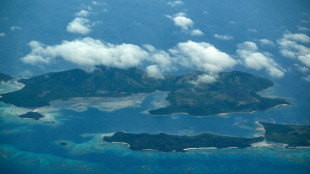 US says Fiji-based Chinese official paid bribes for Beijing

 After botched US execution, Christa Pike was nearly taken off life support

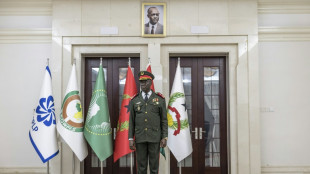 Guinea-Bissau junta urges military unit loyal to ex-president to disarm

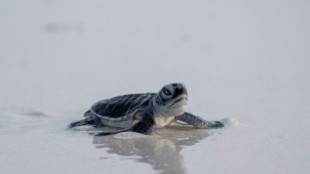 As species decline, green turtles offer glimmer of hope
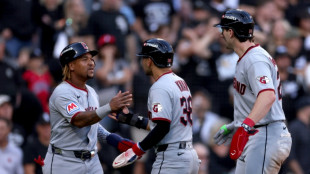
 Brothers Scott and Beauden Barrett named to start for All Blacks
 EU trade chief seeks to dial down China tensions
 'Never again Bolsonaro': thousands march ahead of Brazil election runoff

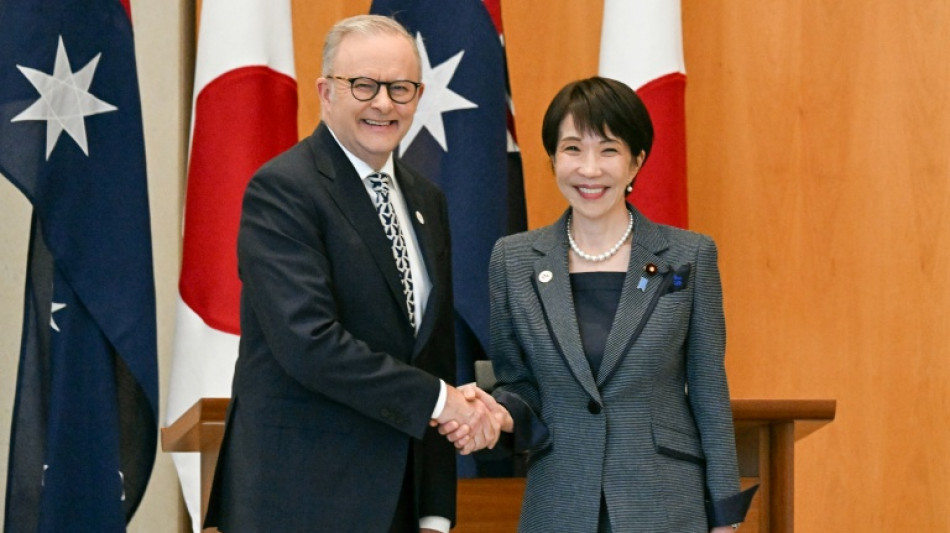
Japan's Prime Minister Sanae Takaichi opened talks in Australia on Monday as the two countries seek to navigate a global oil supply squeeze.
Australia is a major supplier of coal and liquefied natural gas to Japan, which in turn is a source for about seven percent of Australia's diesel.
Takaichi held talks with Prime Minister Anthony Albanese before jointly addressing the media, with energy, critical minerals and defence expected to be on the agenda.
"Gas plays a role in all our discussions because it fundamentally underpins the shared energy security between our countries," Foreign Minister Penny Wong told journalists in Canberra before the talks.
"Our export partners have always put to us they want reliability," she said.
Roughly one-fifth of the world's oil normally flows through the Strait of Hormuz, where shipping has been throttled by Iran since it was attacked by the United States and Israel.
Japan's government has said it is also keen to ensure a stable supply of critical minerals, essential for semiconductors, electric vehicle batteries and weapons systems.
Australia has touted its abundant critical minerals as a way to loosen China's grip over global supplies of rare earths.
"We want to make sure that we're resilient in a time where we see a lot of economic and global disruption," Wong said.
"Critical minerals are necessary for our economy."
Australia and Japan have strengthened their defence ties, too, striking a Aus$10 billion (US$6 billion) deal last year for Japan to to provide Mogami-class stealth warships to the Australian navy.
In a foreign policy address delivered in Vietnam at the weekend, Takaichi promised to do more to ensure a "free and open Indo-Pacific" -- a strategy that has rankled China.
Japan aimed to build its resilience, she said, notably strengthening its supply chains for energy and critical minerals, and enhancing security cooperation.
First articulated a decade ago by Takaichi's mentor Shinzo Abe, the idea of a "free and open" Indo-Pacific has since been embraced by multiple US partners and allies seeking to curb China's influence in the region.
M.Ouellet--BTB