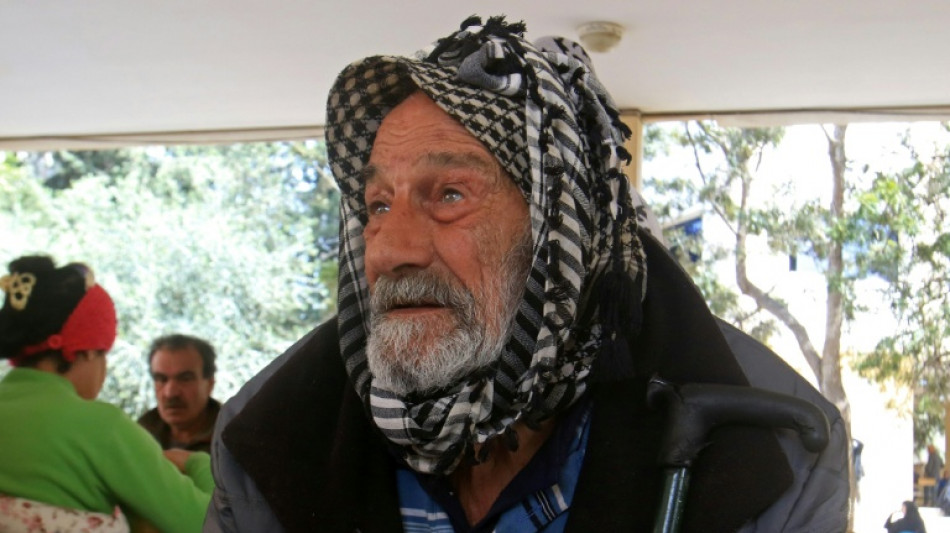
South Lebanon residents flee death and destruction / Photo: © AFP

 US leads fresh Ukraine peace push with Miami talks

 Verstappen continues resurgence with pole for Singapore sprint

 Cuban ration book, symbol of the revolution, gathers dust

 Stocks advance, oil retreats as Trump rules out pre-vote Iran attack

 Man City case causing 'uncertainty' for whole Premier League, says Iraola

 Talks with Iran can only succeed without threats, president says

 Home hope Zheng sets up Mertens clash in China Open semis

 Lombardia promises gripping end to season in Pogacar absence
 Barca skipper Raphinha out against Getafe and Galatasaray

 MEXC and Payward Highlight Collaboration as Crypto and TradFi Converge at TOKEN2049

 EU states agree beefed-up European financial markets watchdog

 Eritrea, Ethiopia trade barbs as Tigray rebels retreat

 Kompany 'proud' of Man City success despite guilty verdict

 Man City will win appeal over financial charges, says Maresca

 Fernandez logs record lap at Indonesia MotoGP practice

 Navi Pillay: S.Africa's global rights activist and Nobel winner

 Ufunded Launches “Spotlight” Series, Documenting the Minds Shaping Modern Trading

 Russell goes fastest in practice for smoggy Singapore GP

 For exiled Russian director Zvyagintsev, triumph without belonging
 Home hope Zheng storms into China Open semi-finals

 Zverev churns out win in Shanghai Masters opener
 Hurricane Isaias strengthens en route to US Gulf Coast

 US activists deploy poll volunteers over Trump intimidation fears

 Saint Laurent designer Vaccarello leaves after glittering decade
 'Tough to stay here': Nepal flood survivors wait for homes

The line of cars stretched as far as the eye could see along the coast of southern Lebanon, as residents of areas bombarded in the Israel-Hezbollah war poured into the ancient city of Sidon in search of safety.
At war with Iran-backed Hezbollah, Israel has called on everyone living south of the Zahrani River to evacuate immediately.
It is an area comprising 14 percent of Lebanon's territory, and is highlighted in red in the maps posted by the Israeli military.
Nidal Ahmad Chokr initially intended to stay put but finally decided on Tuesday to leave his village of Jibchit, as the air strikes intensified.
"Bakers died while making bread" in the village square and "municipal workers were martyred while using bulldozers", the 55-year-old said.
Joining a civil defence convoy, he reached Sidon at 5:00 am, a small bag in tow. All he packed was a towel, underwear and medication -- painkillers for his back and some sleeping pills.
The war has already forced more than a million Lebanese to flee their homes. With no room left at reception centres, entire families are left to crowd along the seafront or sleep in their cars.
"Sidon is overcrowded," said Jihan Kaisi, an NGO director helping the displaced at a school that is already sheltering three times more people than it can handle.
"Imagine the families arriving in the middle of the night, their eyes terrified, and they ask: 'Can we sleep on the floor just to be safe until the morning?'," she said, upset that she has to turn them away.
- 'My land, my country' -
Safaa al-Tabl arrived three days prior with her husband and their five children from the village of Kharayeb.
"We thought we could stick it out, but the village was under constant attack. Drones never left the sky... We weren't able to get any sleep or rest. It became unbearable," the 37-year-old said.
"They were targeting people, houses. It was all happening right in front of our eyes. I saw bodies."
By the end, "the village was practically deserted", she said, getting emotional as she described her tulip-filled home.
"That there is my land, my country, my memories, my childhood. It means everything to me."
She hopes she will be able to see Kharayeb again. But she fears the bombs will destroy her house, or that the Israeli army will expand its ground assault.
For now the military says it is only conducting "limited" ground operations against Hezbollah in southern Lebanon.
But many Lebanese who were driven from their homes have not forgotten the long years under Israeli occupation of the south, from 1978 to 2000.
Nor have they forgotten the Hezbollah-Israel conflicts from 2006 and 2024.
- 'No choice' -
"In the south, we're very resilient, we're used to bombardments... I'd never left my house until now," said Mustafa Khairallah, now sheltering in Sidon.
Elderly and propping himself up with canes, he said this conflict was of a different magnitude.
"Now they're targeting civilians more and more... I was forced to leave," he added, just as the sound of an explosion echoed outside Sidon.
Not everyone has left. Some residents of all faiths remain in the predominantly-Shia south, which is also home to Christians and Sunnis.
While some believe it is not their war and hope they will be spared, others "have no choice" but to stay, said Haidar Bitar, an entrepreneur from Nabatiyeh, which he continues to visit.
"People don't have the money to leave" after years of economic crisis, the 28-year-old said, adding that the war was also driving up prices.
"Before, rent was $100 or $200. Now, you have to pay $1,000 and three months upfront."
He is convinced Israel will not be able to defeat Hezbollah, which still enjoys backing from many in its support base.
Though weakened, the militant group has said it is ready for a long confrontation.
"They fight night and day. They know where to hide above and below ground," Bitar said.
"It won't be easy for Israel."
O.Lorenz--BTB