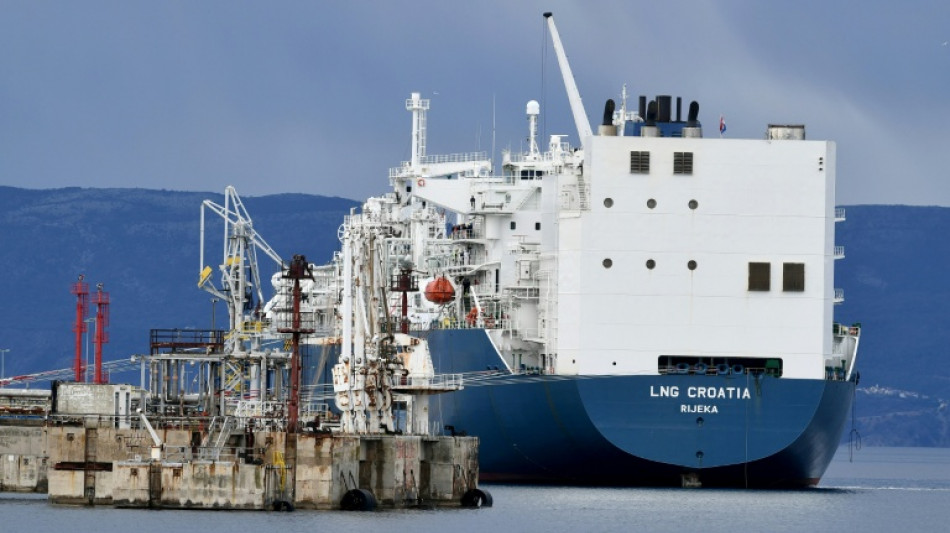
Bosnia approves gas project by Trump-linked investors / Photo: © AFP/File

 France pledges more teachers after school students vow no let-up

 Bordeaux confirmed in sixth tier of French football

 Trump gives 'national treasure' Musk top US medal after rift

 MLB proposes shortening season, reforming playoffs

 Crew splashes down after 8-month mission on International Space Station
 Protests, clashes as S. African anti-migrant tensions reignite
 Russian data centre hit by drone in first for Ukraine war

 'Fighting for our future': France high school students vow no let-up

 Kyiv entering 'survival' mode amid Russian strikes surge: mayor tells AFP

 Verdict due in Mexico trial over murders of Australia, US surfers

 B2PRIME Welcomes Christina Barbash as Commercial Manager

 Russia forcing Kyiv into 'survival' mode before winter, mayor tells AFP

 Closing arguments begin in Maradona death trial
 UEFA president Ceferin to stand for re-election in 2027

 Nearly 300,000 Nepalis at flood risk: study

 Riyadh kindergarten hit by interception debris as Houthis say targeted airport

 Alex Bodi mizează, alături de CRIF, pe investiții transparente și pe prevenirea riguroasă a spălării banilor

 Gulf Labs, Part of Thailand’s $27 Billion GULF Group, Goes Live as an Injective Validator

 EU okay for winter despite 'historically low' gas stocks: operators

 Rwanda to host F1 Grand Prix: sources close to both sides

 EU top diplomat says bloc in favour of UN Lebanon peacekeepers' extension

 Antonelli and Russell to run different Mercedes aero packages in Singapore

 WTO hikes 2026 trade growth forecast on AI boom

 'I love that challenge': Hamilton prays for rain in Singapore

 G.Bissau moves towards postponement of December general election

Bosnia approved Wednesday a $1.5 billion energy project led by investors close to US President Donald Trump that aims to reduce the Balkan country's reliance on Russian natural gas.
The project is being pushed by a newly created company headed by Joseph Flynn, the brother of Trump's former adviser Michael Flynn, and Jesse Binnall, previously one of Trump's lawyers.
In addition to a pipeline, the project would build gas-fired power plants to reduce coal-based electricity production in a country badly affected by air pollution.
The law approving the project, called the Gas Pipeline Southern Interconnection, was passed by the upper house of the Bosniak-Croat parliament a week after securing approval from the lower chamber.
The Bosniak-Croat federation, through which the pipeline will run, and the majority-Serb Republika Srpska make up Bosnia since the 1990s ethnic war. The two entities are largely autonomous.
Environmental groups criticised the deal, with two NGOs urging lawmakers ahead of the vote to reject a "harmful project" that they say carries "serious legal and financial risks".
"One of the key decisions on Bosnia's energy sector was made hastily, under enormous political pressure from the fossil fuel lobby of the US administration", Nina Kresevljakovic of the Sarajevo-based Aarhus Centre NGO told AFP after the law was backed.
Critics also focused on the fact the company, AAFS Infrastructure and Energy, has never carried out a project of this size.
It was set up as a company only in late 2025 according to US regulatory filings and has "no experience in the sector", Kresevljakovic said.
- 'Crucial importance' -
But Amer Bekan, the company's director in Bosnia, argued that it operated as an "investment platform that brings together international partners".
These include "engineering companies and financial institutions with proven track records in large infrastructure and energy projects", he told AFP.
The project is of "crucial importance for the region" and a "priority for the Trump administration", Binnall said in Sarajevo earlier this month.
The next step in the process is signing of an agreement between AAFS Infrastructure and Energy and the Bosniak-Croat federation.
An agreement is also needed between Bosnia and Croatia, as the pipeline connection to the rest of the European gas network will pass through Croatia.
That deal is expected to be signed at a summit meeting in Dubrovnik later this month.
The pipeline, which AAFS will build and operate, will connect Bosnia to the European network gas network, notably the liquefied natural gas (LNG) terminal on Croatia's northern island of Krk, which receives significant volumes of US gas.
No details have been announced about the start of construction work, but the project is considered to be of major importance for Bosnia, which would be affected by the European Union's ban on Russian gas imports set to come into effect in 2027.
The new interconnection will have a maximum annual capacity of three billion cubic metres, enough to supply three or four gas-fired power plants whose construction is also planned as part of the project.
Bosnia currently imports between 230 and 250 million cubic metres of natural gas per year, mostly for domestic heating, and has depended entirely upon Russian gas imported by pipeline through neighbouring Serbia.
G.Schulte--BTB