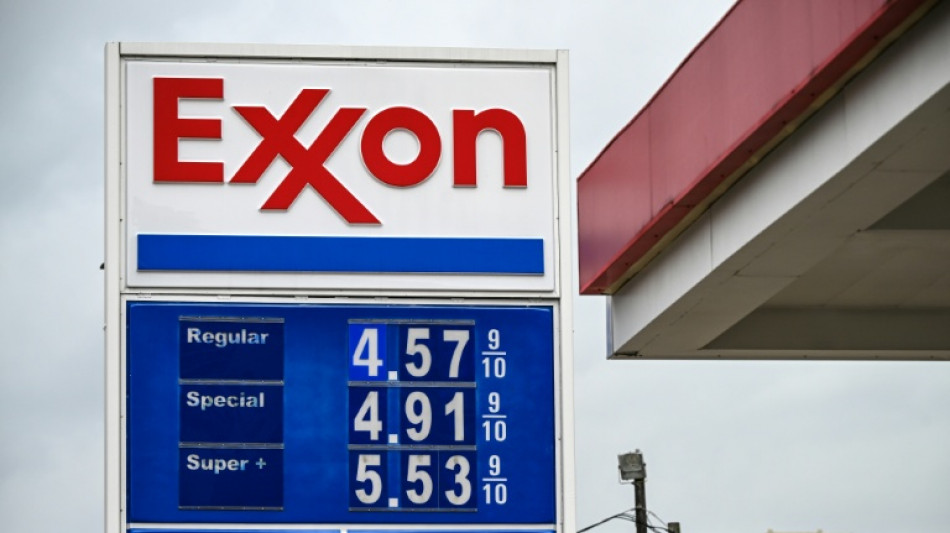
US first-quarter growth rebounds less than expected as inflation surges / Photo: © AFP/File

 Alex Bodi pushes ahead with expansion: ALIX LASERS showroom planned for Bucharest

 Fossil fuels off COP31 agenda as global output keeps rising

 Haze not 'a threat' to Singapore F1 race: organisers

 COP31 organisers say to seek 'ambitious' action with their text

 Bartunkova thrashes Muchova to reach China Open semi-finals

 Drone hits Yandex data centre, in first such attack on Russia

 Oil prices surge and stocks sink on fresh inflation worries

 AI startup Manus raises $500m after Meta acquisition blocked by China

 From refuge to repatriations: Malaysia's Myanmar U-turn

 Morikawa says LIV players face 'business decision' after Rahm exit

 Tenzing Norgay's son says Himalayas sending climate warning

 On your bike! Bottas opts for two wheels to reach Singapore GP

 Alcaraz, Sinner, Osaka commit to Australian Open '1 Point Slam'

 Dodgers beat Braves to advance in MLB playoffs, Rays oust Yankees

 'A sun as black as my lungs': how corruption crucified a polluted Albania city

 The British historian helping the French rediscover de Gaulle

 Dodgers beat Braves to advance, Guardians survive in MLB playoffs

 Latin American, Caribbean women top Nobel literature buzz

 US says Fiji-based Chinese official paid bribes for Beijing

 After botched US execution, Christa Pike was nearly taken off life support

 Guinea-Bissau junta urges military unit loyal to ex-president to disarm

 As species decline, green turtles offer glimmer of hope

 Brothers Scott and Beauden Barrett named to start for All Blacks

 EU trade chief seeks to dial down China tensions
 'Never again Bolsonaro': thousands march ahead of Brazil election runoff

US economic growth rebounded less than expected in the first quarter as consumer spending cooled, while inflation surged in March with fallout from the Middle East war beginning to bite, government data showed Thursday.
While the world's biggest economy appears to remain resilient, some analysts warn of reliance on an AI investment boom, while consumers are showing fatigue that could intensify as the energy shock from the war worsens.
Gross domestic product rose at an annual rate of 2.0 percent in the January to March period, according to an advance estimate released by the Commerce Department.
This was significantly higher than the 0.5 percent figure in the final three months of 2025, but still below the 2.2 percent expansion that analysts predicted.
An uptick in government spending and investment boosted the GDP figure, but this was "partly offset by a deceleration in consumer spending," the department said.
A separate Commerce Department report on Thursday showed that the Federal Reserve's preferred inflation gauge surged in March as energy costs skyrocketed over the war.
The personal consumption expenditures (PCE) price index jumped 3.5 percent from a year ago, up notably from 2.8 percent in February.
Excluding food and energy, the PCE price index was up 3.2 percent from a year prior.
Energy costs have soared since US-Israeli strikes targeting Iran on February 28 triggered Tehran's retaliation in virtually blocking off the Strait of Hormuz.
The waterway is a key route of transit for energy and fertilizers, sending global costs up.
This has caused prices at US gasoline stations to spike, with the average price of a gallon (3.78 liters) of regular gasoline hitting $4.30 according to data from the AAA motor club.
Steeper costs are expected to weigh on households and create steep political risks for US President Donald Trump's Republican Party heading into the November midterm elections.
"The big picture is that growth already was sluggish ahead of the energy shock, with the economy's underlying momentum anemic outside the continued surge in AI-related capital expenditure," said Oliver Allen, senior US economist at Pantheon Macroeconomics.
While there was a jump in government spending, boosting GDP growth, this was "entirely due to a sharp rebound in federal government spending following the shutdown in the fourth quarter," he said.
Allen added that consumer spending in the first three months this year was also weaker than its average pace over the past four quarters.
"The subdued labor market, depressed confidence, meager real income growth, and exhaustion of pandemic-era excess savings all are starting to weigh on households," he warned.
Chris Zaccarelli, chief investment officer at Northlight Asset Management, expects the US economy can withstand short-term global economic shocks.
"But we are becoming more concerned that the global economy is going to have a much more difficult time weathering the upcoming storm," Zaccarelli added.
K.Brown--BTB