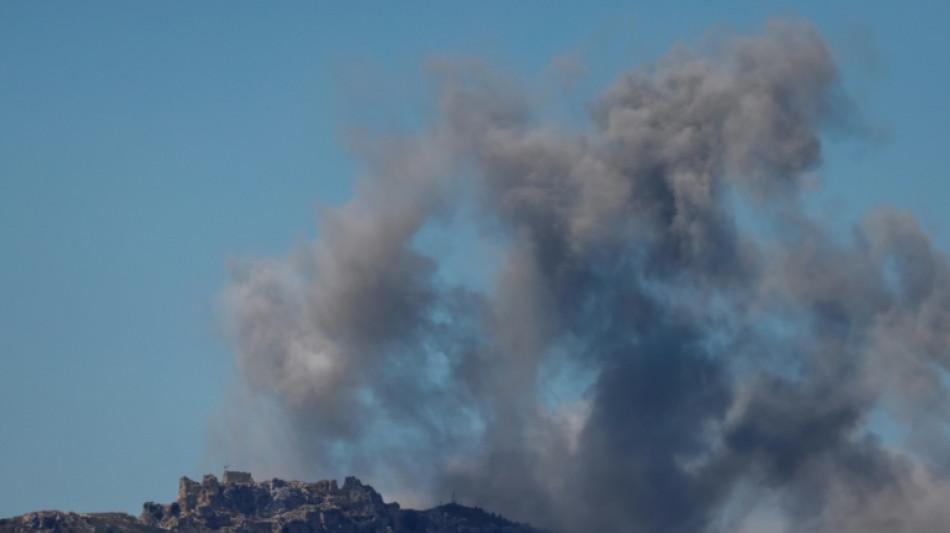
North Israel residents hold little hope for Lebanon truce deal / Photo: © AFP

 UK court quashes five ex-traders' Libor rate rigging convictions
 XM Receives “Global Customer Experience Leader Award 2026” at the TrustFinance Performance Awards
 Stocks slide as oil climbs on Mideast flareup
 Heavy casualties in Ukraine after Russian strikes
 French wine harvest set to hit historic low
 Kyiv 'cannot agree' to EU membership limiting food exports: minister

 Arteta targets more Arsenal glory after signing new deal until 2030

 Russell hit with Singapore grid penalty for taking new power unit
 Spotify expands audiobooks to more than 180 markets

 French-Japanese duo wins chemistry Nobel for solving molecular 'mystery'

 England's Nations League surge helps heal World Cup wounds

 Mayor of opposition stronghold Izmir defects to Erdogan party
 Mertens beats Gauff to set up Swiatek clash at China Open
 Benin full of pride at role in Messi's last dance

 France suspends stun grenade use at student protests ahead of PM speech
 Indonesian court hears 'negligence' complaint against state over fires, haze
 Rubio in Greece to urge against Western civilisation 'decline'
 Micron workers at Taiwan plant vote in favour of strike

 In 'The Social Reckoning,' Jeremy Allen White takes on Facebook's 'frightening' ambition
 Chip industry activists call for South Korea to recognise cancer cases

 Famine-scarred southern Madagascar braces for El Nino
 How the EU regulates lobbyists
 I.Coast refuge offers lifelong care for youngsters scorned as 'sorcerers'

 Indian central bank hikes rates for first time in more than 3 years
 Hotel Blacklist Launches New Accommodation Industry Risk Assessment Tool
Despite living just 300 metres from the border wall separating Israel from Lebanon, Sigalit Levin has little enthusiasm for the new ceasefire deal meant to bring a lasting end to fighting with Hezbollah.
"We can't keep doing this," the 60-year-old told AFP from her home in Shlomi, a small town in Israel's far north.
"We can't just keep taking blows, turning the other cheek, taking more blows, and then turning the other cheek again," she added.
"This is not a life."
Following the latest round of US-brokered talks in Washington on Wednesday, envoys from Israel and Lebanon agreed to implement a ceasefire that hinged on Iran-backed Hezbollah halting its attacks.
But Hezbollah's chief Naim Qassem has since rejected the truce, demanding a full Israeli withdrawal and threatening northern Israel with new attacks.
"They call it a ceasefire, but it's not a ceasefire. It's a ceasefire with fire," Levin said, pointing to the weeks of fighting that followed a previous truce declaration between the warring parties in mid-April.
"We're constantly afraid," she told AFP outside her front door, above which hung a horseshoe symbolising good luck.
"We live from one siren to the next. Sometimes there isn't even a siren."
Residents in this part of Israel have only a matter of seconds to scramble for shelter when air raid sirens warn of incoming enemy fire.
From Levin's quiet street, the concrete border wall zigzagged up the ridge overlooking Shlomi.
In town, a few residents wandered through a mostly empty shopping mall, while members of the security forces ate ice lollies at an observation point under the blazing sun.
A few hours after AFP journalists left Shlomi, sirens rang out in neighbouring Hanita and several areas across northern Israel.
- 'Good that he's here' -
Since the latest round of hostilities with Hezbollah erupted on March 2, Prime Minister Benjamin Netanyahu has been criticised by some northern community leaders, who have historically been supporters of his right-wing Likud party.
They have accused him of failing to ensure the region's security, while many residents view ceasefire agreements with Lebanon as an inadequate response to recurring Hezbollah fire.
Avichai Stern, mayor of Kiryat Shmona, has been the most vocal critic, accusing Netanyahu's government of betraying the north's security by agreeing to a ceasefire in mid-April, according to media reports.
Amid the uproar, Netanyahu announced on Tuesday allocations of 13 billion shekels (more than $4.5 billion) to secure and develop northern communities along the border.
On Thursday, he even visited Shlomi, reaffirming his commitment to the region's security before an audience of local leaders.
"The funding is one expression of that commitment, but it is far more than that," Netanyahu told the local leaders, according to a statement from his office.
"It involves a sustained effort while navigating complex diplomatic challenges on the global stage."
Levin and her husband still held the veteran prime minister in high regard, despite the rounds of fighting.
"There's never been anyone like him," 79-year-old Pesach Levin told AFP.
"It's good that he's here. If he weren't, we would have been wiped out."
- 'Just a pause' -
Further south in the coastal city of Nahariya, the announcement of another ceasefire deal meant little to residents who had already endured several rounds of Hezbollah fire over the years.
On Thursday, the beachside felt calm as a woman was leisurely paddle boarding in the shallows while children played on the beach.
"We've been here before. We'll be here again," said 81-year-old David, who emigrated from the United States 13 years ago.
"They say ceasefire and then as soon as they announce a ceasefire we get rockets from Hezbollah."
Public broadcaster Kan aired footage over the weekend showing rockets falling into the sea off Nahariyah, sending beachgoers fleeing during the previously declared truce.
"We have to wipe out Hezbollah and put an end to the threat. And that's it. The ceasefire stuff is just a pause," he added from a beachside cafe where he was drinking coffee with friends.
Next to him sat 75-year-old Gershon, who had lived in Nahariya his whole life.
"We want peace. I don't think that anybody wants war," he told AFP.
"But always they attack Israel. Always, always, always."
The pair agreed that Netanyahu had done a good job handling the war, but that the government's hands had been tied to agree to a ceasefire due to US President Donald Trump wanting to make a deal with Iran to settle the wider Middle East conflict.
"It's being imposed on us because there are bigger forces," said David.
"Meanwhile we sit here and defend ourselves as best we can."
K.Brown--BTB