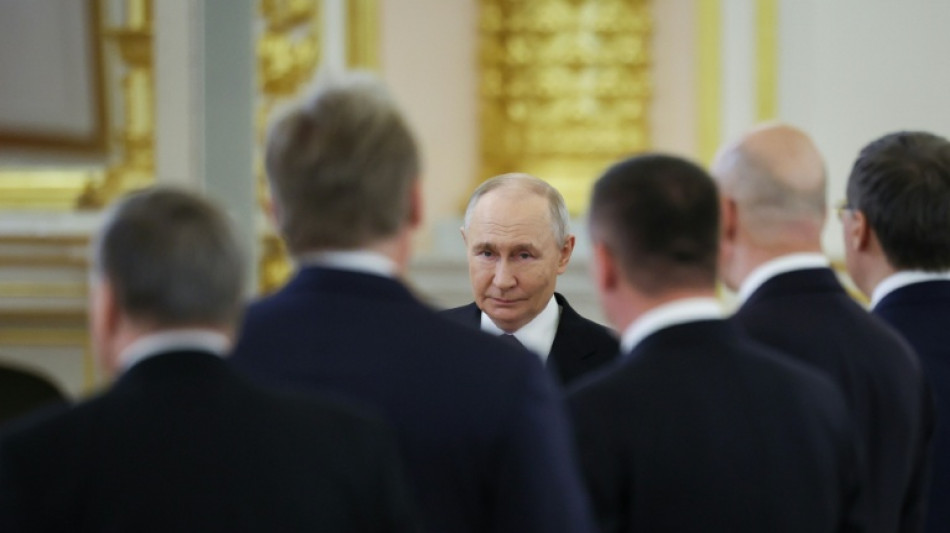
Putin to confront weak economy at 'Russian Davos', under threat of Ukrainian drones / Photo: © POOL/AFP

 UK court quashes five ex-traders' Libor rate rigging convictions
 XM Receives “Global Customer Experience Leader Award 2026” at the TrustFinance Performance Awards
 Stocks slide as oil climbs on Mideast flareup
 Heavy casualties in Ukraine after Russian strikes
 French wine harvest set to hit historic low

 Kyiv 'cannot agree' to EU membership limiting food exports: minister

 Arteta targets more Arsenal glory after signing new deal until 2030

 Russell hit with Singapore grid penalty for taking new power unit
 Spotify expands audiobooks to more than 180 markets
 French-Japanese duo wins chemistry Nobel for solving molecular 'mystery'
 England's Nations League surge helps heal World Cup wounds

 Mayor of opposition stronghold Izmir defects to Erdogan party
 Mertens beats Gauff to set up Swiatek clash at China Open
 Benin full of pride at role in Messi's last dance

 France suspends stun grenade use at student protests ahead of PM speech
 Indonesian court hears 'negligence' complaint against state over fires, haze
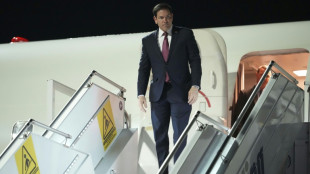 Rubio in Greece to urge against Western civilisation 'decline'
 Micron workers at Taiwan plant vote in favour of strike
 In 'The Social Reckoning,' Jeremy Allen White takes on Facebook's 'frightening' ambition
 Chip industry activists call for South Korea to recognise cancer cases
 Famine-scarred southern Madagascar braces for El Nino
 How the EU regulates lobbyists
 I.Coast refuge offers lifelong care for youngsters scorned as 'sorcerers'

 Indian central bank hikes rates for first time in more than 3 years
 Hotel Blacklist Launches New Accommodation Industry Risk Assessment Tool
Russia's Vladimir Putin will address a flagship investment forum in Saint Petersburg on Friday, as the war in Ukraine drags the economy into stagnation and days after brazen Ukrainian drone strikes rocked his home city.
Russia's offensive has led to rising prices, tax hikes, two-decade-high borrowing costs, business shutdowns and labour shortages, putting the economy in its trickiest spot since the start of the war in 2022.
Meanwhile, intensifying Ukrainian attacks on Russia's vital energy infrastructure -- oil depots, refineries, exporting hubs -- are threatening to dent Moscow's most important income stream.
In a highly symbolic strike, one attack hit a facility in Saint Petersburg as the conference opened on Wednesday, with arriving dignitaries greeted by a plume of back smoke in the background.
"The Russian economy is entering a stagnation, with high interest rates and high inflationary pressure," Alexander Kolyandr, a London-based Russian economy expert, told AFP on the eve of Putin's speech.
"I don't see the Russian economy entering the 1990s or something similar, it's just a slow degradation of everything," he added.
Russia's GDP contracted by 0.2 percent in the first three months of the year, according to official statistics -- the first quarterly slump in three years.
And the government posted an $80 billion budget deficit in the first four months of 2026 -- equivalent to 2.5 percent of annual GDP and more than was planned for the entire year.
- 'Russian Davos' -
The Saint Petersburg International Economic Forum (SPIEF) was once dubbed "Russia's Davos".
Western investors keen to make a buck in Russia's chaotic and fast-growing economy would gather to strike deals and hobnob with the Russian elite in the early years of Putin's rule.
But since the assault on Ukraine, it has become a marker of the ex-KGB spy's new place in the world.
Drones and machine guns are put on exhibition display.
Guests from the likes of China and Saudi Arabia are now the top attendees. Americans and Europeans are few and far between.
Their slimmed-down ranks led by figures such as former Hollywood actor turned Putin-backer Steven Seagal, American conspiracy theorist Candace Owens, and MPs from the right-wing Alternative for Germany party.
Putin has previously used the event to insist the state can handle the billions being pumped into the military campaign, bash Western sanctions as a form of self-harm and insist that life at home will remain stable.
But in recent months, many Russians say life has become more expensive, as the economic costs of the war spread.
Asked by AFP about Russia's economic woes, the Russian leader on Thursday channelled Mark Twain.
"Rumours of my death have been greatly exaggerated," he said, rejecting the idea Russia was on the brink of a full-blown crisis.
- 'Shut down' -
Far away from where Putin will take to the stage on Friday, some small and medium businesses told AFP they were facing closure.
"Basically, we're planning to shut down," Svetlana, the owner of a maternity and kids brand in the Far East city of Khabarovsk, said.
"People are having less kids, tightening their belts, the costs are rising," the 40-year-old told AFP by phone.
Internet blackouts -- imposed by authorities as a means of thwarting Ukrainian retaliatory drone strikes -- mean her card payment terminal is often out of service.
"We are going back to life 18 years ago, when there was no internet or social media," she said.
"I'm tired of worrying about fines because of the new laws and the endless stream of new requirements that keep popping up," she said.
Vera, a 42-year-old owner of a beauty salon in the Moscow region, said her supplies have "doubled in price" this year.
But having survived "near collapse" in 2022, she is confident she can pull through.
"These difficulties are just unpleasantries," she told AFP.
- 'No good solution' -
The "slow degradation" of the economy would be irreversible unless the Kremlin made "political decisions" such as ending the war and restructuring the economy, expert Kolyandr said.
Russia has run a "two-tier" economy since the start of the war, prioritising the state-dominated defence industry above everything else, he said.
While higher oil prices off the back of the Iran war have increased Russia's revenues, it has not been to the extent needed to refill the state budget, he added.
Labour shortages are also biting, with some 30,000 men a month being recruited for the war.
"There is no good solution," Kolyandr said.
"They will continue to kick the can for as long as possible."
P.Anderson--BTB