Art, maths and killing: Ukraine drone chief's formula to stop Russia / Photo: © AFP

 England's Nations League surge helps heal World Cup wounds

 Mayor of opposition stronghold Izmir defects to Erdogan party
 Mertens beats Gauff to set up Swiatek clash at China Open
 Benin full of pride at role in Messi's last dance

 France suspends stun grenade use at student protests ahead of PM speech

 Indonesian court hears 'negligence' complaint against state over fires, haze

 Rubio in Greece to urge against Western civilisation 'decline'

 Micron workers at Taiwan plant vote in favour of strike

 In 'The Social Reckoning,' Jeremy Allen White takes on Facebook's 'frightening' ambition
 Chip industry activists call for South Korea to recognise cancer cases

 Famine-scarred southern Madagascar braces for El Nino
 How the EU regulates lobbyists
 I.Coast refuge offers lifelong care for youngsters scorned as 'sorcerers'

 Indian central bank hikes rates for first time in more than 3 years
 Hotel Blacklist Launches New Accommodation Industry Risk Assessment Tool
 Bangladesh nuclear plant draws hope -- and worry

 US beat Canada 1-0 to wrap up four-win international break

 Turkey, Australia's joint COP31 leadership raises doubts
 For Turkish NGOs, COP31 offers rare space for action

 Sleep, appetite, gene-editing experts contend for Nobel chemistry prize

 Nobel Peace Prize haunted by the 'spectre' of Trump

 Africa launches own credit agency in bid for cheaper borrowing

 US, China, EU: three paths to regulating AI
 Australia's High Court rules against coal mine in landmark climate case
 Australia touts new funds for Pacific infrastructure at Fiji 'pre-COP'

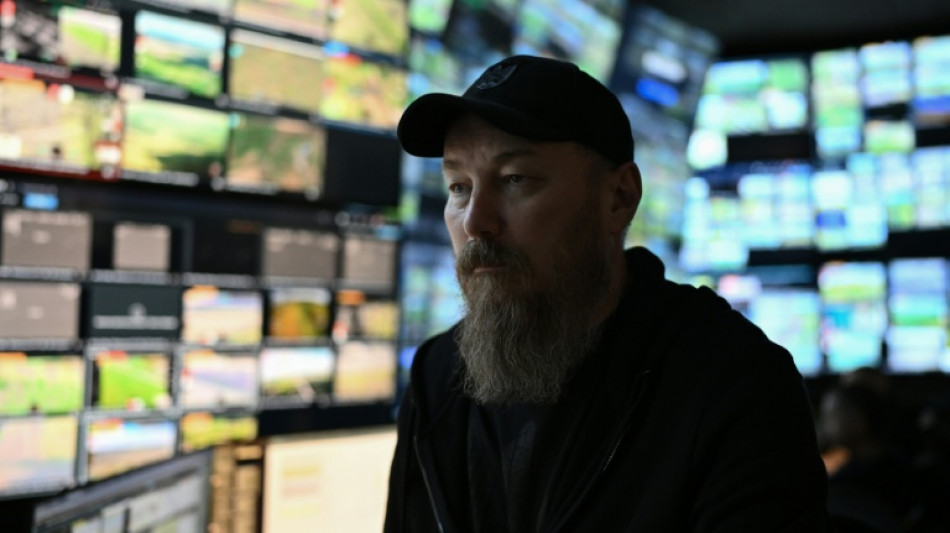
Robert "Madyar" Brovdi's underground command post features walls of blinking screens playing footage of Ukrainian drones attacking Russian troops, frontline maps, and scoreboards of destroyed targets.
The drone attacks that the grey-bearded 50-year-old oversees from the bunker -- in a secret location in Ukraine -- are recorded and analysed, for him to develop strategies to stop the Russian invasion.
The secretive and unlikely head of Ukraine's unmanned systems forces, whose recent strikes have embarrassed the Kremlin, grumbles that he does not like interviews, but his face lights up when the conversation turns to maths and war.
"Numbers are the foundation of war. Everything starts there. Anyone who ignores this cannot play this game. They will be followers rather than leaders," Brovdi told AFP.
Better known by his call-sign of Madyar, Brovdi was a wealthy grain trader with no military background when Russia invaded Ukraine in February 2022.
He volunteered to fight, then set up his own drone unit -- "Madyar's Birds" -- well before many had realised the full importance of the technology, quickly earning plaudits inside the military.
Zelensky appointed him in June 2025 to command the army's overall unmanned systems forces.
His path reflects how Ukraine has leveraged innovation to fight Russia's more conventionally powerful army.
"I simply brought my accounting system with me to the war. We took the names of grain varieties from the table and entered the types of drones and ammunition there," he told AFP.
Brovdi has masterminded some of the biggest attacks on Russia, with long-range drone strikes on oil and military facilities chipping away at Vladimir Putin's war chest.
These attacks have made Madyar a priority target for Russia, he says, forcing him into secret underground bunkers.
On a visit to one site, AFP journalists had to follow strict protocols, including a ride in a car with blacked-out windows.
- 'Dangerous, committed' -
Ukrainian artwork and drone carcasses provide an eclectic decor to the interior of Brovdi's underground bunker, from where he commands a unified force of some of Ukraine's highest-ranking drone units.
He receives a stream of calls in his windowless office, stepping in and out to speak to teams hunched over screens in a command post.
Last week his forces hit Saint Petersburg, just as Putin's flagship economic summit commenced in the city.
Other long-range strikes have sparked fires that have burned for days at oil facilities hundreds of kilometres behind the front line.
The strikes have drawn grudging recognition from Russian military analysts.
"Madyar is a dangerous, committed, and professional enemy," Andrey Medvedev, a blogger and Russian-state news reporter wrote last year.
Another, the Rybar Telegram channel, credited Madyar with creating "the most effective formation of its kind" within the Ukrainian army.
His unmanned systems forces claim responsibility for 30 to 35 percent of all confirmed destroyed Russian targets, even though they make up just two percent of the Ukrainian army.
His strategy to win the war is a bet on numbers: kill more Russians than Moscow can mobilise.
To improve the effectiveness of strikes, Madyar relies on data from the videos streaming into his command post.
They show Ukrainian drones chasing Russian forces near the front, hunting them as they flee through fields and forests until the feed cuts on impact.
Some videos make it onto Brovdi's social media accounts -- where he is followed by hundreds of thousands -- with cartoony music and mocking captions.
Inside Ukraine, some have found the footage mocking the dead morally questionable, with legal experts suggesting it could qualify as a war crime under the Geneva Convention.
- 'Revenge' -
He is widely popular in Ukraine, especially on social media, and his drone forces are vaunted by President Volodymyr Zelensky.
Next to the screens of combat videos in Madyar's bunker is artwork from renowned Ukrainian painters, including a still life of flowers by Maria Prymachenko.
"Art allows us to ground ourselves and take our minds off the circumstances that have brought us here," Madyar told AFP.
Before the war, he ran an art foundation in his native region of Transcarpathia in western Ukraine.
The works give him a feeling of home, where he can no longer go for security reasons.
"I can't lay my eyes on my favourite place at home, on some elements of my house, a vase, a view from my window," he said.
His wife enlisted in the army shortly after him, and heads his unit's troop support service.
Apart from her, only a small circle knows where he will be even two hours ahead.
The father of two says his force's success is compensation for the personal sacrifices.
"That momentary satisfaction, when you have taken revenge by taking the remote control into your own hands and seen the results of your work with your own eyes."
M.Furrer--BTB