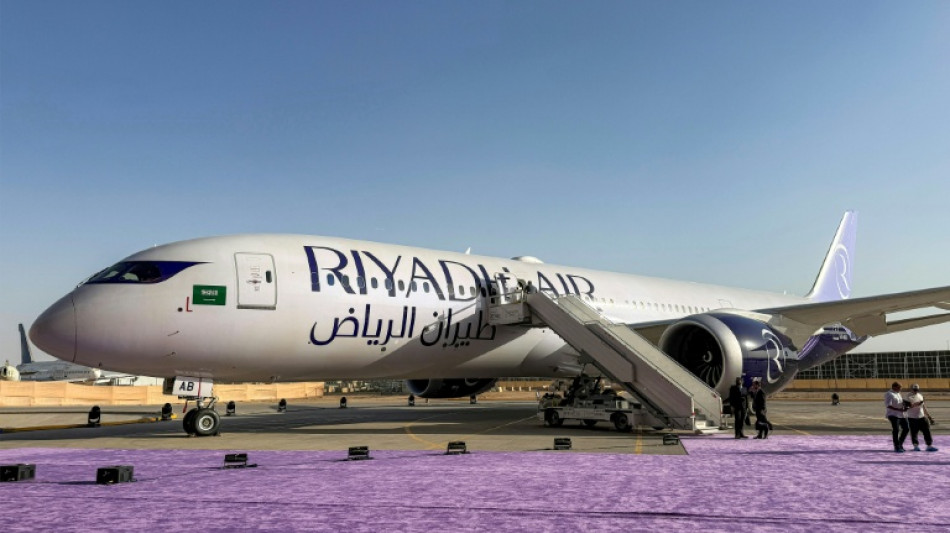
Saudi's new national carrier gets off ground despite war, delays / Photo: © AFP

 England's Nations League surge helps heal World Cup wounds

 Mayor of opposition stronghold Izmir defects to Erdogan party
 Mertens beats Gauff to set up Swiatek clash at China Open

 Benin full of pride at role in Messi's last dance

 France suspends stun grenade use at student protests ahead of PM speech

 Indonesian court hears 'negligence' complaint against state over fires, haze
 Rubio in Greece to urge against Western civilisation 'decline'
 Micron workers at Taiwan plant vote in favour of strike

 In 'The Social Reckoning,' Jeremy Allen White takes on Facebook's 'frightening' ambition
 Chip industry activists call for South Korea to recognise cancer cases
 Famine-scarred southern Madagascar braces for El Nino
 How the EU regulates lobbyists
 I.Coast refuge offers lifelong care for youngsters scorned as 'sorcerers'

 Indian central bank hikes rates for first time in more than 3 years
 Hotel Blacklist Launches New Accommodation Industry Risk Assessment Tool

 Bangladesh nuclear plant draws hope -- and worry
 US beat Canada 1-0 to wrap up four-win international break
 Turkey, Australia's joint COP31 leadership raises doubts
 For Turkish NGOs, COP31 offers rare space for action

 Sleep, appetite, gene-editing experts contend for Nobel chemistry prize

 Nobel Peace Prize haunted by the 'spectre' of Trump

 Africa launches own credit agency in bid for cheaper borrowing

 US, China, EU: three paths to regulating AI

 Australia's High Court rules against coal mine in landmark climate case
 Australia touts new funds for Pacific infrastructure at Fiji 'pre-COP'

Saudi Arabia launched its second national carrier Riyadh Air after more than a year of delays on Wednesday, defying the economic turmoil triggered by the Middle East war and strong competition from established Gulf airlines.
A London-bound Boeing 787 Dreamliner in Riyadh Air's white and lavender livery took off at 2:30am (2330 GMT Tuesday), putting in motion a flagship project in Saudi Arabia's push to reduce its economic reliance on oil.
Riyadh Air, the country's second state-owned airline after Jeddah-based Saudia, is meant to help turn the Saudi capital into a global hub to rival Dubai, the world's busiest for international passengers.
"We want to bring glamour, we want to bring refinement, we want to bring grace back," Riyadh Air CEO Tony Douglas told AFP.
The launch, originally planned for 2025, was set back by delivery delays from Boeing, which has suffered a series of manufacturing and safety problems in recent years.
It also follows unprecedented attacks from Iran, which has fired thousands of drones and missiles at Gulf targets including airports, casting the wealthy region into sudden economic uncertainty.
But, for Douglas, ex-CEO of Abu Dhabi's Etihad airline, the inaugural flight is "the culmination of four years' worth of preparation".
"I think Riyadh, as a result of its geography, during this particular point in time, has been less affected" by the attacks, he said, seated in a Riyadh Air Dreamliner cabin at a pre-launch event.
"You have the trials and the tribulations, you win some, you lose some, you make progress, you sometimes have setbacks, but you have made it, and this day we've made it," added the CEO.
- Saturated market? -
Saudi Arabia is building a major new airport in Riyadh with a planned capacity of 120 million passengers a year by 2030, compared to 53 million at the existing King Khalid International Airport.
Riyadh Air is owned by the $900 billion Public Investment Fund, the main vehicle for de facto ruler Crown Prince Mohammed bin Salman's ambitious Vision 2030 economic reforms.
In a statement of intent, the airline ordered 132 Boeing 787 Dreamliners and last June signed for 25 Airbus A350-1000s, with an option for 50 more.
"Our ambition is to be able to connect to over 100 international cities over the next five years," Douglas said.
At a ceremony celebrating the first planes' delivery, PIF chief and Riyadh Air chairman Yasir Al-Rumayyan described "a historic moment for the nation" and said the company would create "200,000 direct and indirect jobs".
Saudi Arabia is focusing on Vision 2030's more pragmatic ventures as extravagances like NEOM, a futuristic city in the desert, and Riyadh's cuboid skyscraper Mukaab, are scaled back or scrapped to save costs.
Saudi Arabia, which is hosting the 2030 World Expo and the 2034 football World Cup, and welcomes millions of pilgrims to Mecca each year, aims to triple its annual air traffic to 330 million passengers by 2030.
Some analysts have cast doubt over these ambitions in a regional market that is saturated with competitors such as Dubai's Emirates, Qatar Airways and Etihad.
Yet Saudi airlines hold a significant advantage over Gulf competitors: a domestic market of approximately 35 million people, by far the region's largest.
M.Furrer--BTB