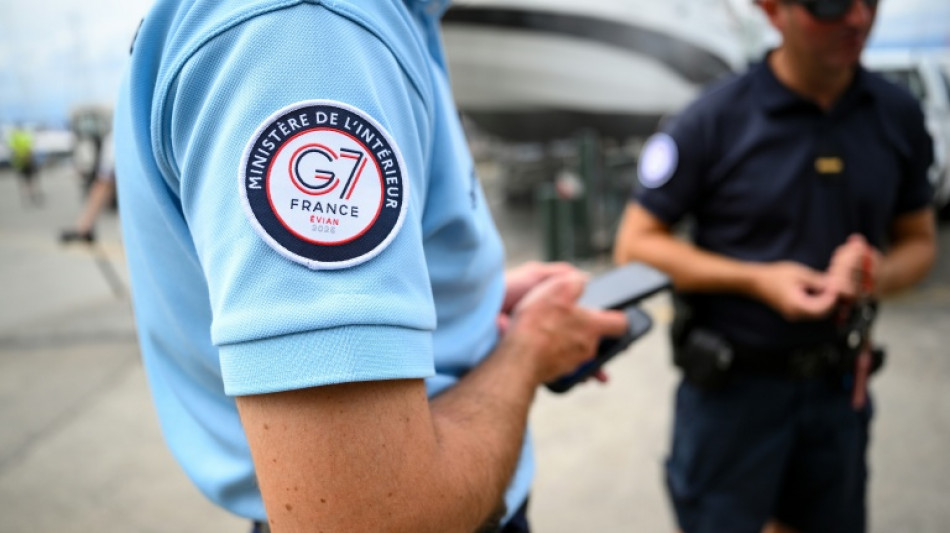
G7 summit under tight security on both sides of Lake Geneva / Photo: © AFP

 England's Nations League surge helps heal World Cup wounds
 Mayor of opposition stronghold Izmir defects to Erdogan party
 Mertens beats Gauff to set up Swiatek clash at China Open
 Benin full of pride at role in Messi's last dance

 France suspends stun grenade use at student protests ahead of PM speech
 Indonesian court hears 'negligence' complaint against state over fires, haze
 Rubio in Greece to urge against Western civilisation 'decline'
 Micron workers at Taiwan plant vote in favour of strike
 In 'The Social Reckoning,' Jeremy Allen White takes on Facebook's 'frightening' ambition
 Chip industry activists call for South Korea to recognise cancer cases
 Famine-scarred southern Madagascar braces for El Nino
 How the EU regulates lobbyists
 I.Coast refuge offers lifelong care for youngsters scorned as 'sorcerers'

 Indian central bank hikes rates for first time in more than 3 years
 Hotel Blacklist Launches New Accommodation Industry Risk Assessment Tool
 Bangladesh nuclear plant draws hope -- and worry
 US beat Canada 1-0 to wrap up four-win international break
 Turkey, Australia's joint COP31 leadership raises doubts
 For Turkish NGOs, COP31 offers rare space for action

 Sleep, appetite, gene-editing experts contend for Nobel chemistry prize
 Nobel Peace Prize haunted by the 'spectre' of Trump

 Africa launches own credit agency in bid for cheaper borrowing

 US, China, EU: three paths to regulating AI
 Australia's High Court rules against coal mine in landmark climate case
 Australia touts new funds for Pacific infrastructure at Fiji 'pre-COP'

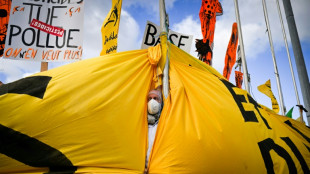
France and Switzerland are imposing tight security for a looming G7 summit in Evian-les-Bains, with a demonstration to be held Sunday in Geneva serving as their first test.
Memories endure of a 2003 summit in the well-heeled spa town on the French side of Lake Geneva, which saw violence and extensive damage in the nearby Swiss cities of Geneva and Lausanne. Both countries are determined to avoid a repeat of the fiasco when world leaders start their meeting Monday.
Evian, wedged between Lake Geneva and the Alps, poses particular security challenges.
Geneva Airport is the main arrival point for incoming leaders, while some delegations are basing themselves in Switzerland.
French authorities are handling the immediate protection layer around the summit, with reinforced security zones covering Evian, nearby Thonon-les-Bains and the main transport routes.
Nearly French 16,000 police, gendarmes, troops, firefighters and border guards will be deployed, using boats, motorcycles and drones, alongside mounted police and dog-handling units, the Haute-Savoie regional prefecture said.
According to government prefect Emmanuelle Dubee, the deployment aims to address "the risk linked to the extremely tense international context", the "terror threat, which remains high in France", the "risk of sabotage and cyber-attacks", and "public order disturbances".
- Swiss deploying troops -
At the end of the lake, Geneva is about 40 kilometres (25 miles) southwest of Evian.
Switzerland has approved the deployment of 2,000-5,000 military personnel to "support" the cantonal police.
Around 4,000 Swiss troops will be deployed on land, Lake Geneva and in the air, coordinating with the French military.
Amid the swarm of uniforms, for French and Swiss residents alike the summit will mean traffic restrictions, border crossing closures, increased security checks and tight restrictions on the right to protest.
The aim is to stop a recurrence of 2003, when tens of thousands of anti-globalisation protesters gathered in the region to demonstrate against the G8 summit held in Evian.
Groups rioted, looted and clashed with police in Lausanne and Geneva, causing millions of dollars of damage.
Since then, cross-border police and intelligence cooperation has been strengthened, but the trauma still haunts minds in Geneva where a demonstration will be held Sunday.
- Protest route 'absurd' -
"Geneva must not become the capital of rioters," said Francois Baertschi, president of the Geneva Citizens' Movement political party and a member of the cantonal parliament.
Geneva authorities are permitting a demonstration by the "No-G7" coalition, the day before the three-day Evian summit begins.
The approved route was initially deemed "very problematic" by the coalition, which brings together more than 60 organisations.
The route set out by authorities keeps protesters on the north side of the lake -- away from the city centre -- and though now revised, still takes them through a major roadworks zone in front of the United Nations.
"The new route is still absurd, since it goes through streets with shops and cars, whereas we wanted to march along the lakefront, but it is acceptable," said No-G7 member Francoise Nyffeler.
Nyffeler told AFP she had "given in a lot to the authorities" to reach an agreement on the route.
Though the anti-globalisation movement has lost momentum in recent years, and the protest organisers are insisting on peaceful action, the authorities are wary of infiltration by radical groups.
Many Geneva retailers have already begun boarding up their shop fronts -- even those well off the demonstration route.
"We are doing everything we can to ensure it goes as smoothly as possible," Swiss President Guy Parmelin told the Geneva Press Club in May.
"It's not quite the same situation as in 2003," he added, highlighting the extra security deployment.
"Things should turn out differently, although we can never rule out the unexpected," he said.
Due to conditions imposed by authorities in France, the No-G7 coalition there has meanwhile abandoned plans for a counter-summit and demonstration in the border town of Annemasse on Sunday.
M.Odermatt--BTB