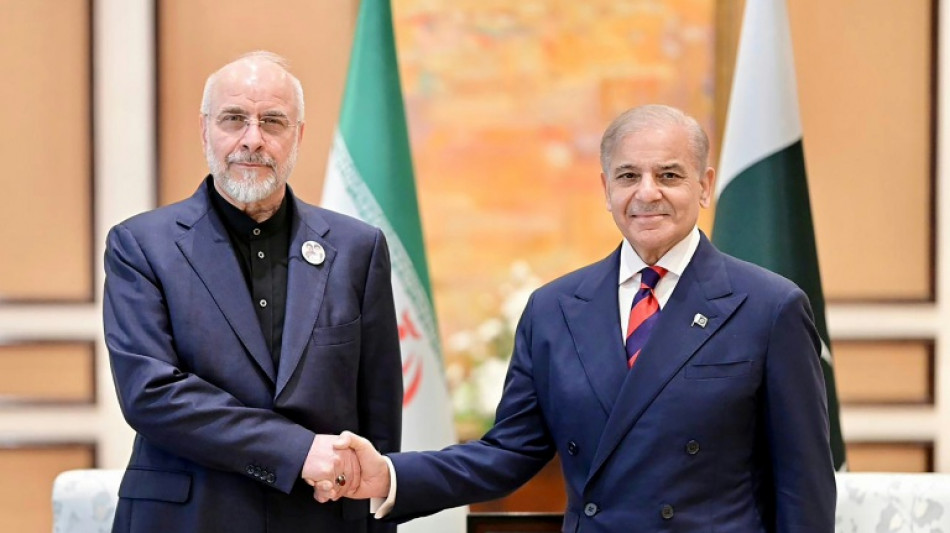
Ghalibaf: ambitious 'public face' of post-Ali Khamenei Iran / Photo: © Pakistan Prime Minister's Office/AFP

 Rubio in Greece to urge against Western civilisation 'decline'
 Micron workers at Taiwan plant vote in favour of strike

 In 'The Social Reckoning,' Jeremy Allen White takes on Facebook's 'frightening' ambition
 Chip industry activists call for South Korea to recognise cancer cases
 Famine-scarred southern Madagascar braces for El Nino

 How the EU regulates lobbyists
 I.Coast refuge offers lifelong care for youngsters scorned as 'sorcerers'

 Indian central bank hikes rates for first time in more than 3 years
 Hotel Blacklist Launches New Accommodation Industry Risk Assessment Tool
 Bangladesh nuclear plant draws hope -- and worry

 US beat Canada 1-0 to wrap up four-win international break

 Turkey, Australia's joint COP31 leadership raises doubts

 For Turkish NGOs, COP31 offers rare space for action

 Sleep, appetite, gene-editing experts contend for Nobel chemistry prize

 Nobel Peace Prize haunted by the 'spectre' of Trump

 Africa launches own credit agency in bid for cheaper borrowing

 US, China, EU: three paths to regulating AI
 Australia's High Court rules against coal mine in landmark climate case
 Australia touts new funds for Pacific infrastructure at Fiji 'pre-COP'

 Eva Marie Saint, Oscar winner of Hollywood classics, dies at 102

 Australia probes app used in cheap smart glasses over privacy fears
 England needed to 'move on' from World Cup pain, says Tuchel
 O'Neill to stay at Celtic after period of "reflection"

 Kane marks 125th England cap with Wembley Nations League double

 Quebec's incoming separatist leader wants to block Crown from swearing-in
Iranian parliament speaker Mohammad Bagher Ghalibaf has emerged as the key negotiator and one of the most high-profile figures in the Islamic republic's leadership as it enters a new phase after the US-Israeli war.
A pillar of the Iranian establishment for some three decades and one of its most prominent non-clerical figures, Ghalibaf, 64, had spearheaded the war effort and led the high-stakes negotiating process that culminated with an agreement announced Monday to halt the hostilities.
Ghalibaf survived more than five weeks of US-Israeli attacks on Iran that killed supreme leader Ali Khamenei, top security official Ali Larijani and a host of other key figures.
He came into public view for the first time in weeks in April to lead the Iranian delegation in talks in Islamabad with the United States, meeting Vice President JD Vance, the highest-level contact between the two foes since before the 1979 Islamic revolution.
An image published on social media by Iranian embassies abroad put Ghalibaf centre stage in the Iranian negotiating team, looking animated and gesturing with his hand, as Foreign Minister Abbas Araghchi busied himself with teacups.
The workings of the Iranian leadership without Khamenei, who dominated it for nearly four decades, remain unclear.
Khamenei's son Mojtaba was named as his successor but has yet to appear publicly after he was reportedly wounded in an airstrike.
"Following Larijani's assassination, Ghalibaf has emerged as the new public face of the Islamic republic's war effort and diplomacy," said Farzan Sabet, a managing researcher at the Geneva Graduate Institute.
"But we shouldn't overstate the extent to which he's in the driver's seat: He still answers to higher powers in Tehran," he added.
These include Mojtaba Khamenei and the Revolutionary Guards, the ideological arm of Iran's military, where Ghalibaf was a key figure as aerospace forces commander, Sabet said.
- 'Professional bargainer' -
While the trip to Islamabad was Ghalibaf's first appearance in public since before the war, he has kept a high profile online with almost daily social media posts, mixing commentary on recent developments and the negotiations with threats of harsh retaliation should the fighting resume.
His posts on X in idiomatic American English have garnered wide attention and raised questions over who is actually writing them, given Ghalibaf is not known to be a fluent English speaker.
Referring to threats of a ground invasion, a post on Ghalibaf's X account said on April 1: "You come for our home... you're gonna meet the whole family. Locked, loaded and standing tall. Bring it on."
The IranWire news site has said the posts appeared to have been written by a former adviser based in the United States, but this has not been confirmed.
While the Islamabad talks failed, The Washington Post reported that Ghalibaf left a striking impression on the US delegation after years when Washington never dealt directly with key Iranian decision makers.
Ghalibaf "impressed the American team as a refined and professional bargainer -- and potential leader of a new Iran", said the Post.
In a sign of his expanding sway, he was appointed in May to oversee Iran's vital relationship with China, the biggest buyer of Iranian oil.
- 'Ambitious and opportunistic' -
Ghalibaf's varied experience, which spans military and civilian life, has seen him work as a commander in the Revolutionary Guards, Tehran police chief, Tehran mayor and now speaker of parliament.
It is unclear if he is fully trusted by the new hardline hierarchy of the Guards.
Known to be fiercely ambitious, he has stood for the Iranian presidency on multiple occasions but has never been successful, most notably in 2005 when ultra-conservative Mahmoud Ahmadinejad, little-known at the time, took the job.
A qualified pilot, Ghalibaf is known for boasting that he is able to captain jumbo jets.
Human rights groups have accused Ghalibaf, in his various functions, of playing a key role in suppressing protests, from the 1999 student demonstrations to the 2009 Green movement that erupted after a disputed election, right up to the nationwide protests that peaked in January 2026, just before the latest war.
"As a politician he's shown himself to be ambitious and opportunistic, but also cautious, a trait that has helped him advance his career to the top of the Islamic republic's power structure without getting purged like so many others have been," said Sabet.
T.Bondarenko--BTB