Red rocks yield coveted minerals in DR Congo / Photo: © AFP

 Australia touts new funds for Pacific infrastructure at Fiji 'pre-COP'

 Eva Marie Saint, Oscar winner of Hollywood classics, dies at 102
 Australia probes app used in cheap smart glasses over privacy fears
 England needed to 'move on' from World Cup pain, says Tuchel

 O'Neill to stay at Celtic after period of "reflection"

 Kane marks 125th England cap with Wembley Nations League double
 Quebec's incoming separatist leader wants to block Crown from swearing-in
 Emmys gala will now stream its premier television awards
 Paramount completes Warner Bros takeover, creating Skydance
 Trump blames France unrest on Islam, migration

 Apple's Cook praises EU over efforts to protect children online
 Nobel winner Halzen says years of October 'misery' finally over
 Quebec separatist win rattles Carney's unity push
 'Itching' for change: Shiffrin cuts back slaloms this season
 'Gen Z has risen up': Tens of thousands mass for tense France school protests
 Caribbean tourism hotspot loses men to Russian war machine
 Danish reservists practice war games to respond to 'aggression'
 Bhuvneshwar returns to India's T20 squad for New Zealand tour

 Asos says probing 'unauthorised activity' after phone alerts

 Stocks climb as oil prices retreat under $100 per barrel

 Neutrinos: space particles that change our view of universe

 'Destined' Djokovic wins China Open, extending unbeaten record
 Iceland is 'critical outpost' for security, says Rubio during visit
 Israeli settlers beat AFP photographer covering West Bank

 'Gen Z has risen up': Tens of thousands demand better education in France

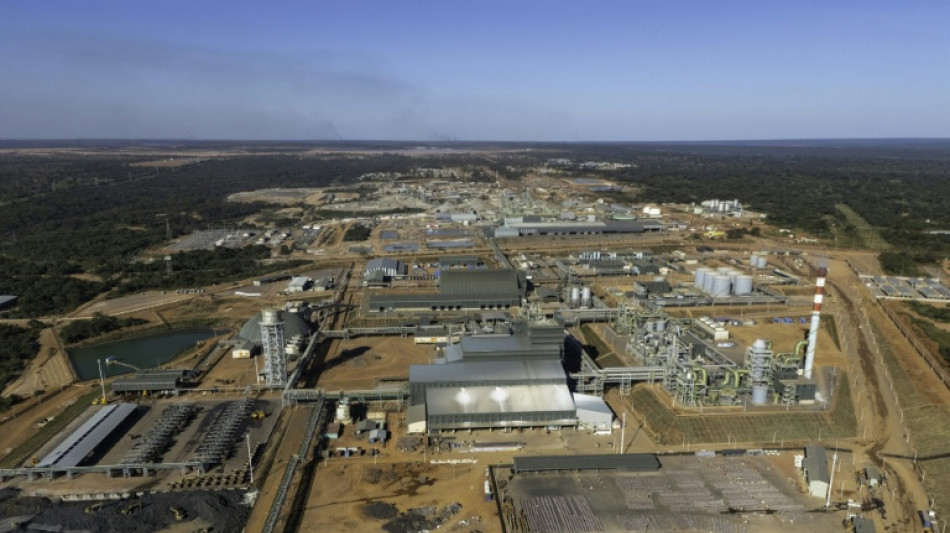
In vast warehouses at the Kamoa copper mine in the southeastern Democratic Republic of Congo, mountains of reddish rocks pile up as the machines grind away day and night.
The deposit, reputed to be the largest in Africa, is one of the Democratic Republic of Congo's hidden treasures -- which are at the centre of a global race for critical minerals.
In the ultra-modern installations, thousands of workers churn out the red gold -- coveted by international markets for its exceptionally high copper content.
China has long been mining it, and now the United States is vying for a share in the country's mineral wealth, seeking to challenge Beijing's hold on the strategic resources used to make cars, phones and weapons.
"Kamoa at the moment is one of the largest copper mines in the world" with capacity to produce 300,000 tonnes a year, its managing director Annebel Oosthuizen told AFP.
It is "growing to become the largest copper mine in Africa and probably the fourth largest copper mine in the world", aiming to churn out half a million tonnes from 2028, she added -- "right up there in terms of world capacity".
- Mineral riches, poverty -
The DRC is one of the poorest countries in the world.
Of its roughly 100 million inhabitants, nearly two in three live below the poverty line, according to official statistics.
Yet the vast central African nation is also one of the world's biggest sources of critical metals indispensable to global industry.
It is Africa's top copper producer, with 3.4 million tonnes in 2025.
The ore mined at Kamoa has a copper content of 2.8 percent, four times the global average.
It is also the world's leading producer of cobalt, with 68 percent of world supply.
All this puts it at the heart of Chinese and US economic interests and they actively covet it.
Copper and cobalt are essential for the manufacture of smartphones, computers, cars and batteries.
Copper conducts electricity, while cobalt allows that energy to be stored.
These minerals are also vital to aeronautics, defence and renewable energy.
According to the United Nations Conference on Trade and Development (UNCTAD), global demand for copper is expected to rise by more than 40 percent by 2040, while demand for cobalt is set to quadruple by 2030.
"In terms of copper stocks available and what will be required, one has to... triple the current copper that's available over the next couple of years" at Kamoa, Oosthuizen told AFP.
- US-DRC deal -
Kamoa Copper S.A. is a joint venture owned in equal parts by Canada's Ivanhoe Mines and China's Zijin Mining, with the Congolese state holding a 20-percent minority stake.
China has invested massively in the country for nearly 20 years and is estimated to account for 70 percent of mining activity, according to the Congolese chamber of mines.
But in December, Kinshasa accepted a strategic partnership agreement with Washington -- part of a peace accord for the DRC, which has been plagued by conflict for more than 30 years.
The accord has so far failed to end the fighting in the violence-stricken east of the country but an initial list of 25 mining sites has been submitted to Washington for potential investment or exploitation licences.
In February, Swiss commodities giant Glencore signed a memorandum of understanding with the US-led Orion Critical Mineral Consortium to grant the latter a potential 40-percent stake in the Swiss conglomerate's mining assets in the DRC.
"This will allow the United States to benefit from production coming out of the DRC through Glencore," Marie-Chantal Kaninda, president of Glencore DRC, told AFP.
- Chinese interests -
Kolwezi, the closest town to the Kamoa site, is encircled by a dozen giant industrial mines.
They have earned it the nicknames "Copper capital" and "World cobalt capital".
Along the neatly paved road linking the city centre to the small, pristine local airport, many shops bear signs in Chinese characters.
English is widely spoken in local hotels and restaurants catering to a foreign business clientele.
"I was born and raised in Kolwezi. I've always seen mines and Chinese people here," said 26-year-old taxi driver Kevin Mwarabu.
Now DRC officials have indicated they are content to do business with both the big powers.
The country's subsoil remains largely under-explored.
Even so, the mining sector "drives the entire Congolese economy", said Economy Minister Daniel Mukoko.
The US–China rivalry in the global race for strategic minerals "is not our war", said Eric Kalala, head of the state-owned General Cobalt Company (EGC), which holds a monopoly over the marketing of non-industrial cobalt production in the country.
"There is room for everyone," he said at the Katanga Business Meeting in Kolwezi in May.
"The DRC covers 2.4 million square kilometres (0.9 million square miles) and across all that land there is exploration to be done."
F.Müller--BTB