Colombia's Indigenous Guard up in arms over new president's agenda / Photo: © AFP

 How are Ukraine strikes, Mideast war driving US fuel prices?
 Colombia's Indigenous Guard up in arms over new president's agenda
 From tech giants to anonymous nonprofits, the biggest donors in US midterms
 Israel's far-right Ben Gvir seeks new ground in election
 Trump slams NBA's LeBron James for national anthem actions
 Australia sanctions North Koreans over 'fraudulent' IT work, cybercrime
 UK singer-songwriter Raye wins Mercury Prize for second album
 Antonelli needs ‘perfect weekend’ to realise title dream
 Reclaiming the walls in a former Salvadoran gang hotspot

 Musk wants to merge SpaceX and Tesla: Here's what to know
 Musk's wants to merge SpaceX and Tesla: Here's what to know
 Hashimoto sweeps to gymnastics world all-around title

 Super Bowl MVP Walker returns to Seattle with unbeaten Chiefs

 Red Bull advisor Marko slams Horner memoir as 'collection of untruths'
 France reports first human Shamonda virus case, says no health risk

 Rekindled Gucci desirability fails to light flame under Kering sales

 Thousands rally as Serbia heads to pivotal poll
 Marathon star Aga banned six years for doping and misleading investigation
 USA to host women's football Club World Cup in 2028 - FIFA
 Finland grants licence for world's first nuclear waste repository
 'Old-fashioned' South Africa thump Australia to level Test series
 No more taking out the trash at your Airbnb
 Swiss supreme court upholds Guatemala ex-police chief sentence
 UN climate disaster fund moves to provide $20 mn aid for Nepal
 Africa faces 'complex' Ebola outbreak after spread to Nigeria: WHO
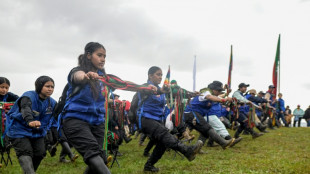
In the mountains of southwestern Colombia, hundreds of Indigenous guards who protect their lands from crime are debating how to negotiate a standoff with right-wing President Abelardo de la Espriella.
For decades, the Indigenous Guard has defended remote Colombian territories against powerful guerrillas and drug cartels, without firearms.
They have rescued kidnapping victims, searched for children recruited by armed groups, and even protected forests from deforestation.
Today, the struggle of this ancestral defense force is with Colombia's new leader, who wants to assert more state control over their activities.
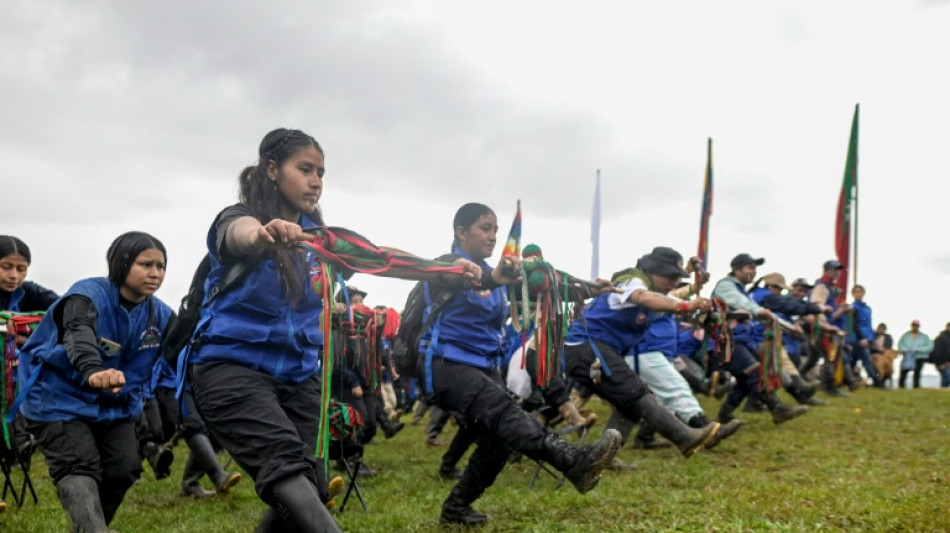
"Guard, guard, strength, strength, for my people, for my land," the guards chanted as they held their traditional wooden staffs aloft during the gathering in Caloto in violence-plagued Cauca department.
Their ire is directed at a bill that would allow the government to gather data on the guards and on where they operate for a national registry.
These custodians of the land see the bill as a violation of the right to self-determination for which they fought for centuries.
The government initiative "could become a mechanism for surveillance, stigmatization, and prosecution" in a country ravaged by more than half a century of armed conflict, the Regional Indigenous Council of Cauca (CRIC) said in a statement.
The guards argue that any weakening of their security role would lead to more violence and loss of life.
"Our territory is at risk," Jorge Sánchez, a 55-year-old CRIC member told AFP at the Cauca gathering.
On October 14, some 6,000 Indigenous people from across the country dressed in the red and green garb of the Guard converged on Cauca to protest the bill.
- On the frontlines -
A decade after the Marxist rebel army FARC made peace with the state, Colombia's mountains, highlands and rainforest are still bristling with armed groups that profit from drug trafficking and illegal mining.
In these remote areas inhabited chiefly by Indigenous peoples, the Indigenous Guard is the first line of defense for communities.
"We are the ones who walk the territory and warn of imminent risks," said Jose Joy Martenorio, CRIC's political coordinator.
In the event of an emergency, they summon dozens of supporters who rush to the scene with sticks and push out the guerrillas.
The guard's role has redoubled in importance amid the worst surge in violence since the 2016 peace deal.
At least 120 Indigenous people have been murdered by armed groups in the last ten years, according to CRIC.
In February, the guards rescued former vice-presidential candidate and Indigenous leader Aida Quilcue, who was kidnapped and held for several hours by guerrillas in Cauca.
They also played a key role in the audacious, highly publicized rescue in 2023 of four children lost for 40 days after a plane crash in the Amazon rainforest.
- Opposing visions for Colombia -
Indigenous people represent only around 4 percent of the Colombian population but have outsized influence.
The guard's voter mobilization was key to the 2022 election of the country's first left-wing president Gustavo Petro, who was succeeded by De la Espriella in August.
De la Espriella, a millionaire US-backed lawyer, has moved quickly to end restrictions on fracking and on mining in ecologically sensitive areas, both of which Indigenous communities oppose.
The tough-talking president has dismissed their objections as posing "obstacles to Colombia's development" and warned that he will not be dissuaded by protests.
"We have two opposing visions for the country," said CRIC member Edwin Capaz Lectamo told AFP.
"One is centered on the land, life, spirituality, and worldview," he said, while the other "sees the land as a business opportunity."
B.Shevchenko--BTB