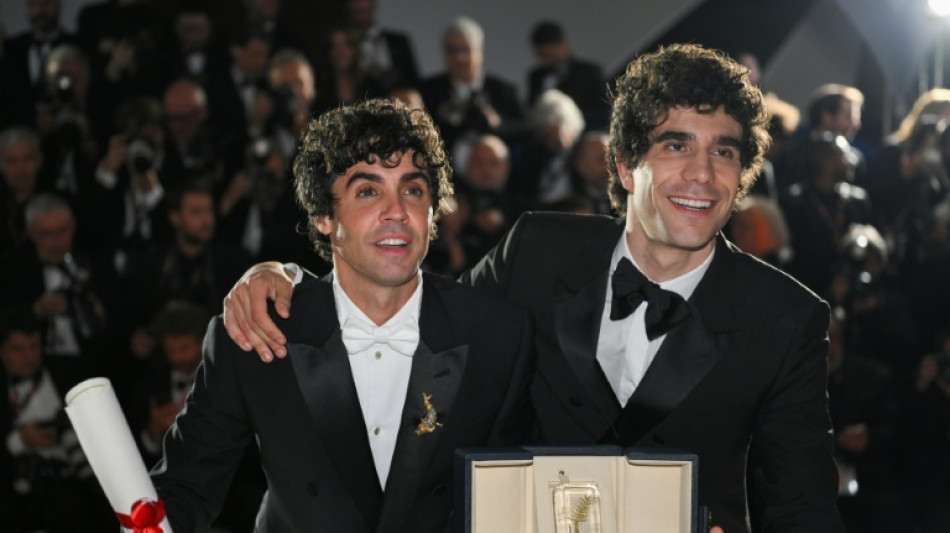
Oscar hopeful 'La Bola Negra' offers lessons about communicating, directors say / Photo: © AFP/File

 Oscar hopeful 'La Bola Negra' offers lessons about communicating, directors say

 Trapped: Soaring fuel costs hurt Maine lobster industry before midterms

 Marc Marquez beats brother Alex to Australian MotoGP pole

 Ebola vaccine trial begins in DR Congo

 Travelling man Wade equals Prem try record

 Rescuers search for seven people in Nairobi building collapse

 Sacha Baron Cohen revives the 'problematic dinosaur' Ali G in new film

 New race in Barcelona tops 17-event '27 IndyCar season

 Neymar backs Flavio Bolsonaro in Brazil election

 Melania Trump says she brokered truce in war-torn Ukrainian city

 Leclerc tops times for Ferrari in opening practice for US Grand Prix
 Bayern Munich coach Kompany in hospital after collapsing

 Signs point to renewed major US military ops against Iran

 European, Mideast foreign ministers push peace and diplomacy at Istanbul talks
 Ex-All Black centre Williams undergoes 'miracle' heart surgery

 Netanyahu launches major West Bank operation after Israeli soldiers killed

 AFP photographer captures striking images from West Bank attack

 Oil hits $116 with stocks mixed on earnings, AI

 De Zerbi says Tottenham's dire record at Chelsea 'more motivation'

 Lula, Bolsonaro in final debate showdown before Brazil vote

 Poulter latest golfer to leave LIV
 Gunman kills one, wounds five in town outside Paris

 Melania Trump says secured ceasefire in Ukrainian city of Oleshky

 Carrick 'confident' he can turn around Man Utd slump

 PSG v Lyon French Ligue 1 game postponed due to Paris protests

Festival darling "La Bola Negra" ("The Black Ball"), now leading many Oscars predictions lists, retraces the tragic past of Spain, but its subject matter is more relevant than ever, its co-directors say.
Javier Ambrossi and Javier Calvo, collectively known as "Los Javis," have wowed critics and filmgoers with their sweeping queer epic telling the interconnected stories of three gay men over multiple generations.
"It's a film about the danger of lack of communication... which really can lead us into horrible situations," Ambrossi, 42, said in an interview with AFP.
"I think we need to talk, not only in our country, but I believe it's quite a global issue. We live in an increasingly interconnected world of mobile networks, yet we make less and less effort to understand one another."
The film stars rising talents Guitarricadelafuente, Miguel Bernardeau, Milo Quifes and Carlos Gonzalez alongside veterans Penelope Cruz and Glenn Close in featured roles.
The movie, out in select US theaters, begins in 1932 in Granada, amidst the tensions that ultimately led to the Spanish Civil War before winding through history to wrap up in 2017 in modern-day Madrid.
Early inspiration for the movie came from an unpublished play written by poet Federico Garcia Lorca, who was executed by fascist forces at the beginning of the Spanish Civil War in 1936.
"We had to dig deeply into all the material, into Federico's works, into Federico's poems," the 35-year-old Calvo said.
He explained he went so far as to memorize some of Lorca's poems and letters in order to better understand the writer, and perhaps guess how the play might have ended if he had finished it.
"Whenever I felt lost... I went back to read the books, reading them over and over," Calvo added.
- Oscars buzz -
The film's first thread, which comes directly from Lorca's work, follows Carlos (Quifes), who has been rejected from a social club in Granada in southern Spain for being gay, through a voting system using black and white balls.
As conflict erupts, the action moves to a small town where young trumpeter Sebastian (Guitarricadelafuente) finds himself co-opted by Francisco Franco's rebels.
Sebastian is ordered to watch over prisoner Rafael (Bernardeau), a Republican who is inspired by Lorca's real-life partner.
Los Javis use the stories to tell the tale of a brutal war that divided Spain and left deep scars, and the story of the joys and hardships of ordinary men turned into soldiers.
"It was a war that ultimately involved everyone, and everyone was affected," said Guitarricadelafuente, who has generated Oscars buzz for his performance.
The war is "still a ghost that appears from time to time," added the actor and singer, who is one of the composers of "La Nieve" ("The Snow") from the film's soundtrack, which could be an Oscar contender for best original song.
For Bernardeau, who is Spanish, the film offered him a chance to study his own country's history without the "bias" found in classrooms.
"It helped me develop a critical perspective, much as Rafael had, and to understand the significance of events at that time: the weight of the tragedy, the weight of war, the reality of the deaths -- but also hope," he told AFP.
The film wraps up in 2017, when Alberto, a young historian, unearths a family secret.
Los Javis tied for best director honors in Cannes, and the Spanish-language film won the top audience prizes in San Sebastian and at the Toronto International Film Festival, a reliable bellwether for Academy Awards success.
Ambrossi said that he was thrilled about the film's success, but also surprised by it, given that it tells "a very Spanish story, really -- about Spanish literature, about the history of Spain, about the Civil War, about Federico Garcia Lorca."
Calvo said the reaction to "La Bola Negra" outside Spain has taught him that "if something is important to you, if you have truly felt it, then many other people will feel it, too."
"It's a way for us to connect," he said.
P.Anderson--BTB